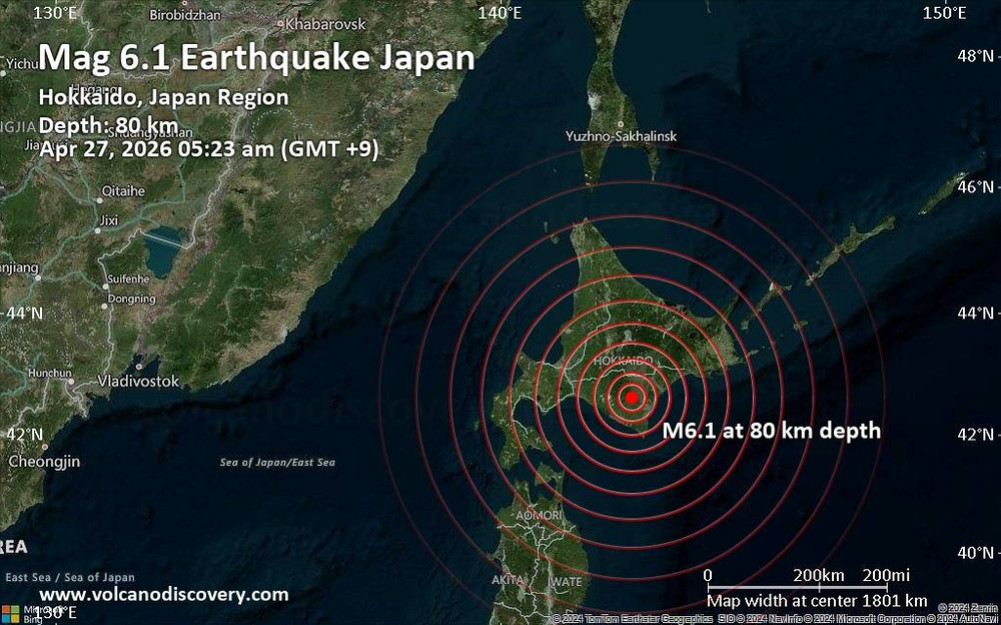
According to the Japan Meteorological Agency (JMA), the earthquake struck at 5:23 a.m. local time, centered in the southern region of Hokkaido.
We use Google Cloud Translation Services. Google requires we provide the following disclaimer relating to use of this service:
This service may contain translations powered by Google. Google disclaims all warranties related to the translations, expressed or implied, including any warranties of accuracy, reliability, and any implied warranties of merchantability, fitness for a particular purpose, and noninfringement.
A powerful earthquake measuring 6.2 on the northern island of Hokkaido struck early Monday morning in Japan. The Japan Meteorological Agency (JMA) said the quake struck at 5:23 a.m. local time, centered in southern Hokkaido. It was about 83 kilometers deep, down from an initial estimate of 6.1. The JMA warned residents to be vigilant, saying there was a high possibility of more earthquakes of similar magnitude in the coming days and weeks. A 5.0-magnitude earthquake struck just hours earlier, a few hundred kilometers south of Hokkaido, signaling that the region's seismic activity is continuing to increase. The quake followed a 7.7-magnitude quake in northern Iwate Prefecture last week that caused little damage but sent shockwaves across the country.
The quake's impact was felt as far as the capital Tokyo, where large buildings shook and six people were injured.
In addition, tsunami waves of up to 80 centimeters high were seen in the Iwate region, while smaller waves hit other northern areas.
The JMA then warned of the risk of a powerful earthquake of 8.0 or higher. The current 6.2-magnitude quake is also considered part of the same series.
Japan lies on the Pacific Ocean's 'Ring of Fire'. The country, which sits at the junction of four major tectonic plates, is hit by about 1,500 earthquakes each year. This is about 18 percent of the world's total.
A devastating 9.0-magnitude earthquake and tsunami in Japan in 2011 left more than 18,500 people dead or missing.
Although Japan has been investing heavily in earthquake preparedness and risk reduction since then, recent events have once again highlighted the need for vigilance.