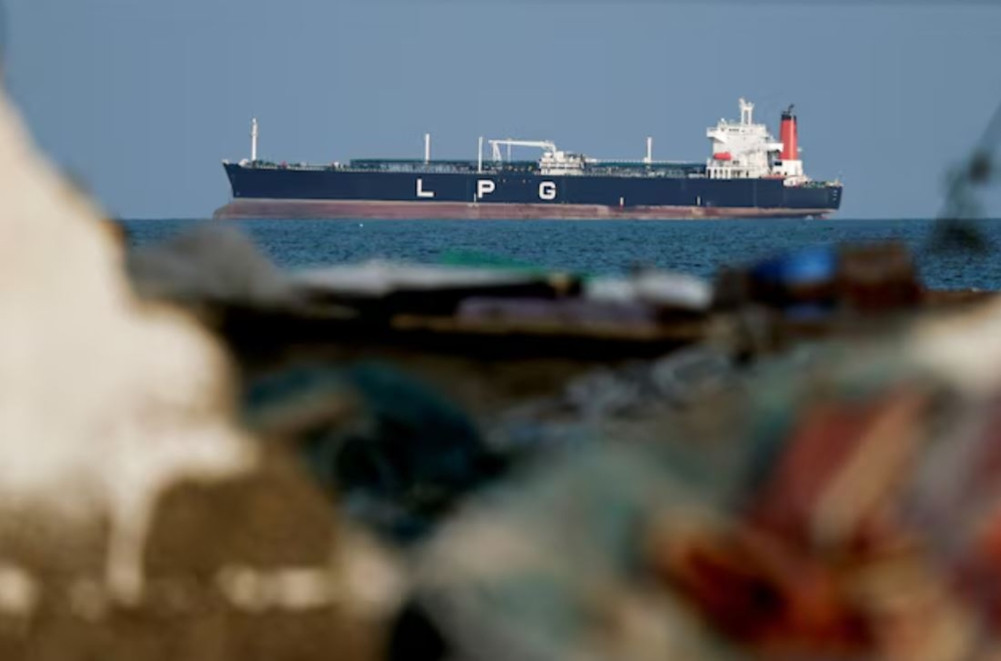
Iranian Parliament Speaker Ghalibaf said that the Strait of Hormuz will not open as long as the blockade remains in place.
We use Google Cloud Translation Services. Google requires we provide the following disclaimer relating to use of this service:
This service may contain translations powered by Google. Google disclaims all warranties related to the translations, expressed or implied, including any warranties of accuracy, reliability, and any implied warranties of merchantability, fitness for a particular purpose, and noninfringement.
Iran announced on Friday that the Strait of Hormuz was open, but ships faced problems in navigating the waterway. Iran's Foreign Minister Abbas Araghchi announced on Friday that the strait was open, but on Saturday, Parliament Speaker Mohammad Bagher Ghalibaf warned that the blockade would remain.
'The blockade on Hormuz will remain in place until the US blockade of Iranian ports is lifted,' he said.
John Paul Rodrigue, a maritime supply expert at Texas A&M University in the US, said he had received reports that many ships were having problems navigating.
'Several ships attempted to pass through the Strait of Hormuz after Friday's announcement. But they turned back after the situation became unclear,' Rodrigue told Al Jazeera. 'All sides are issuing contradictory statements.'
Friday Shortly after the 10-day ceasefire between Lebanon and Israel came into effect, Foreign Minister Araghchi announced the opening of the Strait of Hormuz. Iran has been demanding an end to Israeli attacks on Lebanon.
“The Strait of Hormuz has been opened for the duration of the ceasefire. The passage is completely open to all commercial vessels,” Foreign Minister Araghchi wrote on social media. He said that ships should coordinate with Iranian maritime authorities.
However, he did not say whether ships passing through Hormuz would have to pay a fee to Tehran. Tehran had started collecting tolls from ships passing through Hormuz shortly after the war began.
US President Donald Trump thanked Iran for opening the Strait of Hormuz in a post on the social media platform Truth on Friday.
However, he also warned that the US Navy's blockade of Iranian ports would remain in place until an agreement is reached.
In response, Iranian Parliament Speaker Ghalibaf said that Hormuz would not open as long as the blockade remains in place.
Earlier on April 7, Trump had announced a two-week ceasefire with Iran, claiming that an agreement had been reached to open the Strait of Hormuz. The ceasefire was brokered by Pakistan.
Pakistani Prime Minister Shahbaz Sharif said that Iran and the US had agreed not to attack either side or each other's allies.
However, Israel continued its attacks on Lebanon, claiming that the agreement did not include fighting the Lebanese armed group Hezbollah. Trump also supported the Israeli claim.
In return, Iran has vowed not to open the Strait of Hormuz until the attacks on Lebanon stop. Iran has been providing financial and military support to the Lebanese rebel group Hezbollah.
During this period, Iran and the US began talks in Islamabad, Pakistan, on April 11. This was the first direct talks between the US and Iran since the Islamic Revolution in Iran in 1979. However, no agreement was reached in the talks.
Then, on April 13, the US announced a blockade of Hormuz. According to which, the US has banned ships from entering and leaving Iranian ports through the Gulf of Oman and the Arabian Sea. The US has announced such a blockade with the aim of stopping Iran's oil trade.
Despite the current tensions, both countries are also preparing for the upcoming talks. Pakistan is also taking the initiative for a new round of talks. The international community is also urging both countries to reach an agreement through dialogue.
Why is Hormuz important?
The Strait of Hormuz, which borders Oman and Iran, is strategically and commercially very important. The disruption in this strait has led to a global energy crisis and price hike.
Since ancient times, this strait has been an important route connecting West Asia to the rest of the world. Most of the crude oil and gas that goes to the world market from West Asia exits through Hormuz.
The narrowest point of the strait is only 33 kilometers wide. There are two narrow shipping lanes of 3 kilometers each, entering and returning from West Asia.
Before the war, more than 20 percent of the world's total gas and crude oil used to flow from here. Most of that oil is destined for Asian markets.
Western European countries that have cut off trade with Russia due to the Ukraine war also used to receive significant amounts of crude oil from here.
The impact of the closure of the Strait of Hormuz has been felt globally. The crisis in crude oil, gas, chemical fertilizers, and raw materials needed to make plastic materials is global.