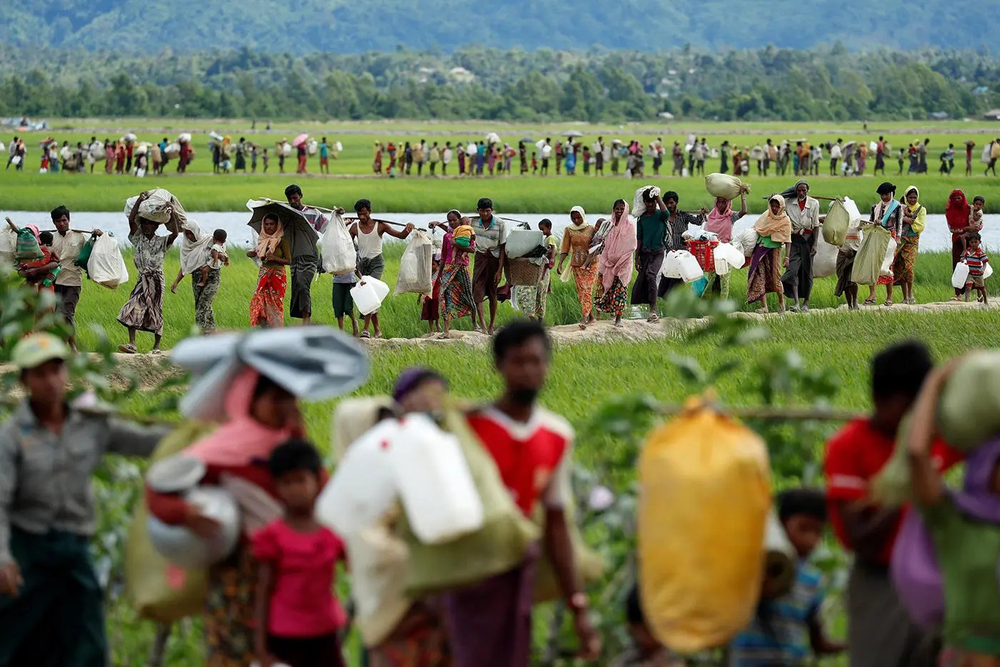
According to a 2026 report by the United Nations High Commissioner for Refugees (UNHCR), around 1.18 million Rohingya are displaced in Bangladesh's Cox's Bazar area. They have not yet been formally recognized as refugees by Bangladesh.
We use Google Cloud Translation Services. Google requires we provide the following disclaimer relating to use of this service:
This service may contain translations powered by Google. Google disclaims all warranties related to the translations, expressed or implied, including any warranties of accuracy, reliability, and any implied warranties of merchantability, fitness for a particular purpose, and noninfringement.
The International Organization for Migration (IOM) said on Tuesday that 250 people, including women and children, are missing after a boat carrying Rohingya refugees from Teknaf, Bangladesh, capsized in the Andaman Sea. Officials said strong winds, an old and overcrowded boat and a dangerous route were among the factors that led to the accident. Some of the missing people are Bangladeshi nationals. Rafiqul Islam, a survivor of the incident, told AFP news agency that he was lured by smugglers to Malaysia under the pretext of a job. He said he was left floating in the sea for a long time after the boat capsized. He also said he was burned by oil leaking from the boat. "The boat was on the move for four days before it sank. We were adrift for 36 hours before a ship rescued us," he said. He said that about 30 people died in the process of suffocation. Being a Muslim-majority country, the Rohingya consider Malaysia an attractive destination. The accident has highlighted the ongoing security challenges facing the Rohingya and the fact that the rest of the world has not been able to provide them with sufficient support .
Thousands of Rohingya fled their homes from Myanmar's Rakhine state in August 2017, due to widespread government repression, violence and serious human rights violations. They made the difficult journey through war and dangerous sea crossings across the Bay of Bengal in the hope of finding safety. Since then, the Rohingya have been leaving the country every year . But the cost they face after being displaced is no less .
The United Nations has described the Rohingya as 'the world's most persecuted minority' . They have also migrated to Malaysia, Thailand, Southeast Asia, and India, Pakistan, and Nepal in South Asia in search of opportunities. The Rohingya are a Muslim ethnic minority group who have lived in Buddhist-majority Myanmar for centuries. Despite living there for generations, they are not recognized as an official ethnic group by the Myanmar government. They have also been denied citizenship since 1982, making them the world's largest stateless population.
Between August and December, between 655,000 and 740,000 people fled Myanmar and arrived in Cox's Bazar, Bangladesh, according to World Relief Response.
Some of these people have moved elsewhere. Most have settled in Kutupalong and Nayapara and surrounding areas in Cox's Bazar. There are about 33 Rohingya refugee camps here. This area is one of the largest refugee camps in the world. According to the 2026 report of the United Nations High Commissioner for Refugees (UNHCR), the population here has reached at least 1.18 million. According to the UNHCR, about half of this population is children. According to the United Nations Children's Fund (UNICEF), these children are deprived of education, are at risk of child labor, child marriage, and human trafficking.
The UNHCR has reported that these children are
.
The UNHCR has yet to fully register them, but the number of people living here is also large. Since the start of military rule in Myanmar in 2021, Myanmar's Rakhine State has become more insecure. The military has been accused of burning down civilian homes and targeting them in some places during operations here. Such insecure conditions have displaced more people.
Bangladesh has not formally recognized the Rohingya as refugees despite the UN registering them as refugees and providing humanitarian assistance. According to the UN, 95 percent of families in the camps rely on humanitarian assistance from charities. Without formal refugee status from the Bangladeshi government, they have few formal education and formal work opportunities. Food aid for Rohingya refugees has been drastically reduced, according to a new report by the International Rescue Committee (IRC). According to the report, nearly half a million young people aged 18 to 24 living in refugee camps in Bangladesh are unemployed. The report also conducted a comparative survey of 500 households in the Cox's Bazar refugee camp and the surrounding local community. According to it, 84 percent of Bangladeshi host community members living in the area said they were optimistic about the future of their children. However, only 2 percent of Rohingya refugees said they felt optimistic about the future of their children.
The crisis report highlights the food rations in the region, including the lack of essential nutrition. Rohingyas are mostly engaged in informal labor. The IRC said that during the survey, refugee families reported a 24% drop in average annual income between 2016 and 2020. Wages for unskilled workers have fallen by 38%.
“In Cox’s Bazar, I met families who are doing their best to survive. But food aid is dwindling. They have no means to secure an income. I met parents who have no choice but to leave leftover food for their children. Many parents have no choice but to send their children to work to weather the crisis,” said Elinor Raikes, IRC’s Senior Vice President and Head of Program Delivery. The IRC said the international community must step up support for Rohingya refugees. From here, refugees risk their lives to Indonesia and Malaysia in search of an easy life and a bright future. This illegal journey, carried out on old boats, is one of the most dangerous sea journeys in the world. (with the help of the agency)