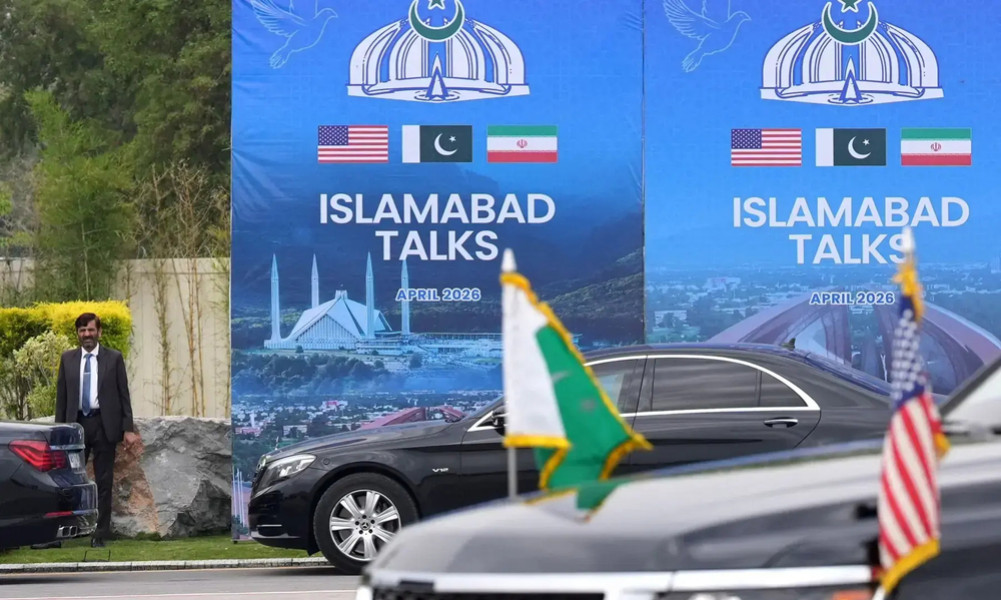
According to US media, the talks were not fruitful due to persistent differences over the issue of nuclear proliferation and Iran's control over the Strait of Hormuz.
We use Google Cloud Translation Services. Google requires we provide the following disclaimer relating to use of this service:
This service may contain translations powered by Google. Google disclaims all warranties related to the translations, expressed or implied, including any warranties of accuracy, reliability, and any implied warranties of merchantability, fitness for a particular purpose, and noninfringement.
The US-Iran talks in Islamabad have ended without an agreement. The talks, which began on Saturday, lasted a total of 21 hours until Sunday morning. During this time, both sides exchanged various documents and discussed them extensively. But no agreement could be reached.
According to US media, the talks could not be fruitful as differences persisted over the nuclear issue and Iran's control over the Strait of Hormuz.
'We discussed many issues with the Iranians. This is good news. However, we could not reach any agreement. This is sad. I think it is sadder for Iran than for America,' he said at a press conference in Islamabad, 'We could not reach such a situation. Where the Iranians accept our conditions.'
He told the Iranian representatives that the US had clearly presented its proposals and that this was the final one. He claimed that the US had presented itself in the talks with very good intentions and as flexible as possible. 'We have made it clear on which issues we are ready to compromise and which we will not compromise on,' he said. The US team led by Vance returned to Washington after the press conference. He did not provide detailed information about the issues discussed in the talks. However, he said that the US is seeking a commitment from Iran to abandon its nuclear weapons ambitions. '
They are not in a position to make nuclear weapons. However, we want. A positive response from them not to do such things in the future,' Vance said.
President Donald Trump's son-in-law Jared Kushner and Ambassador to the Middle East Steve Witkoff were also participating in the talks in the US delegation led by Vance.
The issue of ending the war permanently, the issue of nuclear proliferation and control of the Strait of Hormuz, compensation for the destruction caused in the war, among other issues, were raised in the talks, according to the Iranian side. Iranian officials said that the talks could not take place due to differences on those issues.
Iran's Fars News Agency wrote, citing a source close to the Iranian delegation. “The US tried to achieve all those things through talks, which it could not through war. We could not accept the US’s tough demands on Hormuz, peaceful nuclear programs and many other issues.”
Iranian Foreign Ministry spokesman Esmail Baghai said that the two countries have reached an understanding on many issues. He said that differences remain on two to three important issues. “These talks were held in an atmosphere of mistrust and suspicion after a 40-day war. Therefore, we did not expect an agreement to be reached in a single meeting. No one expected that,” he said.
The Iranian delegation to the talks was led by Parliament Speaker Mohammad Bagher Ghalibaf. Iranian Foreign Minister Abbas Araghchi and other senior officials were in the delegation.
Spokesperson Baghai said that the success of the talks would depend on the US’s good intentions and trust. He said that Iran cannot reach an agreement that goes against its legitimate rights and interests. Iran's Tasnim news agency, citing a person closely following the talks, said the ball was in the US court. "Iran presented appropriate initiatives and proposals in the talks. Now the ball is in the US court," the source said.
He also said that the blockade on the Strait of Hormuz would remain in place until a proper agreement is reached with the US. Since the US-Israeli attack on February 28, Iran has been blocking the Strait of Hormuz. As a result, about 20 percent of the world's crude oil and natural gas have not been able to flow out.
The 10-point conditions put forward by Iran for the talks include the recognition of Iran and Oman's sovereignty over Hormuz. Only a short time ago, Iran's parliamentary security committee had passed a proposal to charge transit fees for oil tankers passing through Hormuz.
Pakistan's Deputy Prime Minister and Foreign Minister Ishaq Dar expressed confidence that diplomatic dialogue between the US and Iran would remain open. He said that Pakistan will take the initiative for that.
‘We hope that both sides will continue to work with a positive spirit to achieve lasting peace and prosperity for the entire region and beyond,’ he said, ‘Pakistan will also play its role in facilitating relations and dialogue between Iran and the United States in the coming days.’
Both the United States and Iran have praised Pakistan’s mediation and thanked Prime Minister Shahbaz Sharif and Army Chief Asif Munir.
The 40-day war was temporarily halted for two weeks after Pakistan’s mediation on April 8. After that, talks between the two sides were held in Islamabad on Saturday. This is the first time that Iran and the United States have held direct talks since the Islamic Revolution in Iran in 1979. All previous talks were indirect.