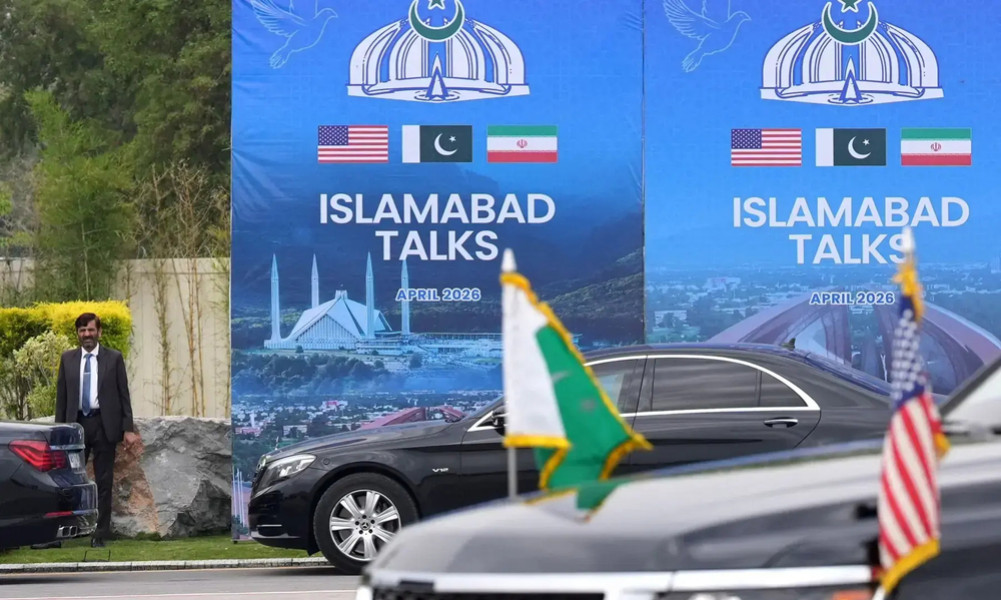
On March 29, the foreign ministers of Pakistan, Saudi Arabia, Turkey, and Egypt met in Islamabad.
We use Google Cloud Translation Services. Google requires we provide the following disclaimer relating to use of this service:
This service may contain translations powered by Google. Google disclaims all warranties related to the translations, expressed or implied, including any warranties of accuracy, reliability, and any implied warranties of merchantability, fitness for a particular purpose, and noninfringement.
For the first time since the 1979 Iranian Islamic Revolution, representatives of Iran and the United States are in direct talks. Previously, all the talks between the two countries were indirect. However, Pakistan is holding direct talks with its direct involvement by inviting representatives of both countries to Islamabad and putting them in the same room. Until a few days ago, the task of getting two warring enemies to talk in the same room was no less challenging. The background to the talks was as follows:
United States President Donald Trump had warned that he would “destroy Iran’s civilization” if an agreement was not reached by 8 pm Eastern Time on Tuesday (5:45 am Nepali time on Wednesday). He had threatened to attack energy centers and bridges. About 90 minutes before the deadline, Trump announced on his social media that a two-week ceasefire had been reached with Iran. Iran also confirmed this soon after.
Trump said the Iranians had agreed to a ceasefire after talks with Pakistani Prime Minister Shehbaz Sharif and Field Marshal Asim Munir. Iran also thanked Pakistani Prime Minister Sharif. Sharif later said a ceasefire had been agreed and that both sides had been invited to Islamabad for talks on Friday.
By Wednesday afternoon, Sharif had also spoken directly with Iranian President Masoud Peshmerga. Pakistan is one of the countries worst hit by the fuel crisis caused by the ongoing war.
The war has also had a social impact here. Shia supporters attempted to attack the US consulate in Karachi on March 1. At least 10 people were killed in the attack.
Despite all this, Pakistan has been continuously initiating talks between Iran and the US. On March 3, Pakistan's Deputy Prime Minister and Foreign Minister Ishaq Dar, while addressing the Senate, said that Pakistan would play a role in creating an environment for talks.
However, the situation was not easy. In particular, Pakistan also faces the challenge of maintaining a balanced relationship with Saudi Arabia. On March 12, Prime Minister Sharif and Army Chief Munir went to Jeddah to meet Saudi Crown Prince Mohammed bin Salman. There, they opposed the increasing Iranian attacks against the Gulf countries. Similarly, they expressed "full solidarity" with the Gulf country.
It was necessary for Pakistan to maintain its mutual defense agreement with Riyadh, which was signed in September. But it was also necessary to win Iran's trust to bring it to the negotiating table.
While the war was going on, Pakistani Army Chief Munir had a telephone conversation with Trump from March 22 to 23. On March 23, Prime Minister Sharif tagged Trump and Iranian Foreign Minister Araghchi on social media and urged them to hold talks. However, both Iran and the US said that there was no possibility of talks. On March 26, Foreign Minister Dar confirmed that the US had put forward a 15-point proposal to Iran for talks through Pakistan. It included a commitment to end its nuclear weapons program and to reopen the Strait of Hormuz. Tehran rejected this and put forward its own 10-point demands. These included ending hostilities, lifting sanctions, paying compensation, and maintaining its sovereignty over the Strait.
On March 29, the foreign ministers of Pakistan, Saudi Arabia, Turkey, and Egypt met in Islamabad. Before the meeting, Sharif held a long conversation with Pezheskiyan. China also indirectly supported the talks. Meanwhile, Foreign Minister Dar also visited Beijing.