The spacecraft entered the Earth's atmosphere, cutting through the air at 33 times the speed of sound.
We use Google Cloud Translation Services. Google requires we provide the following disclaimer relating to use of this service:
This service may contain translations powered by Google. Google disclaims all warranties related to the translations, expressed or implied, including any warranties of accuracy, reliability, and any implied warranties of merchantability, fitness for a particular purpose, and noninfringement.
AP: After nearly 50 years, the astronauts of the Artemis-2 mission have returned after traveling around the moon. They landed in the Pacific Ocean at 5:45 am on Saturday morning Nepali time. The Orion capsule named Integrity, which took off from Florida on April 1 at 6:45 pm (Nepalese time on April 2 at 4:20 am), returned to Earth. The
mission showed places far from the moon that have never been seen by human eyes before. The spacecraft also saw a total solar eclipse and many other planets in space. They also clearly observed the Earth shining in the dark. The
The US Space Agency (NASA) sent these passengers into space near the lunar orbit as a test. NASA will send another team within the next two years, which will land on the moon. NASA has also planned to build a base camp (moon base) on the moon in the next decade by conducting various studies and research in stages.
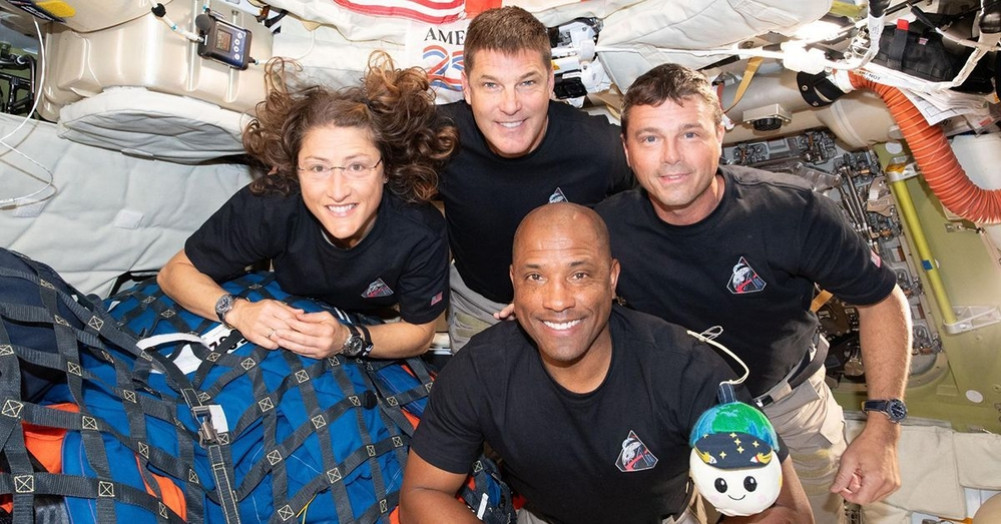
Earlier, the spacecraft entered the Earth's atmosphere by cutting through the air at a speed of 33 times faster than the speed of sound. Then its speed gradually decreased. The four astronauts, including Commander Reed Wiseman, Pilot Victor Glover, Christina Koch and Canadian Jeremy Hansen, parachuted into the sea near San Diego.
From there, the US Navy took them to the USS John P. Martha. NASA chief Jared Isaacman called these passengers "messengers sent to the stars by human civilization." He said the team members did a great job. This is the first inclusive team to go on a lunar mission. In a sign of societal transformation, NASA has chosen an international team representing diverse ethnic backgrounds and different countries.
As a result, Christina Koch became the first woman to fly to the moon, Victor Glover became the first black astronaut, and Canadian Jeremy Hansen became the first non-American to travel to the moon. NASA has taken this mission as the first step in its work towards building a lunar base camp.
Artemis-2 did not land on the moon, did not enter lunar orbit, but observed it closely. It broke the record of Apollo-13 and traveled the farthest distance from Earth to humans, 252,756 miles (406,771 kilometers).
In the most emotional moment, the tearful astronauts remembered their lunar module and Commander Wiseman's late wife Carol. Their curiosity and love, as well as the various images of the moon and Earth, have captivated everyone.
The Artemis-2 team showed the blue Earth sinking behind the gray lunar horizon through an image called 'Earthset'. It reminded us of the historic 'Earthrise' of Apollo-8 in 1968.
NASA Administrator Jared Isaacman said, 'We are back to sending people to the moon, returning them safely, and preparing a series of missions like this. This is just the beginning.'
Although the nearly 10-day flight was scientifically fruitful, it was not free from technical problems. Valve problems were observed in both the capsule's water and fuel systems. The spacecraft's toilet broke down repeatedly, but the astronauts made fun of it.
'If we want to go deeper into space, we have to endure some discomfort, we have to take some sacrifices and risks, all of these are normal,' Koch said.
Hansen said, 'No matter how much testing we do on the ground, the final big test will be in space.'
Under the new Artemis plan, astronauts will practice docking their capsule with one or two lunar landers in orbit next year on Artemis-3. Artemis-4 aims to land two astronauts near the moon's south pole in 2028.
Returning mission after 50 years
Agency: NASA sent several spacecraft to the moon under the Apollo missions in the 1960s and 70s. It was considered part of the 'Space Race' with the Soviet Union during the Cold War. In 1957, the Soviet Union sent a dog named Laika into space via Sputnik 2. Within four years, on April 12, 1961, the Soviet Union's Yuri Gagarin set foot in space.
Feeling the pressure to challenge the Soviet Union's dominance in space exploration, the United States invested heavily in NASA. On July 20, 1969, Neil Armstrong and Buzz Aldrin of Apollo 11 set foot on the moon. Neil became the first person to set foot on the moon, and Buzz set foot on the moon 19 minutes later, setting a record for being the second.
Since then, a total of 12 Americans have set foot on the moon under the Apollo missions within 3 years. The last time was on December 14, 1972, by Eugene Cirin of the Apollo 17 mission. However, after that, the United States did not send any spacecraft to the moon for almost 50 years. After this, NASA's budget was gradually cut. It was cut after large investments, risks, and people's interest began to decline.
NASA then focused its attention on the Space Shuttle and research into near-Earth orbit. However, after 50 years, the United States has again taken up the moon program. NASA's goal under this program is to establish a human lunar camp in the next decade. China is now challenging the United States in the 'space race'. China's goal is to send its citizens to the moon by 2030.