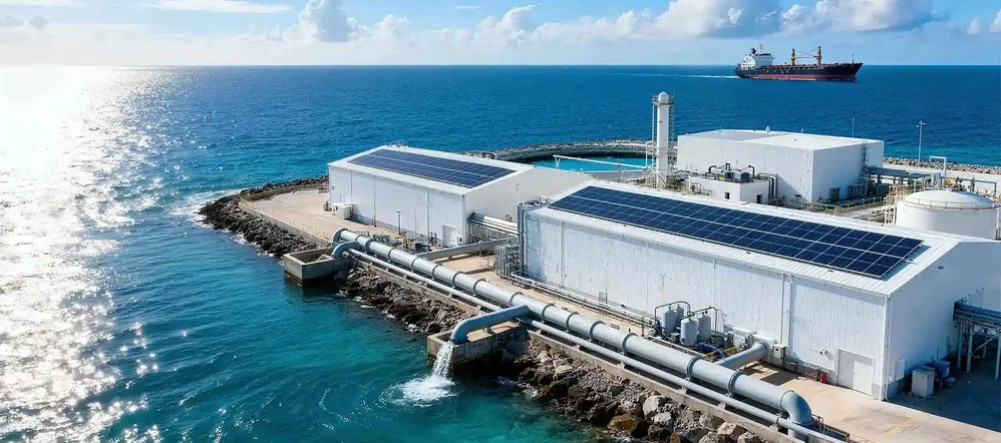
Approximately 62 million people (including migrant workers) living in the Gulf Cooperation Council (GCC) member states of Bahrain, Kuwait, Oman, Qatar, Saudi Arabia, and the UAE rely on treatment plants for their drinking water.
We use Google Cloud Translation Services. Google requires we provide the following disclaimer relating to use of this service:
This service may contain translations powered by Google. Google disclaims all warranties related to the translations, expressed or implied, including any warranties of accuracy, reliability, and any implied warranties of merchantability, fitness for a particular purpose, and noninfringement.
US President Donald Trump on Thursday warned Iran to immediately open the Strait of Hormuz. He threatened to destroy Iran's oil and water processing plants if the blockage in the strait persists.
The US military had already attacked Iran's water processing plant several days before Trump's warning. The Gulf and Arabian regions have a tradition of treating seawater to remove salt and impurities from it and use it. But the current war has made large processing plants unsafe.
At least 30 villages were affected by the attack on the processing plant on Qeshm Island in southern Iran in the first week of March, Iranian Foreign Minister Abbas Araghchi said.
"30 of our villages have been affected. There will be big consequences for the attack on Iranian infrastructure. The US started this, not Iran," he said. Since then, Iran has been continuously attacking water processing plants in West Asia. But While fuel prices and shortages are creating shortages around the world, the issue of attacks on water treatment plants has been overlooked.
There are now more than 400 treatment plants along the Arabian Gulf coast, stretching from the UAE to Kuwait. All the plants have become unsafe due to the war.
Last Monday, an Indian was killed when Iran attacked a treatment plant in Kuwait. Similarly, Kuwait's Ministry of Electricity and Water had stated that there was extensive damage to infrastructure. On Friday, another treatment plant in Kuwait was attacked again. However, Iran has refused to take responsibility for it. Qatar, the UAE, Bahrain and Saudi Arabia have also been attacked.
Natural fresh water resources are also very limited in the Gulf countries. Traditionally, rainwater is stored and used here, which is used underground water. Therefore, water treatment plants have become an important means of supporting daily life here.
The Gulf Cooperation Council (GCC) member states of Bahrain, Kuwait, Oman, Qatar, Saudi Arabia and the UAE (including migrant workers) rely on treatment plants for their drinking water, with an estimated 62 million people relying on treatment plants for their drinking water. According to a 2022 survey by the French Institute of International Relations, 42 percent of the UAE, 70 percent of Saudi Arabia, 86 percent of Oman and 90 percent of Kuwait's drinking water is treated from the sea. Similarly, nearly 90 percent of Bahrain and nearly 99 percent of Qatar's drinking water is treated from the sea.
According to a 2023 GCC report, the six Gulf states produced a total of 7.2 billion cubic meters of treated water. Of this, Saudi Arabia alone treated about 3 billion cubic meters. When operating at full capacity, experts say that the treatment plants in these countries can treat a total of 26.4 billion cubic meters of water annually.
The discovery of oil in the late 1930s led to an increase in the number of people coming here for business and work. This number has increased even more since 2000. Exploitation of nature, the impact of global warming, droughts and erratic rainfall are also posing challenges to limited resources. That is why Gulf countries have been increasing their investment in water treatment. According to a 2023 study published by the Arab Center in Washington, DC, about 40 percent of the world's total treated water is produced in the Gulf Coordination Council (GCC) member states. The Saudi government had allocated US$80 billion for the construction of water treatment plants in 2023.
Environmental researcher Nasser Al-Sayed has expressed concern that attacks on water treatment plants in the region could set back economic development. 'The importance of treated water in supporting the development of the Gulf is great. However, this issue, which is related to daily life, is often ignored, he said. “Any disruption to these infrastructures can lead to a crisis.”
Hydrologist Raha Hakimdawar said that an attack on a water treatment plant could also affect the domestic food production cycle. Not only drinking water, but also desalination of water is necessary for irrigation, industrial purposes and other household purposes.
“The region is currently highly dependent on food imports. The problem will increase further with the lack of treated water. On the other hand, the supply system is also in crisis due to the disruption seen in the Strait of Hormuz,” said Hakimdawar, a senior advisor at Georgetown University in Qatar.
Even if Saudi Arabia attacks one of its treatment plants, it can make up for the shortage from another. The country also has a large strategic reservoir. The UAE has also built large strategic reservoirs.
However, small states like Qatar, Bahrain and Kuwait will soon face water shortages, Hakim Dawar said. “These countries are highly dependent on desalination. They have very few strategic reservoirs,” he said. “The biggest thing is that such attacks cause psychological panic and panic. Because water is essential for human life.”
The US-Israeli are attacking water treatment plants in Iran. In northern Iran, glaciers, groundwater and rainwater meet the demand. However, in recent years, climate change and drought have also exacerbated the drinking water problem in cities like Tehran. There is a compulsion to use treated water in the south.
Small Persian islands like Qeshm have no choice but to rely on treated water. Similarly, 80 percent of drinking water in Israel comes from treatment plants. Iran has been continuously attacking water infrastructure here in recent days.
How is it processed?
The processing process is called desalination. In this process, salt and minerals are removed from seawater and the water is said to be suitable for human consumption and irrigation. Water is processed mainly through thermal distillation or reverse osmosis.
For this, seawater is first sent to desalination plants. There, the water is boiled using special equipment. In this process, sand particles, salt and other impurities remain at the bottom, while the steam rises to the top. The steam is condensed and water is made again. After adding the necessary minerals to it and disinfecting it, it is sent to homes, businesses or industries through pipelines for use.
Another, reverse osmosis process. It uses high-pressure pumps to divide seawater into two parts through a filter (membrane) with small holes. On one side, the brine with more salt and minerals remains. On the other side, pure water goes. This process consumes less energy than thermal and is effective even for small plants.
Attacks against international law
Attacks on water infrastructure are prohibited by international law, but have not been implemented in practice. Article 54 of the 1949 Geneva Convention states that attacks on infrastructure and supplies of drinking water, including infrastructure related to the right to life of civilians, should not be carried out.
As of June 2025, 175 countries have signed it. However, the US, Israel and Iran have not signed it. This is not the first attack on a water center in a war. Both sides had previously attacked water pipes in the Russia-Ukraine war. Attacks on water pipes had also caused a crisis in Afghanistan.
In January 2025, Israel attacked a water treatment center in northern Gaza. This center is the only one operated by the Palestinian Water Authority. Israel attacked the supply pipeline and water treatment centers.
During the war, Israel cut off electricity to the North Sea refinery in Gaza. This has caused a large number of Palestinians to suffer.
In the Gulf region, Houthi rebels based in Yemen had previously attacked the Al-Sakayq refinery in Saudi Arabia in 2019 and 2020. Kuwait experienced a severe water shortage following the 1990-91 Gulf War.
At that time, Iraq had dumped oil into Kuwait's sea, making the seawater unsuitable for processing. As a result, Kuwait had to buy water from Saudi Arabia for a few years.