With the blockade of the Strait of Hormuz causing shortages of gas and crude oil, Asian countries have increased their use of coal to run their industries.
We use Google Cloud Translation Services. Google requires we provide the following disclaimer relating to use of this service:
This service may contain translations powered by Google. Google disclaims all warranties related to the translations, expressed or implied, including any warranties of accuracy, reliability, and any implied warranties of merchantability, fitness for a particular purpose, and noninfringement.
Every region in West Asia is now unsafe. The bombings have affected the sky, land and sea.
According to the latest information given by the US Central Command CENTCOM on Wednesday, more than 12,300 attacks have been launched on Iran since the war began. US President Donald Trump has said that more severe attacks will be launched in the next two to three weeks. The US attacked Iran nearly 1,000 times within the first 24 hours of the war.
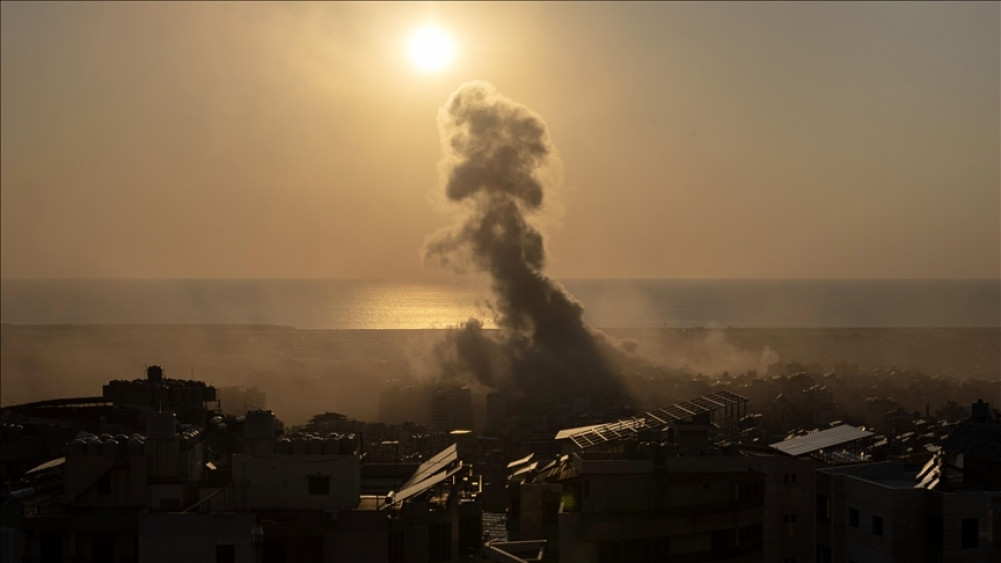
More than 3,600 bombs have been dropped on Tehran, Iran, in the first month alone. Iran is firing missiles and drones at countries in West Asia, including Israel, almost daily. On the other hand, the Houthi rebels have started bombing Israel from Yemen.
Israel has not only attacked Iran, it is also targeting Hezbollah in neighboring Lebanon.
Both Iran and Hezbollah are firing missiles, drones and rockets at Israel. Countries such as Saudi Arabia, Qatar, UAE, Bahrain, Jordan, Oman and others, which are not involved in the war, have also become victims of Iran's counterattacks.
Iran's main nuclear facilities in the cities of Isfan, Fordow and Nantaz are under the US-Israeli target. Iran is repeatedly firing missiles at Israel's nuclear research center in Dimona.
Kuwait, Saudi Arabia, Qatar and other countries' gas and oil fields are under the target.
The US has dropped a large number of bombs on the Iranian navy. 43 Iranian boats have been damaged and sunk here. On the other hand, the US is also accusing Iran of laying underwater bombs in the Strait of Hormuz.
An Iranian ship carrying an oil tanker took refuge in a Sri Lankan port during the war. The ship was damaged in the attack and was leaking oil.
Similarly, Iran is targeting coastal cities such as Abu Dhabi, Dubai Jebel Ali and Manama. Every bomb dropped from the sky, on land and at sea emits a large amount of carbon and pollutes the environment.
Experts say that this harsh attack on oil refineries, nuclear infrastructure and waterways will cause long-term health and environmental problems in West Asia.
Since the war began, the UK-based Conflict and Environment Monitoring Centre (CEOBS) has recorded 400 such incidents, where potentially major environmental damage has been caused.
These include everything from missile bases to tankers in the Persian Gulf. But researchers say the numbers only give a small glimpse of the wider damage.
'This is a small study,' CEOBS director Der Weir told German media outlet DW.com. 'The US has already attacked more than 5,000 sites. So the risk is very high.' He said it was impossible to estimate the damage at this time because the war was still ongoing.
Oil tankers have been stranded in the Strait of Hormuz for more than a month. At least 21 billion liters of oil have been trapped there, according to Greenpeace International.
Oil and gas leaks can cause serious problems for aquatic plants and marine life. The Indian Ocean is home to a number of species, including the rare humpback dolphin. Earlier, US President Donald Trump had urged European countries to help open the Strait of Hormuz. However, the European countries refused to go.
If they went there, Iran could have launched a counterattack. War could have made the situation worse. Iran has been accused of attacking ships passing through here, planting bombs, etc. All these activities put marine life in danger.
The US administration has not yet rejected the plan to seize Kharg Island by mobilizing troops. Iran has said that it is ready for a counterattack. That is why the fear of a possible major conflict has not yet been completely eliminated.
The United Nations has said that damage to oil infrastructure will cause serious damage throughout West Asia. The United Nations has warned that drinking water, air and food may be affected immediately. Two weeks ago, Iran had black rain due to air pollution.
According to experts, when the hydrocarbons in fuel oil in Iran did not burn completely, invisible dust reached the atmosphere. Dust, smoke and toxic chemicals fell from the atmosphere as black rain and fell to the ground.
‘Compounds called polycyclic aromatic hydrocarbons (PAHs) and toxic gases such as sulfur dioxide and nitrogen oxides are also formed from burning fuel. This causes acid rain,’ said Peter Adams, professor of civil and environmental engineering at Carnegie Mellon University in the US.
It causes respiratory and heart problems in those who soak in such water. It can lead to premature death. PAHs also increase the risk of cancer. It also has a major impact on plants and other animals.
Experts have expressed concern that polluted rain can also cause infection in drinking water tanks.
Toxic chemicals, heavy metals and other pollutants can have a lasting impact on soil, water, human and animal health for decades, said Kaveh Madani, an Iranian scientist working for the United Nations. “Coastal oil and gas fields that have been burned, oil spills from ships and sunken ships are all sources of pollution,” he said. “This situation will set the environment of the region back for years.” The Persian Gulf region is one of the world’s most water-stressed regions. There are hundreds of drinking water treatment plants here. Attacks on these plants could lead to a shortage of drinking water in the future. Increasing use of coal
With the blockade of the Strait of Hormuz causing a shortage of gas and crude oil, Asian countries have increased their use of coal to run their industries.
LNG is natural gas that is cooled and liquefied and can be easily stored and supplied. LNG is playing a key role in the world's transition from coal to renewable energy.
It is also a fossil fuel and its use emits methane gas. However, it emits much less pollution into the atmosphere than coal, which emits carbon. That is why countries that are trying to develop renewable energy and green economies have planned to promote its use and move towards renewable energy in the future. But now they are forced to depend on coal.
Before the crisis, coal refineries in South Korea were only allowed to operate at less than 80 percent capacity. The government's goal was to reduce this percentage to zero by 2040.
However, with the LNG gas crisis now looming, South Korea has lifted this limit and instructed coal miners to operate at full capacity. In Japan, there was a rule that refineries could not operate at more than 50 percent capacity. This limit has now been lifted.
Indonesia is making maximum use of its domestic coal. Its use is also increasing in countries such as the Philippines, Thailand, and Vietnam. India already uses coal heavily in industrial activities.
Burning too much coal will pollute major cities. The transition to renewable energy will be delayed and it will increase global warming.
‘Coal is the immediate and renewable energy is the long-term solution.’ “Asian countries will suffer losses in the future because they are overly dependent on coal,” said Julia Skorupska of the Global Coalition Powering Past Coal Alliance. “This crisis is a warning.”
Coal has always been important in emergency energy planning in Asia. “Because of its abundant availability in Asia, it has served as a backup when there is a shortage of gas or a lack of renewable energy,” said Sandeep Pai, an energy expert at Duke University.
China is the world’s largest producer and consumer of coal. It has significantly increased its coal production capacity since 2021 to improve its energy security. It is also investing heavily in renewable energy. India is the second largest coal producer and consumer. It has about three months of coal reserves.
Coal use poses challenges to the environment and public health. The particles emitted from burning coal can penetrate deep into the lungs and bloodstream, causing heart attacks, strokes, lung cancer, and respiratory problems, according to the World Health Organization (WHO).
According to a report by the Energy Policy Institute of Chicago, the entire population in India is forced to breathe such toxic air. India had imposed air-quality regulations some time ago to control pollution. However, now restaurants are allowed to use coal as an alternative to gas. Vietnam also has serious air pollution.
The air pollution here is well above the WHO limit of PM 2.5. Lan Nevin, a shopkeeper in Hanoi, said coal is important for electricity. “But my son has asthma. I worry about his lungs every day,” she told the international news agency AP. (With the help of the agency)