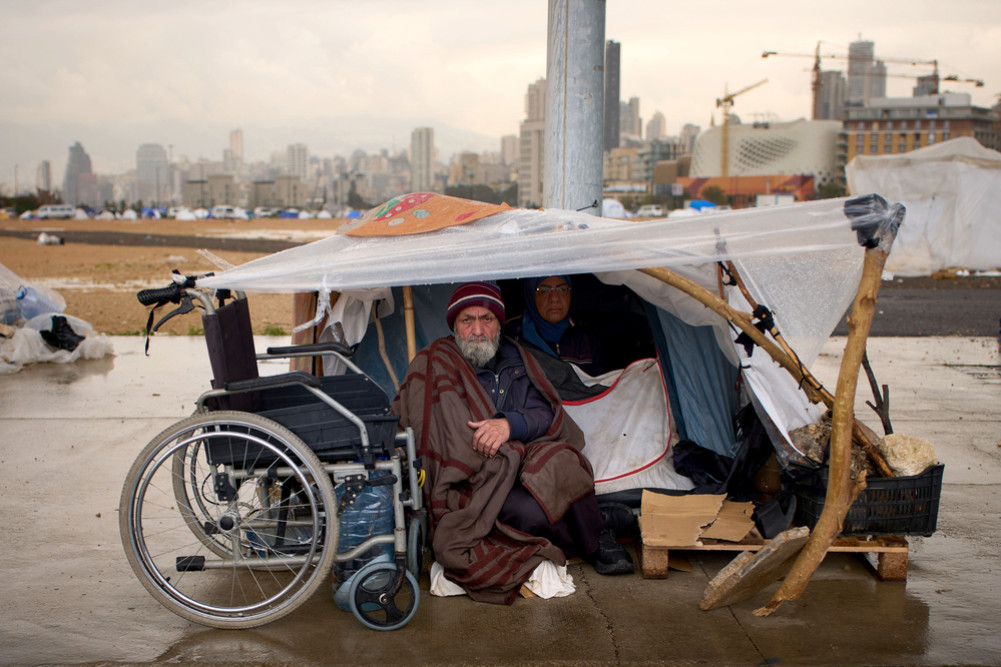
So far, 1,200 Lebanese have lost their lives in the war, and hunger and water shortages are increasing as Israel continues to attack southern Lebanon.
We use Google Cloud Translation Services. Google requires we provide the following disclaimer relating to use of this service:
This service may contain translations powered by Google. Google disclaims all warranties related to the translations, expressed or implied, including any warranties of accuracy, reliability, and any implied warranties of merchantability, fitness for a particular purpose, and noninfringement.
Despite the US-Israel-Iran war taking no sides, the war in Lebanon has had a major impact. The Lebanese militant group Hezbollah launched a missile, artillery and bomb attack on Israel on March 2, declaring its support for Iran. In response, Israel has continued its air and ground attacks on Lebanon.
The war has badly affected the Lebanese people. Carolina Lindholm Billing, the UN refugee agency's (UNHCR) representative in Lebanon, said the impact of the war will be long-lasting. "People are living in constant fear. The psychological impact of this war is going to be huge. Children in particular may be affected for a long time," she said.
Israeli Prime Minister Benjamin Netanyahu on Sunday ordered the army to increase its presence in southern Lebanon. "I have just ordered the expansion of the security buffer zone. We are committed to changing the situation in northern Israel," Netanyahu said in a video message on Sunday.
Israeli forces have advanced 8-10 kilometers from the border in southern Lebanon. Israeli Defense Minister Israel Katz said that the plan is to seize territory up to the Litani River, which is about 30 kilometers from the border. All of these territories are areas of influence of Hezbollah.
Earlier on Thursday, Human Rights Watch issued a statement saying that Israel's strategy of expelling locals from southern Lebanon is a war crime. The Israeli army is destroying civilian homes and many bridges, said UNHCR representative Lindholm Billing. "Israel is continuously destroying bridges connecting northern Lebanon. This has isolated many areas from the rest of the country. It has created obstacles to the delivery of humanitarian relief supplies," she said.
In the process, Israel has also targeted hospitals, educational institutions, government property and private residential homes. According to the Lebanese Ministry of Health, at least 1,200 people have lost their lives in the war so far. Lebanon, with a total population of 5.8 million, has about 1.2 million refugees. Of these, 300,000 are children, according to the International Rescue Committee.
Social workers, rescuers, health workers, journalists and other emergency workers have also been targeted by Israel. Israel is also targeting camps housing Palestinian refugees. Action Against Hunger, a social organization, says that about 500,000 people in Lebanon are facing hunger. The organization says that there is an acute problem with drinking water here.
Taking advantage of the civil war in Lebanon, Israel occupied the southern territories and Hezbollah was born in 1982 in resistance. Hezbollah fought a long resistance war to remove Israel from southern Lebanon. In May 2000, Israel withdrew its troops from the occupied territories of southern Lebanon due to pressure from Hezbollah.
This incident established Hezbollah as a nationalist force. However, the Lebanese people had to endure repeated crises when Hezbollah did not agree to various attempts to give up arms. The last time a ceasefire agreement was signed between the Lebanese government and Israel under the mediation of the United States on November 26, 2024. The agreement included an agreement that armed organizations including Hezbollah would give up their weapons and that Israel would withdraw its troops from Lebanese areas.
Hezbollah agreed with this decision of the government. However, neither Israel nor Hezbollah complied with the agreement. Lebanese Prime Minister Nawaz Salem has stated that his country is still adamant in favor of implementing the agreement. He has objected to Hezbollah's support for Iran in the ongoing war in West Asia. He has stated that his country is in favor of dialogue, not taking sides.
Similarly, Prime Minister Salem has also instructed Iranian diplomats to leave the country. ‘This is not our war, we have been forced into it. It protects the interests of foreigners, not ours,’ Salem had said some time ago. (with the help of the agency)