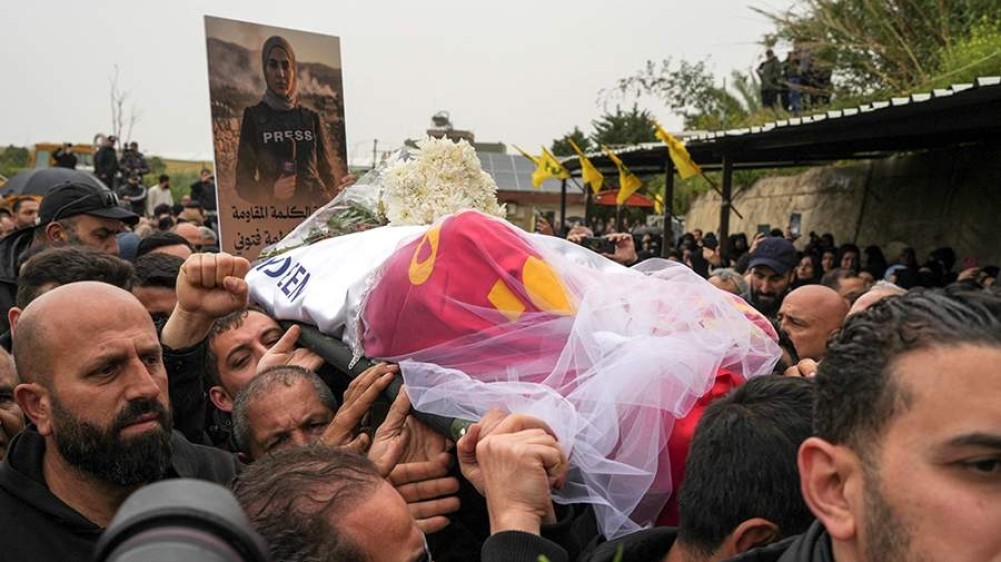
Reporter Fatima and video journalist Mohammad Didibhai were attacked in their car on Saturday afternoon.
We use Google Cloud Translation Services. Google requires we provide the following disclaimer relating to use of this service:
This service may contain translations powered by Google. Google disclaims all warranties related to the translations, expressed or implied, including any warranties of accuracy, reliability, and any implied warranties of merchantability, fitness for a particular purpose, and noninfringement.
Israel's continued attacks in southern Lebanon have caused a humanitarian crisis. About 1.2 million of the country's 5.8 million people have been displaced. At least 1,200 people have been killed since March 2. Public infrastructure such as schools, bridges and private homes have been targeted. The war in Lebanon, which is located on the Mediterranean coast, has made it difficult to deliver humanitarian aid. From health workers working to rescue workers to journalists gathering information, Israel has targeted them. People in the affected areas are taking shelter in schools and public buildings. But these buildings are not safe either. Pregnant women and children are suffering from a lack of nutritious food, according to the International Rescue Committee.
World Health Organization Director-General Tedros Adhanom Ghebreyesus urged Israel on Sunday to immediately stop attacks on health infrastructure. Nine rescue workers were killed in an Israeli attack in Lebanon on Saturday. Similarly, two more rescue workers were killed when Israel attacked a Hezbollah ambulance on Sunday. According to the Lebanese Health Ministry, at least 52 health workers have lost their lives here since the war began.
Even the barracks of the UN peacekeepers here are not safe. An Indonesian peacekeeper was killed by a projectile fired by Israel in southern Lebanon on Sunday. Similarly, three people were injured. Three Ghanaian peacekeepers were injured in an Israeli attack here on March 7.
Three Lebanese journalists were killed in an Israeli attack on Saturday. Ali Shoyeb, who worked for Al Manar TV, and Fatima Fatoni and Mohammad Fatoni, who worked for Al Mayadin channel, died in the attack.
A large number of people gathered for their funeral on Sunday. The people who attended the funeral demanded an immediate end to Israel's inhumane actions in Lebanon. The reporter is Fatima and the video journalist is Mohammad Didibhai. Their car was attacked on Saturday afternoon.
The Israeli Defense Forces (IDF) has accused Ali Shoyeb and Mohammad Fatoni of being affiliated with the military wing of Hezbollah.
The IDF has accused them of working under the guise of journalists. But it has not been able to provide any evidence to support this claim. It also said it was aware of Fatima's death.
UN Deputy Spokesperson Farhan Haq condemned the incident, saying that targeting journalists is tantamount to targeting basic human rights.
“When journalists who are protected under international humanitarian law are targeted, our freedom and the right to information and expression are also targeted,” he said.
Hezbollah has said that the targeting of journalists is motivated by criminal thinking. Lebanese President Joseph Aoun said that Israeli forces violated international law by targeting journalists. Prime Minister Nawaz Salem also condemned the incident.
This is the second time that Israel has targeted journalists during the ongoing war. Earlier, on March 18, Al-Manar TV presenter Mohammed Sheri and his wife were also killed in an Israeli attack while they were sleeping in their home in Beirut.
Israel has also attacked refugee camps during the war. On March 8, Israel carried out two airstrikes on the Ain al-Hinweh camp, a Palestinian refugee camp in the southern Lebanese city of Sidon. One refugee was killed and 10 others were wounded, Lebanon's National News Agency (NNA) reported. Three of the injured were Lebanese citizens.