The Lebanese government has not formally taken sides in the war.
We use Google Cloud Translation Services. Google requires we provide the following disclaimer relating to use of this service:
This service may contain translations powered by Google. Google disclaims all warranties related to the translations, expressed or implied, including any warranties of accuracy, reliability, and any implied warranties of merchantability, fitness for a particular purpose, and noninfringement.
The Israeli attack on Lebanon has killed more than 1,000 people, including 118 children, according to the Lebanese Health Ministry.
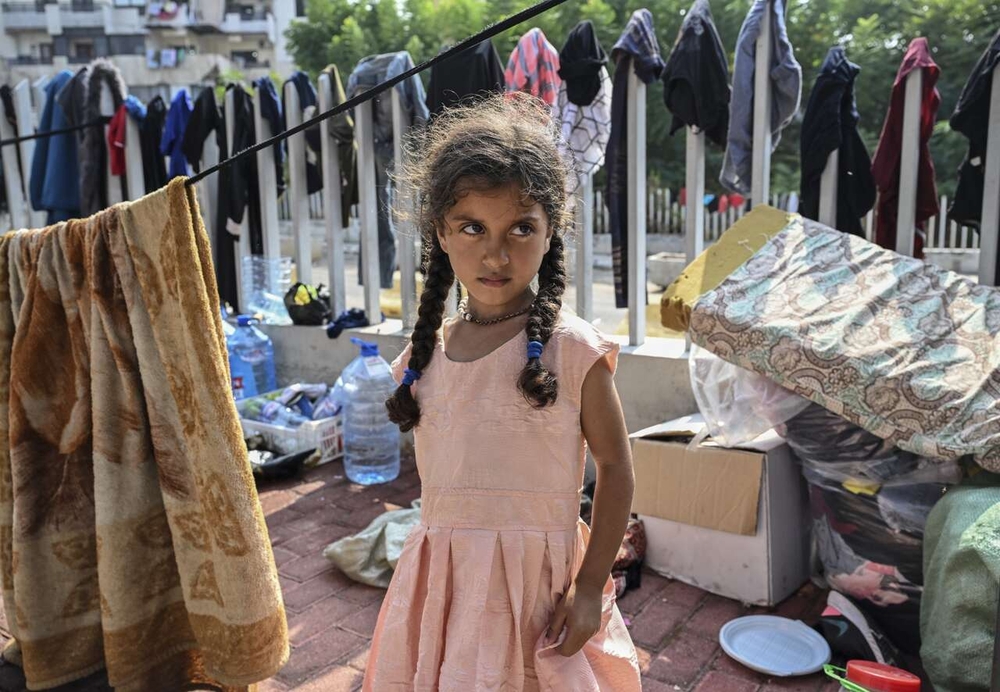
More than a million people have been displaced by the Hezbollah-Israeli war. According to the International Rescue Committee (IRC), 300,000 of those displaced are children.
Pregnant women and children are also suffering from a lack of nutritious food, the IRC said. Hundreds of schools and public buildings have been converted into emergency shelters. People are sleeping in cars and on the streets.
The Strait of Hormuz and air traffic disruptions in West Asia are also hampering the delivery of relief supplies to various countries, the IRC said. “For example, $1.3 million worth of basic medicine intended for Sudan has been stranded in Dubai,” the IRC statement said.
The IRC has been working in Lebanon to provide mobile health services, medicine distribution, blankets, basic and nutritious food items, educational materials and psychological counseling to displaced families.
The IRC said the situation of refugee families displaced by the conflict in Syria and Palestine is even more dire. Action for Hunger, another social organization working in Lebanon, said displaced families are facing a water crisis. The Lebanese government has not formally taken sides in the war.
Lebanese Prime Minister Nawaf Salem has said the conflict is against Lebanon’s national interests. “This is not a conflict we chose. We are involved.” It serves the foreign agenda, not ours,” Salem said in an interview with Al Arabiya. He said Hezbollah was acting at the behest of Iran’s Islamic Revolutionary Guard Corps (IRGC). The Lebanese government had decided to ban all IRGC activities this month. Similarly, Hezbollah was instructed to provide all its weapons to the state. However, despite this, Hezbollah has not changed the government’s decision. Lebanon’s calls to find a solution to the conflict through dialogue have also gone unheeded.
Hezbollah strongly condemned the US-Israeli aggression on Iran on February 28. On March 2, Hezbollah announced that it would avenge the death of Iran's supreme leader Ayatollah Khomeini in a US-Israeli attack, and fired missiles at Israel. In response, Israel has been continuously attacking Lebanon. The direct impact of the war has been felt in Beirut and the Bekaa Valley in the south. Lebanon, already impoverished by the civil war, has deepened its economic crisis.
Nearly 80 percent of the country's population lives in poverty. Access to health, electricity, and education is declining. Israel has been destroying infrastructure in successive attacks. Health and educational centers have been damaged. Hezbollah has also fired dozens of missiles at Israel. Neither side has shown any desire to end the war anytime soon.
Israel aims to eliminate Hezbollah in this war and end the security challenge on its northern border. Hezbollah sees this crisis as a struggle for its existence. Whatever the outcome, the loss of life and property has been enormous.
The ceasefire agreement between Israel and Lebanon in October 2024 stipulated that Hezbollah would gradually disarm. Lebanese Prime Minister Salem said the government was still committed to the agreement. The US-brokered agreement also stopped the 15-month war between Hezbollah and Israel.
Hezbollah remained silent for a long time after the ceasefire. Hezbollah did not take sides in the 12-day war between Israel and Iran in June 2025. Therefore, many assumed that the 15-day war with Israel had weakened the organization. But Hezbollah's decision to back Iran on March 2 has sparked another crisis in Lebanon. This has also angered the Lebanese people.
Mohanad Haig Ali, a
fellow at the McCloam H. Kerr Carnegie Middle East Center in Beirut, says that from Hezbollah's
perspective, the war is necessary. 'Iran was facing an existential crisis, and Hezbollah has been funded and trained by the Iranian regime. The collapse of Iran means the end of Hezbollah as a project,' Ali said. 'On the other hand, even if Hezbollah had not entered the war, Israel would have attacked sooner or later.' That is why, from Hezbollah’s perspective, Israel could not tolerate attacking its main donor. From its perspective, the decision to first assist the donor and conclude a ceasefire agreement in the package is more effective.’ UN peacekeepers stationed in Lebanon have witnessed the Israeli troops entering the area.
Candice Ardial, a spokeswoman for the peacekeeping force in Lebanon, said, ‘Peacekeepers have seen Israeli troops in at least half a dozen places on Lebanese territory near the border. We have heard clashes around the villages of Odaiseh and Khiam. In some places, Israeli troops have entered Lebanese territory up to 5 kilometers from the border. But they are not permanently stationed.’
An Israeli military official
admitted to the Associated Press (AP) that its troops are concentrated in the Lebanese border area. "This defensive work is being done to protect the Israeli community near the border," he said on condition of anonymity, adding, "There could be a major attack and expansion in the future."
The Lebanese army is not involved in the fighting, but three Lebanese soldiers were killed in an Israeli airstrike on Tuesday. The Israeli army said it was investigating the matter. Tensions have also been seen in the border area between Lebanon and Syria. Syria had previously accused Hezbollah of firing artillery into its country. But Hezbollah has denied this.
Hezbollah was born in resistance to Israel.
Armed groups began using Lebanon as a base in the Palestinian struggle for independence in the late 1960s. They used to attack Israel from here. Israel accused the Lebanese government of failing to take the necessary steps to control the armed groups.
Lebanon was plunged into chaos after the civil war broke out in 1975. In March 1978, during the civil war, Israel occupied some areas of southern Lebanon. Israel's policy was to prevent Palestinian armed groups from advancing there. However, Israel was unable to stop the armed groups. In 1982, it took a more aggressive approach and occupied territory as far as Beirut. Hezbollah was founded in the same year to resist Israel's expansionist policies.
Hezbollah continued to resist Israel's occupation of southern Lebanon for 18 years. Iran supported the organization. Finally, in May 2000, Israel withdrew its troops from southern Lebanon. In July 2006, Hezbollah crossed into Israel and killed eight Israeli soldiers. Two more were kidnapped and taken to Lebanon. Israel then launched a major offensive.
But Hezbollah did not lose the 34-day war. Its resistance to Israel actually increased its popularity. The war with Israel ended under UN mediation. But an agreement to disarm Hezbollah was reached, but it was not implemented.
Hezbollah's political power was gradually increasing. In December 2006, a huge rally in support of Hezbollah was held in Beirut. More than 800,000 people participated in the rally. The rally demanded the formation of a national consensus government to free Lebanon from foreign interference. In 2008, after intense opposition pressure, Prime Minister Fouad Siniora expanded his cabinet and gave 11 out of 30 ministries to the opposition. Hezbollah took two ministries.
In 2010, Hezbollah supported Assad's government after protests broke out in Syria against Bashar al-Assad's government. Hezbollah fighters also fought against the Islamic State.

