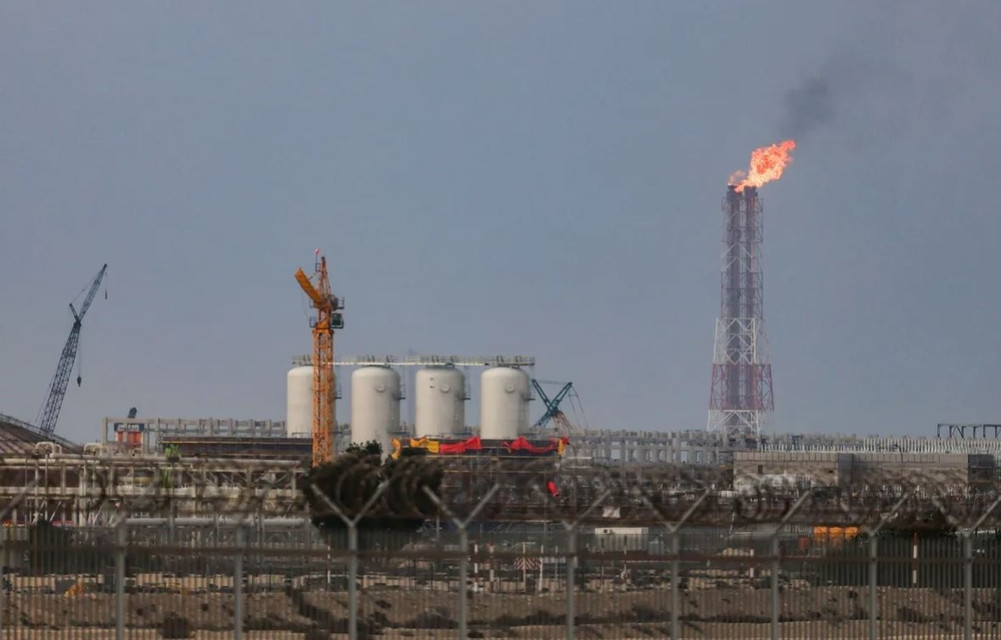
Production in this region had been temporarily halted since the start of the Iran War.
We use Google Cloud Translation Services. Google requires we provide the following disclaimer relating to use of this service:
This service may contain translations powered by Google. Google disclaims all warranties related to the translations, expressed or implied, including any warranties of accuracy, reliability, and any implied warranties of merchantability, fitness for a particular purpose, and noninfringement.
The energy crisis is likely to worsen after Iran attacked Qatar's Ras Laffan. One of the five missiles fired by Iran here on Wednesday caused major damage. The remaining four missiles were intercepted by Qatar.
Production in the region had been temporarily halted since the Iran-Iraq war began. However, analysts say the current damage will have a major impact on production and could raise fuel prices globally. The fuel market has been volatile since the attack.
The price of international benchmark Brent crude oil rose to a high of $111 per barrel on Wednesday.
'India imports 50 percent of its gas requirements from the international market. Of this, about 40 percent of LNG comes from Qatar,' energy economist Kirit Parikh told NDTV. 'India needs to reduce its gas consumption.' The production capacity of the industrial sector, especially the energy sector, will decrease.'
Ras Laffan is an industrial city on the shores of the Persian Gulf. The Ras Laffan Industrial Center is located about 80 kilometers from the capital Doha. Ships leaving from here reach the world market through the Strait of Hormuz.
This industrial zone is operated by the state-owned Qatar Energy. According to the international media Al Jazeera, it is the world's most important liquefied natural gas (LNG) center.
Infrastructure has been built here for processing, transportation and storage. Qatar is the second largest exporter of LNG gas after the United States.
Qatar produces about 20 percent of the world's total LNG consumption. LNG is used for industrial consumption, electricity, domestic gas, and vehicles such as trucks and ships.
Almost all LNG gas in Qatar is first processed at Ras Laffan. It is then distributed to the world market by ship.
LNG and other production here have been temporarily halted since the beginning of March since the war began. Due to Iran's blockade of the Strait of Hormuz, there is a problem with the export of oil and gas from Qatar. That is why production had to be cut here.
LNG gas is sent from here to countries such as Japan, South Korea, Pakistan, Bangladesh, India. In addition, gas is also delivered to Europe and Africa.
Since the blockade of Hormuz, there has been an acute shortage of LNG gas in countries such as Pakistan, Bangladesh, India, Sri Lanka, and others. This attack has increased the risk of fuel shortages and price increases.
The Ras Laffan Industrial Area also produces urea and ammonia chemical fertilizers. Gases such as sulfur and helium, which are needed to make microchips, are also produced here.
Qatar Energy has stated that 25 percent of the world's helium production is supplied from here.