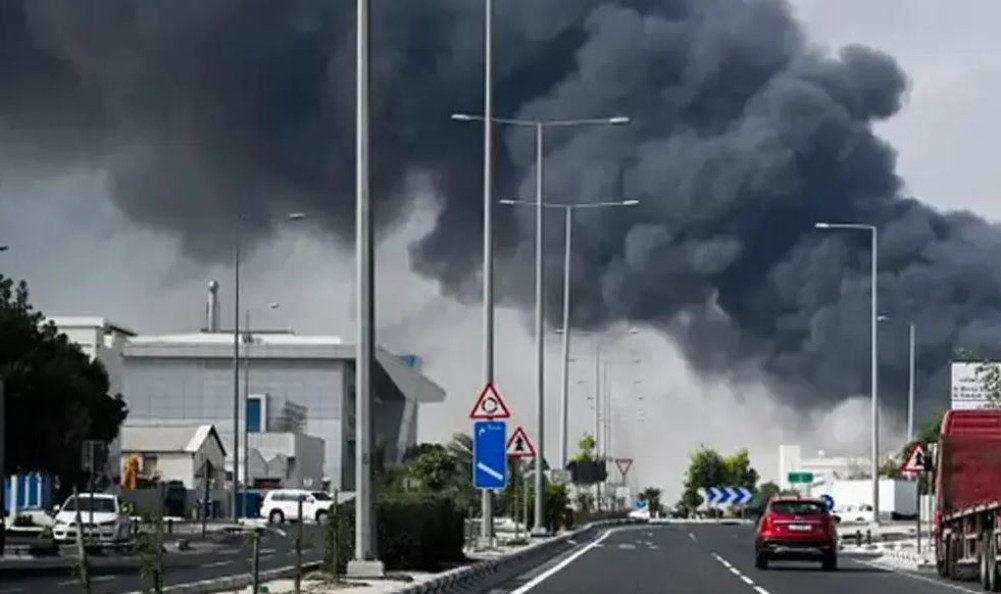
Earlier on Wednesday, Iran attacked oil and gas infrastructure in Qatar, the UAE, and Saudi Arabia.
We use Google Cloud Translation Services. Google requires we provide the following disclaimer relating to use of this service:
This service may contain translations powered by Google. Google disclaims all warranties related to the translations, expressed or implied, including any warranties of accuracy, reliability, and any implied warranties of merchantability, fitness for a particular purpose, and noninfringement.
The war between the US-Israel and Iran continues for the 20th day. Recently, both sides have been targeting each other's energy infrastructure.
Earlier on Wednesday, Iran attacked oil and gas infrastructure in Qatar, the UAE and Saudi Arabia. One of the five missiles launched by Iran on the world's largest LNG gas export area, Ras Laffan, caused significant damage.
The remaining four missiles were intercepted by Qatar. Production in the area had been temporarily halted since the Iran-Iran war began. However, the current damage is expected to have a major impact on production and increase gas prices globally. The UAE and Saudi Arabia have claimed that the missiles coming from Iran were shot down.
Within hours of the attack on energy infrastructure in West Asia, Israel has attacked Iran's South Pars gas field. It is the world's largest natural gas reserve.
In the last two days, Israel has assassinated three top Iranian officials, including Security Council Secretary Ali Larijani, Basij Force commander Gholamreza Soleimani, and Intelligence Minister Esmail Khatib. Similarly, there has been a large-scale attack on Lebanon.
Iran's Supreme Leader Mojtaba Khamenei has warned that Israel will pay a heavy price.
Meanwhile, Qatar has declared itself 'persona non grata' and ordered Iranian diplomats and security officials to leave the country within 24 hours. Similarly, Saudi Arabia has said that it will retaliate if its country is attacked again.
International impact
The war has created instability in the global oil and gas market. Iran's blockade of the Strait of Hormuz has led to a rise in fuel prices and a crisis in the global market.
The Strait of Hormuz is the largest route for gas and oil from West Asian countries to the world market. 20 percent of global crude oil is exported through this route. However, a large number of tankers from various countries are currently stopped in the areas around Hormuz.
The price of international standard crude oil (Brent crude) has risen to $108 per barrel due to the increase in the world market. Whereas, the price of Brent crude was around $72 the day before the war started. Gas prices have also increased.
In countries dependent on oil in West Asia, including Sri Lanka, Bangladesh, and Pakistan, universities and schools have been closed due to a fuel crisis, and government holidays have been extended to reduce fuel consumption. India does not have a diesel and petrol crisis due to Russian oil. But the price has increased. The gas crisis here is huge. Analysts have said that the price of crude oil may cross $200 if the blockade in the Strait of Hormuz continues. ‘The price of Brent crude or West Texas Intermediate may not reach $200 immediately, but the benchmark crude of Oman and Dubai has already crossed the threshold of $150. It looks like it will reach $200,’ said Vandana Hari of Banda Insight, an oil market analysis organization. ‘How long Hormuz remains closed will determine how high the price of oil will rise from here.’
Earlier, US President Donald Trump had urged the international community to send his warship to open the Strait of Hormuz.
However, no one supported him. He has complained to NATO member states that they were not supported in this war.
Iran has allowed ships from some countries to exit through Hormuz. Iran has allowed some ships from India, Pakistan, Turkey and China to exit through here. However, most oil tankers have not taken the risk of leaving ports around Hormuz because of the ongoing war.