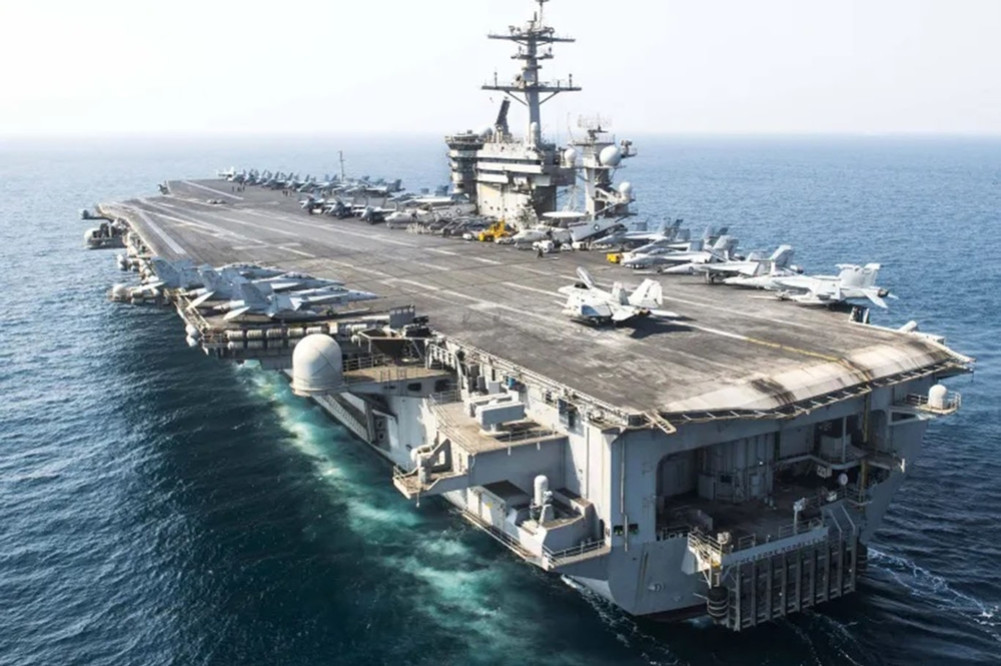
A US warship carrying 75 aircraft and 4,500 troops was damaged by fire.
We use Google Cloud Translation Services. Google requires we provide the following disclaimer relating to use of this service:
This service may contain translations powered by Google. Google disclaims all warranties related to the translations, expressed or implied, including any warranties of accuracy, reliability, and any implied warranties of merchantability, fitness for a particular purpose, and noninfringement.
The world's largest armada (aircraft carrier USS Gerald R. Ford) has sailed from West Asia to the port of Soda on the island of Crete in Greece.
The warship has left the Red Sea as the Iran-US war continues. The ship has been temporarily withdrawn from the war zone for repairs, international media reported, citing a US military source. The US military has temporarily withdrawn the warship and will return. Trump ordered the ship to the Red Sea from the Caribbean to put pressure on Iran.
The decision to return it was made after a fire broke out on the ship last Thursday. The fire on the ship was brought under control after about 30 hours.
Two soldiers on the ship were injured in the fire. About 200 soldiers had minor health problems due to smoke inhalation. They have been treated.
There were about 4500 soldiers on board before the fire broke out. The fire spread to the beds of about 600 soldiers.
The New York Times was the first to report the incident
. But Pentagon officials initially tried to cover it up. The US military claimed that the ship was not damaged and that the airspace was fully operational. Ultimately, the fire broke out due to a technical fault and is under investigation, the US military said. According to the military, the fire started in the laundry space and spread elsewhere, the military said. The USS Gerald, a 100,000-ton, 1,100-foot-long warship, is the world's largest naval warship. Its construction began on August 11, 2005. It was formally handed over to the US Navy on May 31, 2017.
It is also the world's most expensive ship. It cost $13.3 billion to build.
It carries 75 advanced warplanes. It was sent from the eastern Mediterranean to the Caribbean Sea at the end of last October.
Trump deployed the ship to the Caribbean Sea in mid-November to pressure then-Venezuelan President Nicolas Maduro.
During the invasion of Venezuela on January 3, a large number of planes were flown from this ship into the skies of Caracas. The aircraft protected the ground troops who went to kidnap Maduro and kept the Venezuelan air force under pressure. The Venezuelan army was unable to protect the president due to the simultaneous warning from the air and the attack from the ground.
Shortly after the successful operation in Venezuela, Trump ordered the ship to go to West Asia. The US has deployed another warship, the USS Abraham Lincoln, to West Asia. Both warships are being supported by a large number of warships and destroyers. But despite intense pressure and continuous attacks, Iran has not been able to bend. Iran's blockade of the Strait of Hormuz has led to a fuel shortage in the global market. About 20 percent of the world's total fuel flows through the Strait of Hormuz from West Asia. Asian countries are the largest consumers of oil and gas from here. Many countries in Asia are in trouble due to fuel shortages. In order to reduce fuel consumption, countries including Pakistan, Bangladesh, and Sri Lanka have decided to extend public holidays, conduct online studies, and encourage government employees to work from home. The shortage and crisis have increased the price of crude oil in the global market. On Wednesday, the international benchmark Brent crude traded at $104.44.