The United Nations High Commissioner for Refugees (UNHCR) has said that 115,000 people have been displaced in Afghanistan as the Afghanistan-Pakistan war continues into its third week. Similarly, it has said that more than 3,000 civilians have been displaced towards Pakistan.
We use Google Cloud Translation Services. Google requires we provide the following disclaimer relating to use of this service:
This service may contain translations powered by Google. Google disclaims all warranties related to the translations, expressed or implied, including any warranties of accuracy, reliability, and any implied warranties of merchantability, fitness for a particular purpose, and noninfringement.
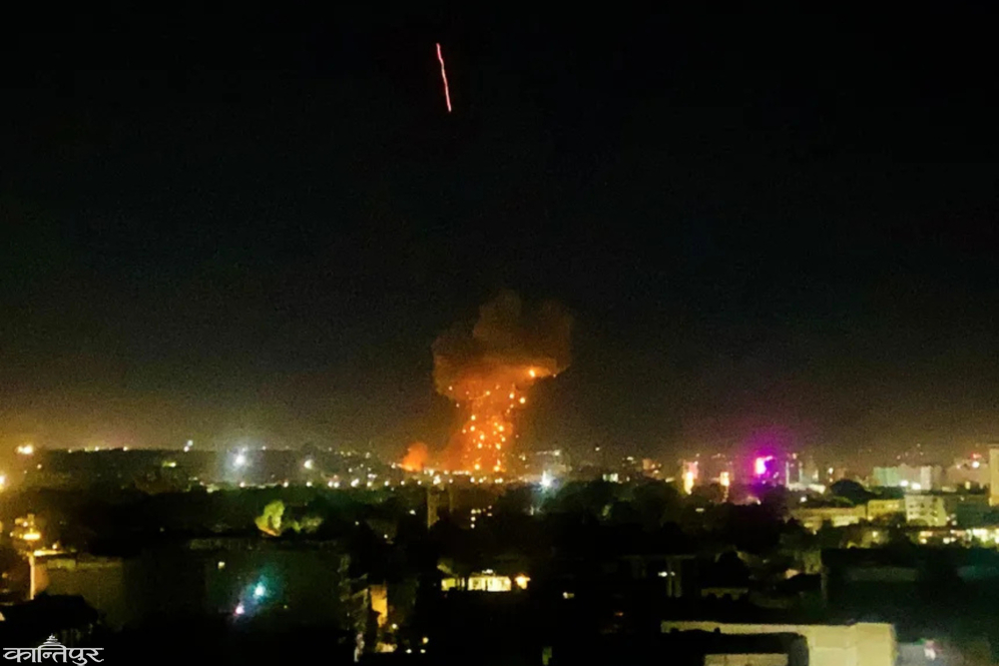
Afghanistan, which has been repeatedly hit by internal conflicts and attacks by foreign powers, has once again come under the target of neighboring Pakistan. Pakistan carried out an air strike in Afghanistan on Monday night. In which 400 people were killed and 250 injured, CNN reported, citing local media. Such attacks are not new to Afghanistan. The British Empire, the Soviet Union and the United States had attacked Afghanistan in the past. However, none of them could achieve their goals or completely capture Kabul. Pakistan has declared open war on Afghanistan and stated that it will destroy the military camps of the jihadist groups, especially the Tehreek-e-Taliban Pakistan (TTP), which are conducting terrorist activities on its soil.
The United Nations High Commissioner for Refugees (UNHCR) has said that 115,000 people have been displaced in Afghanistan as the Afghanistan-Pakistan war enters its third week. Similarly, more than 3,000 civilians have been displaced in Pakistan. The two sides have different claims regarding the details of the dead and injured soldiers. Which has not been independently verified. Pakistan has confirmed that 12 of its soldiers have been killed and 27 wounded. Afghanistan has claimed that 327 Pakistani soldiers have been killed and more than 350 wounded. Similarly, Afghanistan has said that 28 of its soldiers have been killed and 42 wounded. Pakistan has claimed that more than 684 Taliban fighters have been killed and more than 912 wounded.
The history of the conflict between Afghanistan and Pakistan is linked to border disputes. Pakistan has accused Afghanistan of destabilizing its country by funding jihadist armed groups in recent times. However, Afghanistan has denied this allegation.
The Islamic group Taliban, which is running the government in Afghanistan, claims that Pakistan forced the war. It has called this war a ‘crime against humanity’. Afghanistan has accused Pakistan of attacking civilian homes and hospitals. It has also claimed that it has the right to retaliate to prevent foreign attacks.
The seeds of the border dispute were sown even before the creation of Pakistan. After losing the Second Anglo-Afghan War, Afghanistan signed the Treaty of Gandamak in 1879 to become a protectorate with British India. According to this treaty, Afghanistan remained a British protectorate for a few years.
In 1893, the Durand Line defined the border between British India and Afghanistan. Britain had great control over Afghanistan’s security and foreign policy. However, Afghanistan freed itself from British influence by winning the Third Anglo-Afghan War in 1919. It then began to review the treaties and agreements made during the colonial period that limited its sovereignty. Afghan policymakers questioned the Durand Line drawn at the behest of Britain.
In 1947, after the Indian War of Independence, a new nation, Pakistan, was formed in Afghanistan's neighborhood. Pakistan adopted a policy of strengthening relations with the rest of the Muslim world. However, relations with its own neighbor cooled. Afghanistan opposed Pakistan's proposal to join the United Nations. The reason for this was the border dispute since the British era.
British India's North West Frontier Province (now Khyber Pakhtunkhwa) and Balochistan province were part of Pakistan. Pakistan did not accept Afghanistan's proposal to return the Pathan-dominated areas of these provinces. The largest part of the population in Afghanistan (about 40 to 50 percent) is Pashtun. Which is called Pathan in India and Pakistan. Afghanistan had said that the British-era agreement should be canceled, citing this ethnic basis and historical background. But after the proposal was not accepted,
Afghanistan opposed it at the United Nations.
This caused a rift in bilateral relations for a long time. Pakistan has been accusing Afghanistan of providing weapons to the tribal Pathans of Khyber Pakhtunkhwa and Balochistan and inciting them to fight.
The Afghan Taliban, which Pakistan now considers its main enemy, was once a group that it raised. Jihadi organizations flourished after the Soviet Union deployed troops in Afghanistan in December 1979 to protect the communist government. Pakistan provided shelter to these organizations. The strongest of these organizations was the Mujahideen. During the Cold War, the United States and Pakistan jointly provided weapons and financial support to the Mujahideen fighters.
In February 1989, the Soviet army was defeated and left Afghanistan. In 1992, the Mujahideen captured Kabul. However, by this time, many jihadi armed groups had been born here. That is why the Mujahideen could not maintain long-term control over the government. In 1994, the Taliban, a militant organization that broke away from it, captured Kabul.
Only three countries in the world recognized this government. First, Pakistan, and then Saudi Arabia and the UAE recognized it. The Taliban had good relations with Pakistan for a few years. The September 11, 2001 incident in the United States caused a rift in this relationship.
On September 11, there were attempted attacks on the Pentagon, the White House, the Capitol Hill, and two skyscrapers in New York City. The World Trade Center was completely destroyed. The Pentagon suffered some damage. A plane flying with the intention of hitting either the White House or the Capitol crashed in Pennsylvania and was destroyed.
Osama bin Laden claimed responsibility for the attacks. The Taliban had been holding bin Laden in Afghanistan. After the US refused to hand him over, the US-led coalition invaded Afghanistan in October.
The Taliban were overthrown within seven weeks of the attack, which was called the ‘War on Terror’. After this, the US and coalition forces (including Britain, Germany, Canada, Australia, etc.) were engaged in reconstruction work . They were also targeting Taliban fighters .
Pakistan supported the US by cutting ties with the Taliban as soon as the war started . Pakistan's military ruler General Pervez Musharraf told the US that the Pakistani army would be very supportive . During this period, the US also provided significant military and economic assistance to Pakistan .
After the situation in Afghanistan became unbearable, Taliban fighters were entering Pakistan . The Pakistani national army was searching for and attacking them . However, American analysts suspect that Pakistan has a dual role .
Abbas Faraso has written about Pakistan-Taliban relations in his book ‘Proxy War in Afghanistan’ . ‘The actual cooperation between Pakistan and the Taliban is complex . On the one hand, the Pakistani intelligence (ISI) was with the US.
On the other hand, Pakistan was supporting the Taliban using informal channels. Pakistan also provided military training to the Taliban, provided ideological training in madrasas, and provided secret information.’
Analysts estimate that the Taliban received significant support from Pakistan during the period of regrouping and transformation after being overthrown. In 2007, armed jihadist groups gathered in northwest Pakistan and formed an umbrella organization called ‘Tehreek-e-Taliban’ (TTP). It is called the Pakistan Taliban.
This organization began carrying out brutal attacks on markets, mosques, airports, military bases, and police stations. In 2008, Pakistan banned the group. Its bank accounts and assets were frozen. A reward was offered for information about the leaders of this organization.
In 2012, the same organization attacked a schoolgirl named Malala Yousafzai. In 2014, she received the Nobel Peace Prize.
This group was supporting the Taliban in Afghanistan. Despite ideological similarities and a common history, the Afghan Taliban and the Pakistani Taliban were different organizations. Hamid Karzai, the president of the democratic government of Afghanistan (from 2004 to 2014), repeatedly accused Pakistani intelligence of supporting the Taliban. He was succeeded by President Ashraf Ghani. He said that Pakistan had not taken sufficient steps to control jihadist organizations.
In 2016, Pakistan declared the operation against the TTP a success. During this period, the TTP presence in the border areas of Pakistan was minimal. However, the Taliban was flourishing in Afghanistan. Many jihadist organizations from Pakistan, including the TTP, were concentrated in Afghanistan.
The fighters of these organizations began to counterattack NATO forces by hiding in the mountains. Although the urban areas were under the control of the Ashraf Ghani-led government and the national army, most of the rural areas were under the control of the Taliban. During this period, the Taliban had given the slogan of ‘expel foreign powers from the country’. The people were suffering from the rampant corruption within the country and the impunity caused by years of war.
The Taliban had announced the implementation of the ‘Islamic Emirate’ and imposed strict Sharia law. A large number of young people joined the Taliban.
Finally, in August 2021, when the US and NATO forces left Afghanistan, the Taliban captured Kabul.
Pakistan initially welcomed the Taliban's return to Afghanistan. The then Prime Minister of Pakistan, Imran Khan, expressed that the Afghan people had broken slavery. However, relations between the two countries soon deteriorated. The Pakistan Taliban became active again in 2022.
The organization expanded its reach in areas including Khyber Pakhtunkhwa, North Waziristan, South Waziristan, Kurram, Bajaur and Orakzai in Pakistan. It also attacked Peshawar, Bannu, Punjab and Balochistan.
The Pakistan Taliban demands that the Pathan-dominated areas of Khyber Pakhtunkhwa and Balochistan be given autonomy from Pakistan and that strict Sharia law be implemented there. The Taliban government in Afghanistan is repeating its historical claim (that the Pathan-dominated areas of Khyber Pakhtunkhwa and Balochistan are Afghan territory). Pakistan has accused the Taliban government of Afghanistan of funding terrorism and promoting divisive politics on its soil. Afghanistan has denied this. Pakistan has also accused the Taliban government of being a puppet of India. While India, which stood against jihadist organizations by supporting Russia from 1979 to 1989 and the US from 2001 to 2021, has denied this accusation.
Pakistan-Afghanistan fought several border battles over these issues in 2024 and 2025. In October and November 2025, a ceasefire agreement was reached twice through high-level talks mediated by Qatar and Turkey. However, no permanent solution to the dispute was found.
On February 6, 2026, at least 31 people were killed in a bomb blast in the Pakistani capital Islamabad. ISIS claimed responsibility for the attack. The main culprit in the suicide attack that killed 11 people in Bajaur district on February 16 was an Afghan citizen. The Pakistani Taliban claimed responsibility for it.
Pakistan launched airstrikes on areas where the Pakistani Taliban were based, including Nangarhar, Paktika, and Khost on February 21. On February 25, Pakistani security sources confirmed Afghanistan's involvement in the recent series of attacks and suicide attacks in their country.
Security sources claimed that Afghanistan was involved in seven planned and successful attacks since the end of 2024.
On February 26, when the dispute escalated, the Taliban government attacked a Pakistani military base near the border.
Afghanistan claimed that it was retaliating for Pakistan's attack on its territory a few days earlier. Within hours, Pakistan dropped bombs on several areas, including the Afghan capital, Kabul. Pakistan then declared open war. Since then, both countries have been conducting airstrikes against each other.
- This content has been prepared with the help of various news agencies.

