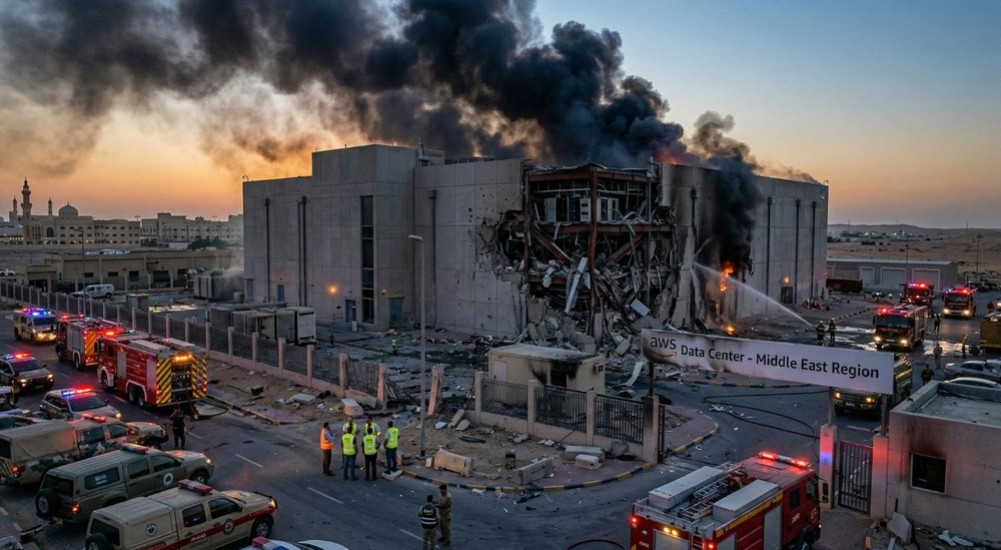
When a data center collapses or suffers major damage, all online services such as websites, mobile apps, cloud services, banking, and e-commerce are immediately shut down.
We use Google Cloud Translation Services. Google requires we provide the following disclaimer relating to use of this service:
This service may contain translations powered by Google. Google disclaims all warranties related to the translations, expressed or implied, including any warranties of accuracy, reliability, and any implied warranties of merchantability, fitness for a particular purpose, and noninfringement.
US Secretary of State for War Pete Hegseth has said that artificial intelligence (AI) is being used and tested in the war with Iran. He praised the technical capabilities of the US military and called it ‘AI First’. On the other hand, Iran is attacking data centers of US companies in West Asia, which could weaken US technological development.
Before the war, the UAE was making attractive progress in AI. Many companies were ready to come here due to the stable political environment, government security guarantees and cheap energy. Which had the potential to become a center for AI development in the future. However, companies are now concerned about the security environment here.
In May 2025, US President Donald Trump visited Saudi Arabia, Qatar and the UAE for four days and announced an investment commitment worth about $2.8 trillion. One of the main projects included in this announcement was a huge $700 billion AI data center to be built in Abu Dhabi.
Open AI claimed that this infrastructure could eventually serve nearly half of the world's population. Along with Open AI, Nvidia, Oracle, and Cisco were also to collaborate on building data centers. In October 2025, Australian company AirTrunk announced plans to build $4.2 billion worth of data centers in Saudi Arabia.
The Gulf countries, which have been attracting one AI company after another and huge investments, are now being disrupted by conflict
'This region is no longer a safe place. No country wants to keep its data centers in an unstable environment,' she said. 'Iran is attacking according to strategy. By attacking hotels, oil and water refineries, it is proving that Gulf countries are cooperating with the US The price of war must be paid.’
The Iran war has raised oil prices. Major waterways, including the Strait of Hormuz, are blocked. Air travel is also affected. Hotels, large buildings and now data centers in West Asia have also been targeted.
The US and Israeli militaries are now using AI systems to identify their opponents. AI is also being used in secret information, cyber operations and the coordination of drones and missiles, said Defense Minister Hegseth.
Large technology companies like Amazon have been collaborating with the US military for years . As a result, the Islamic Revolutionary Guard Corps (IRGC) has stated that these companies have been directly targeted in the war.
The new targets of the attacks announced by the IRGC include US military infrastructure as well as data centers of American companies in the Middle East. Earlier, the IRGC attacked two Amazon data centers in the UAE last week.
The clear reason for this is the US military’s collaboration with Amazon, the IRGC stated. On the same day, a data center in Bahrain was also attacked.
Data centers are physical infrastructures where servers, storage systems, networking equipment, and large amounts of data are processed, stored, and managed. The heart or main factory of a tech company is the data center.
That is why a large number of people work here. New technology development is also done.
Nowadays, many people are increasingly dependent on online services. That is why an attack on a data center can immediately disrupt people's daily lives.
When a data center is destroyed or severely damaged, all online services such as websites, mobile apps, cloud services, banking, and e-commerce are immediately shut down. When apps used by hospitals, banks, and government systems do not work, important tasks such as treatment, payment, registration, and reporting are stopped or delayed.
If data backup is not good, important files, records, and transactions can be permanently lost or corrupted. Many things like transportation booking, digital payments, online employment are disrupted.
When a service is shut down, revenue worth thousands of rupees per minute can be lost, up to lakhs of rupees in the case of large companies. Not only computers, but also services based on them, money and people's daily lives are all affected.
Running a data center is a huge expense even in normal circumstances. Such infrastructure requires a large amount of water and electricity, and highly skilled technical manpower on duty 24 hours a day. It needs to be protected from constant cyber attacks.
Experts say that the conflict is sure to increase its costs.
Last Thursday, Iran made public a list of some of the locations it will target. This includes data centers and offices of technology companies.
An IRGC spokesperson said that in retaliation for the US airstrike on a bank branch in Tehran, data centers in West Asia will be attacked.
Christian Alexander, a principal researcher at the Rabdan Security and Defense Institute in Abu Dhabi, said that protecting data centers from missiles, drones, blasts, shrapnel, fire, water damage and successive attacks will be very challenging.
He said that opening a data center in such risky areas will also increase the insurance premiums that companies have to pay. Similarly, the best engineers (who are the backbone of data centers) are less likely to come to such places.
Data centers are also not easy to hide. Since these huge structures emit high temperatures, everyone can easily notice them. Because of the unique technology used in its buildings and construction sites, they can be easily distinguished in satellite images.
“Data centers are becoming a direct target in war,” said Zachary Kellenborn, a PhD researcher at King’s College London. “Technology companies will also evaluate this fact when deciding where to build new data centers in the future.”