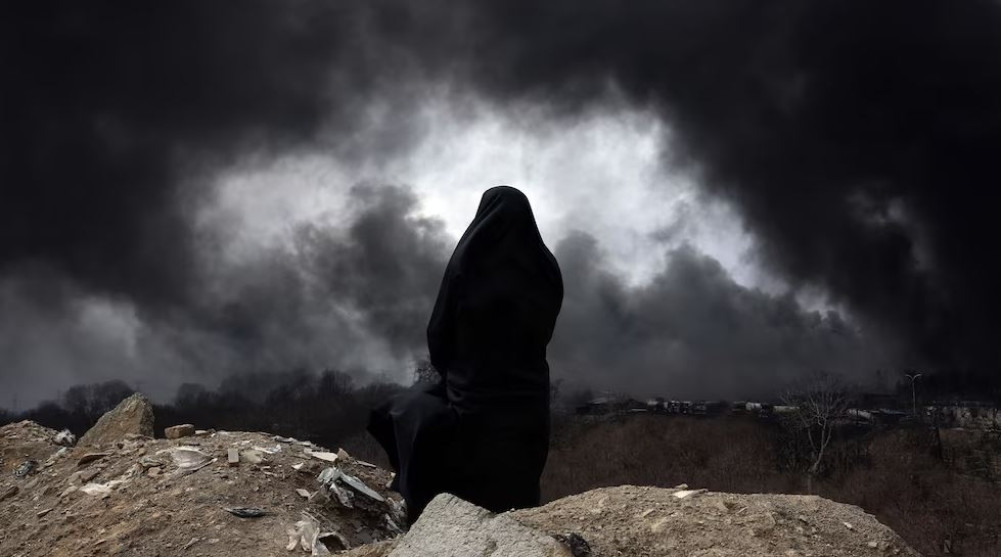
The US is continuously attacking Iran's oil depots and refineries.
We use Google Cloud Translation Services. Google requires we provide the following disclaimer relating to use of this service:
This service may contain translations powered by Google. Google disclaims all warranties related to the translations, expressed or implied, including any warranties of accuracy, reliability, and any implied warranties of merchantability, fitness for a particular purpose, and noninfringement.
Black smoke has spread to the atmosphere after US-Israeli airstrikes on Iranian oil infrastructure. Health experts have warned that it could have a serious impact on public health. Locals in Tehran reported that they were experiencing burning eyes and difficulty breathing in Iran last week. The US is continuously attacking oil depots and refineries here.
Such problems have also been seen in West Asian countries that Iran has attacked. Iran is firing drones and missiles at Gulf countries.
According to experts, toxic chemicals are removed from the atmosphere in a short time after rain. However, people exposed to such rain are at risk of immediate and long-term health problems.
What is black rain?
Dust, smoke and toxic chemicals combine in water droplets in the atmosphere. They then return to the earth as rain.
This situation is a problem when an oil refinery or storage facility catches fire. Wildfires, volcanic eruptions, or industrial pollution can also cause this. According to experts, in Iran, when hydrocarbons in fuel oil are not completely burned, invisible dust particles reach the atmosphere.
“Burning fuel also produces compounds called polycyclic aromatic hydrocarbons (PAHs) and toxic gases such as sulfur dioxide and nitrogen oxides. This causes acid rain,” said Peter Adams, a professor of civil and environmental engineering at Carnegie Mellon University in the US.
In most cases, fuel tanks burn out within a few hours. However, as seen in the Gulf War in Kuwait 25 years ago, fires can burn for months after an oil field explosion.
Tiny dust particles, 40 times smaller than a human hair, can penetrate deep into the lungs and enter the bloodstream. This causes respiratory and heart problems. It can lead to premature death. PAHs also increase the risk of cancer.
In Iran, the World Health Organization and the country's Department of Health and Environment have advised people to stay indoors and wear masks. They have warned that the rain is very toxic and can cause skin irritation and lung damage.
“These events can definitely cause serious health problems,” said V. Faye McNeil, a professor of chemical engineering at Columbia University in the US. “Regular air pollution can also worsen health problems and lead to hospitalizations. This is especially true for seniors, children and those with pre-existing health conditions,” said McNeil, who is also an expert in atmospheric chemistry. “But this is clearly high levels of pollution. That is why there are health problems.”
Iranians are concerned that polluted rain could also cause contamination in drinking water tanks.