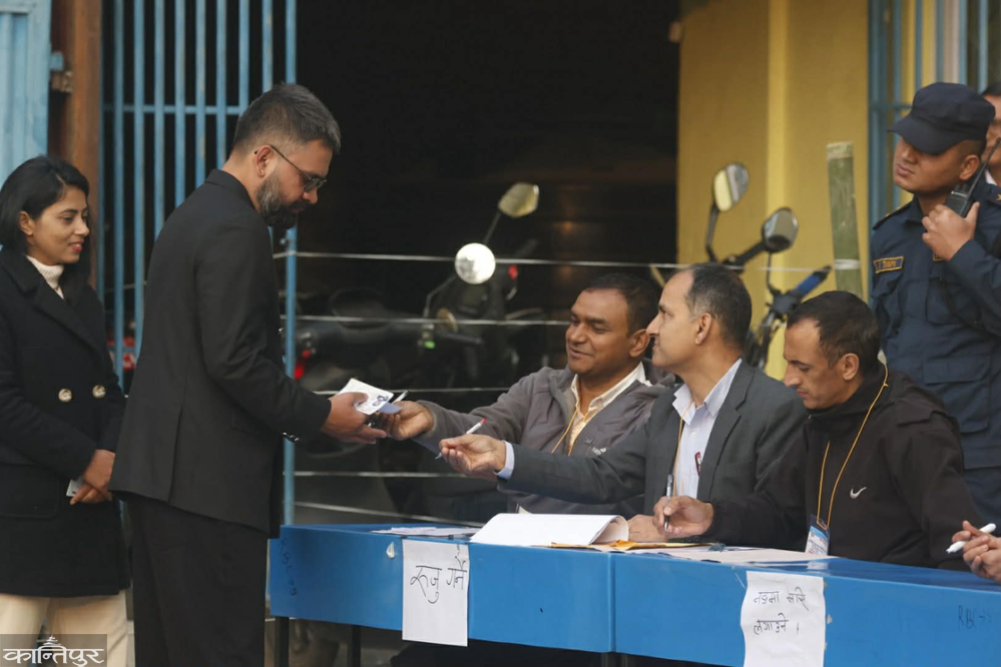
Most of the news published by international media about the election has discussed the popularity of Balen Shah, a senior leader of the National Independent Party and a contender for the post of Prime Minister.
We use Google Cloud Translation Services. Google requires we provide the following disclaimer relating to use of this service:
This service may contain translations powered by Google. Google disclaims all warranties related to the translations, expressed or implied, including any warranties of accuracy, reliability, and any implied warranties of merchantability, fitness for a particular purpose, and noninfringement.
Nepal has held its first election since the Genji movement, and preliminary vote counting has shown the rise of the National Independence Party. Most of the news published by international media about the election has discussed the popularity of Balen Shah, a senior leader of the National Independence Party and a contender for the post of prime minister.
The Associated Press (AP) reported that the election in Nepal was held peacefully. The AP reported that Shah emerged as an influential figure in the election.
Shah emphasized reforms in the health and education sectors during his election campaign, the AP reported. The AP analyzed that the post-election government will face the challenge of addressing the demands of the Genji movement, fighting corruption, and balancing relations with two powerful neighbors, India and China.
The British media outlet BBC has stated that corruption, economic hardship, and inequality have become the main issues in this election. This is why the BBC reported that 77 people died during the protests in Bhadau. The BBC news report mentions that the clash between Balen and former Prime Minister KP Sharma Oli in Jhapa-5 is in the spotlight. The BBC's analysis of the election results is as follows, 'If Balen wins, it will shake up Nepal's dysfunctional governance system.
Nepal has seen many coalition governments for more than three decades. These governments were mainly dominated by three parties. Two of them are communist,' the BBC wrote, 'Can the younger voters convince the rest of the people that a new, energetic generation will shape the country's future, or will the heavyweights who have been at the center of politics for decades continue to hold power? The election will test that.'
British media outlet The Guardian has published a news report titled 'Nepalese vote in a powerful youth campaign against the old'. 'There is a wave of young candidates in this election. They have pledged to improve Nepal's weak economy, challenge decades-old leaders and provide stability and security,' the news said.
Reuters has published a news story under the headline 'Voters seek change after youth leadership show'. It mentions that unemployment and corruption are rampant in the agricultural country of Nepal. UML, Congress and NCP have been at the center of Nepali politics for the last three decades, and there have been 32 changes of government in 35 years. 'However, the main contender in this election is the three-year-old Rastriya Swatantra Party (RSWP), which has put forward rapper-turned-politician Balen Shah as its candidate for prime minister,' the Reuters news said.
Bloomberg also published a news story under the headline 'Nepal's young rapper Balen Shah in battle with old leaders'. German media outlet DW has published a news story titled ‘Genji in the hope of real political reform’. But it also includes the fact that the number of Genji candidates in this election is very low. ‘Only about 5 percent of candidates from this age group (born between 1997 and 2012) are in the election,’ the news item reads, ‘Experts have pointed out that structural obstacles, a political culture that benefits the elderly and a view that youth lacks experience in leadership have created this situation.’ For the past few days, media outlets including Al Jazeera, Financial Times, CBC News, Times of India, and others have continuously analyzed Balen’s popularity among Nepal’s youth. During the silent period in Nepal,
American media outlets CNN , World Press Journal, and others have published news about Balen saying that he is a strong contender for the post of Prime Minister. Russian state-run RT has published an analysis of the ongoing silence, saying that Nepal’s old parties have faced a populist surge. “Some see this as an opportunity for the old parties to be sidelined. This is a possible outcome of the youth-led movement. Others argue that the protests are being orchestrated by foreign powers to weaken legitimate parties,” RT reported in a feature published on March 4.
The Telegraph UK reported that Balen had been writing to the poor on the banks of the river after becoming mayor of Kathmandu. “If he can abuse the metropolitan police like this, what will he do to the Nepal Police? Freedom of expression could be at stake,” Majid Ansari, a law student in Kathmandu, told The Telegraph. The Telegraph also spoke to political analyst Tula Narayan Sah.