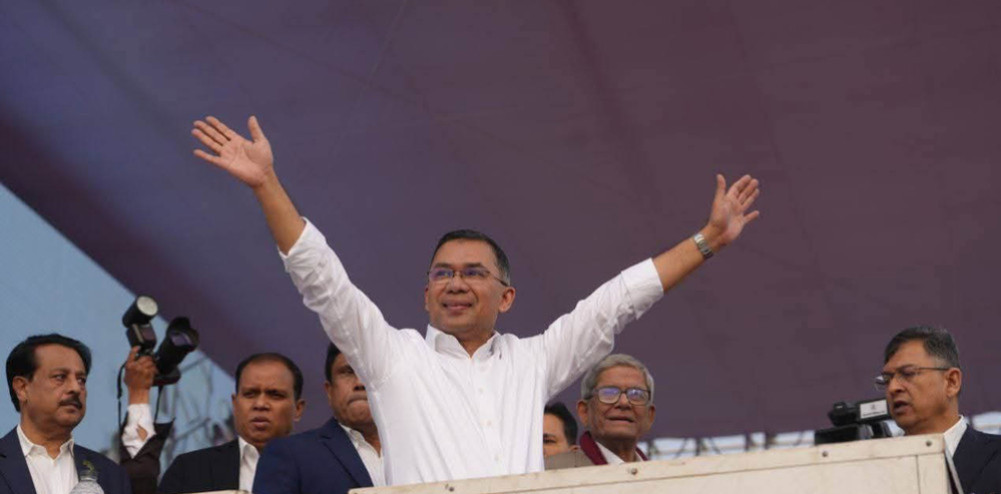
He has also said that the foreign policy will be decided keeping the interests of Bangladesh at the center. After the ouster of Sheikh Hasina's government, Bangladesh's relations with neighboring India have deteriorated somewhat. He faces the challenge of improving them.
We use Google Cloud Translation Services. Google requires we provide the following disclaimer relating to use of this service:
This service may contain translations powered by Google. Google disclaims all warranties related to the translations, expressed or implied, including any warranties of accuracy, reliability, and any implied warranties of merchantability, fitness for a particular purpose, and noninfringement.
Bangladesh National Party (BNP) Chairman Tariq Rahman has become the Prime Minister of Bangladesh. He was administered the oath of office and secrecy by President Mohammad Shahabuddin at the South Plaza of the Parliament Building in Dhaka.
Alongside, President Shahabuddin administered the oath to 25 ministers and 24 ministers of state in his cabinet on Tuesday.
He faces challenges including strengthening Bangladesh's economy, creating jobs, making democratic institutions that were divided during Hasina's tenure independent, ensuring security, and improving relations with foreigners.
During the election campaign, he had said that he would provide farmers with subsidies on fertilizers, seeds, pesticides, agricultural equipment, subsidized energy, and marketing of products. For this, he has put forward the concept of Kisan Card. Similarly, he has put forward the concept of 'Family Card' to provide food subsidies to families.
Supporting small and medium industries, creating 8 lakh jobs in the information technology sector, developing an international payment system, He has announced employment for marginalized communities, training and loans for workers who want to go abroad, and the establishment of ‘Skill Development and Career Centers’ in educational institutions.
He has also said that foreign policy will be decided keeping the interests of Bangladesh at the center. Bangladesh’s relations with neighboring India have deteriorated somewhat after the ouster of Sheikh Hasina’s government. He also has the responsibility to improve it.
Who is Rahman?
60-year-old Tariq is the son of former President Ziyur Rahman and Bangladesh’s first female Prime Minister Begum Khaleda Zia.
During Sheikh Hasina’s government, Tariq was convicted and sentenced to life imprisonment by the International Criminal Court (ICC) in Dhaka in a grenade attack case.
In 2004, 24 people were killed and more than 300 people, including Sheikh Hasina, were injured in the attack targeting Hasina’s public meeting. However, Tariq did not have to serve the sentence as he has been in London since 2008.
He had denied involvement in the incident, saying that he was being politically vendettaed. After the student movement of July-August 2024 ousted Sheikh Hasina, the Supreme Court in January 2025 found Tariq and Begum Khaleda Zia, including leaders, innocent in this case.
Tariq returned home after 17 years in December after the election was announced. Zia died soon after. He then became the party president. He was promoted as the future prime minister in the election.
Out of 300 direct seats, 299 were voted in in the election. Out of 297 seats, when the votes were counted, the BNP won 209 seats. Including allies, the BNP coalition has 212 seats. The election was postponed due to the death of a candidate in one seat.
Similarly, the court had ordered a halt to the counting of votes in two seats. 50 seats are reserved for women in Bangladesh's 350-member parliament. After the full results are in, women will be proportionally represented here based on the vote share received by the parties.
Maldives President Mohammed Mujibur Rahman, Bhutanese Prime Minister Tshering Togbe, Lok Sabha Speaker Om Birlo from Ratna, Foreign Minister Balananda Sharma from Nepal. Planning and Development Minister Asan Ekwa from Pakistan, Assistant Minister Seema Malhotra from the UK and other foreign guests attended Tariq's swearing-in ceremony.
Nobel Peace Prize winner Mohammad Yunus, who led the electoral government after Sheikh Hasina was ousted, held parliamentary elections and a referendum on February 12.
The referendum has ruled in favor of constitutional reforms. In the elections held last week, more than 60 percent of the votes were cast in the referendum and 59.44 percent in the parliamentary elections. Sheikh Hasina's Awami League was barred from participating in these elections.