On Friday, the US imposed sanctions on 14 ships carrying Iranian oil.
We use Google Cloud Translation Services. Google requires we provide the following disclaimer relating to use of this service:
This service may contain translations powered by Google. Google disclaims all warranties related to the translations, expressed or implied, including any warranties of accuracy, reliability, and any implied warranties of merchantability, fitness for a particular purpose, and noninfringement.
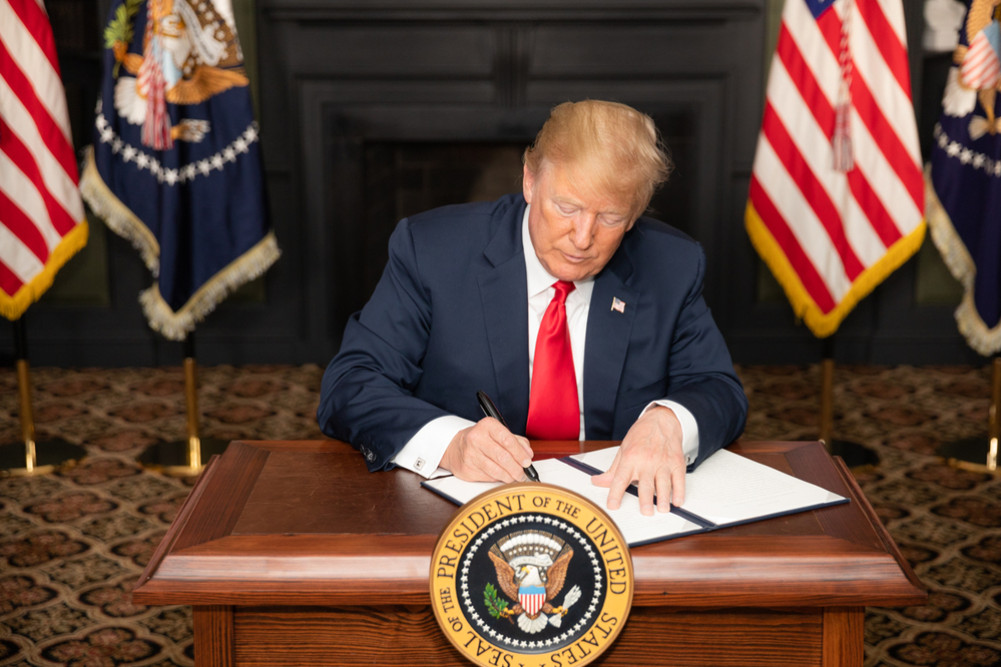
US President Donald Trump signed an executive order on Friday imposing tariffs of up to 25 percent on countries trading with Iran.
Trump has made this decision to combine the policy of talks and pressure. ‘Any goods or services coming to the United States from a country that directly or indirectly buys or sells any goods or services from Iran may be subject to such a fee,’ the order says. This will affect US trade with China. China is Iran’s largest trading partner and the largest buyer of Iranian oil.
Russia, Germany, Turkey and the UAE will also be affected by this decision. This decision has three main goals. The White House has stated that it aims to hold Iran accountable for its nuclear program and force it to end its support for terrorism. Washington also accuses Iran of undermining the security interests of the United States and its allies by causing ballistic missiles and regional instability.
On Friday, the US imposed sanctions on 14 ships carrying Iranian oil. ‘Instead of investing in the living standards of its people and repairing its dilapidated infrastructure, Iran is financing activities that are spreading instability around the world. "There is also increasing repression within Iran," US State Department deputy spokesman Tommy Pigou told CNN.
Talks positive
Iran and the US held indirect talks in Muscat, Oman, before Trump signed the executive order imposing tariffs. Trump said the talks were "very good." Iranian Foreign Minister Abbas Araghchi also said they were a "very good start." Speaking to Iranian television after the talks in Muscat, Oman, ended on Friday, Iranian Foreign Minister Araghchi said the US should continue to reduce mistrust.
Omani Foreign Minister Badr bin Hamad al-Busaidi met separately with Iranian and US officials in Muscat on Friday. He tried to mediate by conveying each side's messages. Iranian media reported that Araghchi presented his initial plan for managing the current crisis to al-Busaidi on Friday. Iran's top diplomat told Al Jazeera that the talks with the US were focused on Iran's nuclear program. US Middle East envoy Steve Witkoff and Trump's son-in-law Jared Kushner also met with al-Busaidi. Photos released by the state-run Oman News Agency showed US Central Command (CENTCOM) commander Admiral Brad Cooper also attending the meetings. The two countries held five rounds of nuclear talks before the 12-day Iran-Israel war in June. Omani mediators also met with US and Iranian delegations at that time.
However, after the war broke out, Washington attacked key Iranian nuclear facilities, and Iran responded by attacking a US air base in Qatar. All these activities have created a situation of lack of communication between the two countries. In October, Trump once again invited Iran to talks. Addressing the Israeli parliament, he said that the United States will talk if Iran is ready for talks.
This time, Iran is ready for talks with the deployment of its warships in the Middle East. Trump has also been continuously warning Iran along with his efforts for nuclear talks. ‘The situation will be very difficult if Iran does not compromise on its nuclear program,’ he said.
Talks stalled on uranium enrichment
All previous talks between Iran and the Trump administration have stalled on the issue of uranium enrichment. . The Trump administration has been demanding that Iran completely end its uranium enrichment activities. Iran is ready to limit uranium enrichment. But not ready to reduce it to zero.
Iran had expressed its desire to move forward in accordance with the 2015 nuclear deal. The agreement was signed in Vienna, Austria, by the United States, Britain, Russia, China, France, Germany, and Iran.
The agreement stipulated that Iran would limit its uranium enrichment to 3.67 percent and its stockpile to 300 kilograms. This level is sufficient for energy and medical purposes. But it is not enough to make weapons. Scientists say that uranium should be enriched to (80-90 percent) for weapons production.
In 2015, the International Atomic Energy Agency (IAEA) was monitoring the implementation of this agreement. For this, 24-hour cameras were installed at all of Iran's nuclear facilities. By signing the agreement, the powers agreed to give Iran easy and fair access to the international market in exchange for abandoning its ambition to build nuclear weapons.
However, in 2018, President Trump announced the US withdrawal from the agreement. The following year, Iran increased its uranium enrichment to 4.5 percent. Iran stopped providing information about its nuclear program by removing the cameras in 2023. It has since accelerated its nuclear program.
In the 5th round of talks in 2025, Iran said it was ready to return to the 2015 level (enrichment level of 3.67 percent). Similarly, the US demanded zero enrichment. However, the talks failed as the Iran-Israel war broke out.