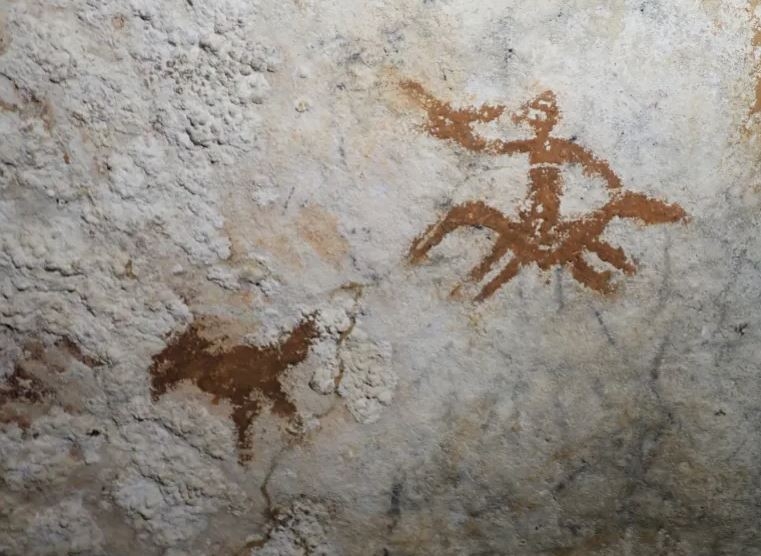
Adhi Agus Oktaviyana, an archaeologist at the Indonesian Research and Innovation Agency (BRIN), said that there is a painting on the cave wall of a man riding a horse with a chicken.
We use Google Cloud Translation Services. Google requires we provide the following disclaimer relating to use of this service:
This service may contain translations powered by Google. Google disclaims all warranties related to the translations, expressed or implied, including any warranties of accuracy, reliability, and any implied warranties of merchantability, fitness for a particular purpose, and noninfringement.
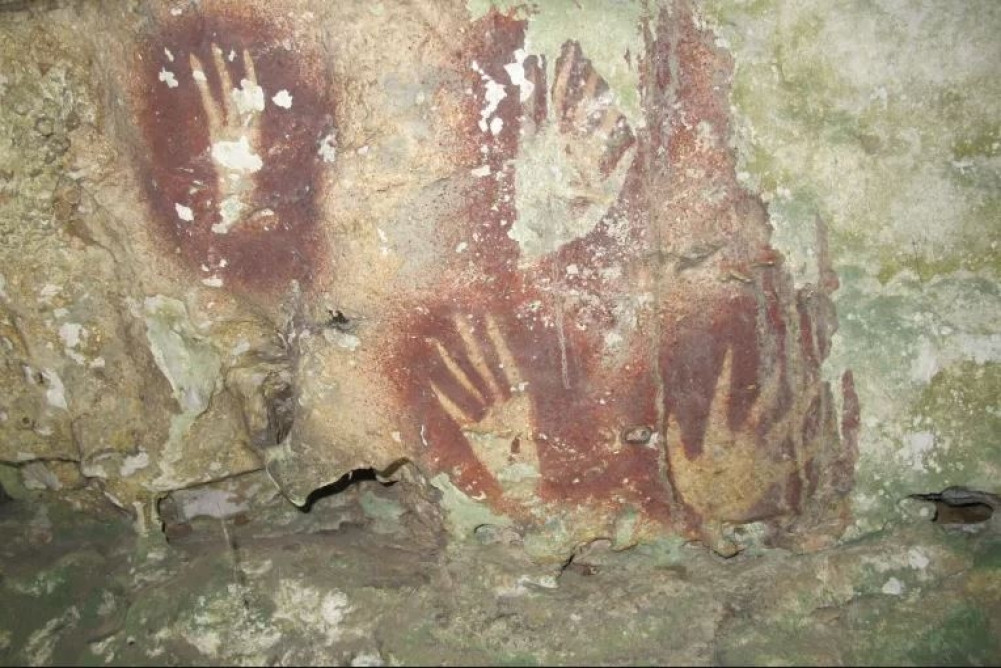
Archaeologists have said that hand stencils (handprints) found in limestone caves on Muna Island in Sulawesi province, Indonesia, may be around 67,800 years old.
These paintings are believed to be the oldest known paintings in the world .
According to Indonesian and Australian researchers, these paintings were made by placing hands on the cave walls and blowing paint around them (using the blowing method). The scientists said that these paintings are brown in color.
Adhi Agus Oktaviyana, an archaeologist at Indonesia's Research and Innovation Agency (BRIN), said that there is a picture of a man riding a horse with a chicken on the cave wall. At first, he said that it was difficult to prove that the figures were actually made by human handprints.
"But eventually we found some stains that looked like human fingers," he said. He has been involved in the search for such handprint paintings in the Muna Island area since 2015.
According to Maxime Obert, an archaeologist at Griffith University in Australia involved in the research, these handprint paintings are only found in the Sulawesi region.
His co-researcher Adam Broom said that there may be a deep meaning hidden in the hand shapes. “There is a deep cultural meaning hidden in this, but its concrete explanation is not yet clear,” he said.
To determine the minimum age of the paintings, scientists analyzed the uranium and thorium elements present in the mineral layers formed over time on the paint. This test, carried out using laser technology, is considered very accurate.
According to the researchers, the caves on Muna Island appear to have been used repeatedly for paintings over a long period of time.
Scientists have said that the current paintings are about 15,000 years older than the paintings found in this Sulawesi region in 2024. These cave paintings further strengthen the theory that human communities migrated through Sulawesi.
'It shows that our ancestors were not only excellent boatmen, they were also artists,' he said.
The culture of the indigenous communities in Australia is considered the oldest living culture in the world. Archaeological evidence shows that the traditions here are more than 60,000 years old.
A 50,000-year-old rock painting from a Murujugama site in northwestern Australia has been included in the World Heritage List.