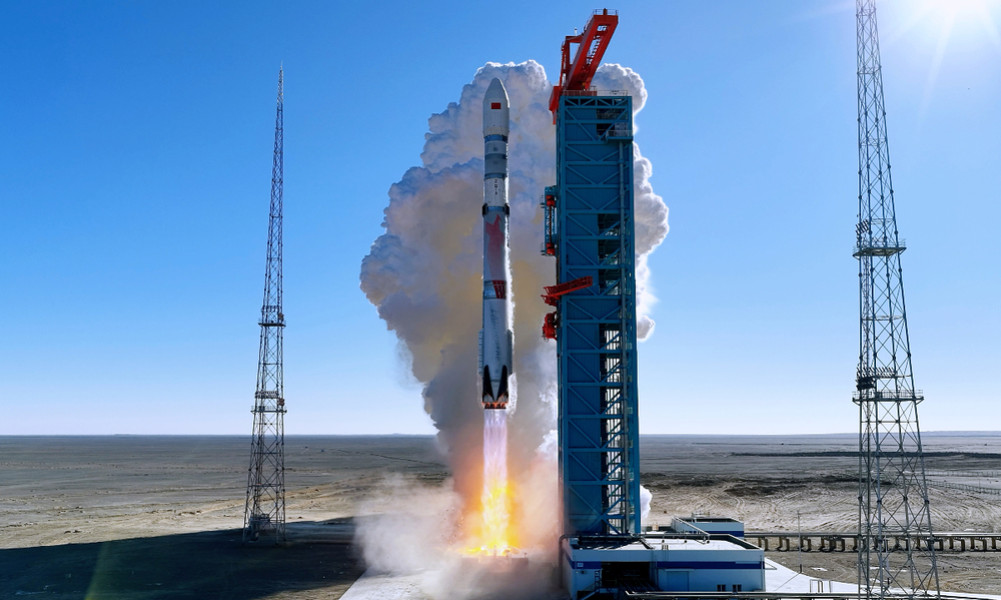
Previously, only the American company SpaceX had built reusable rockets, the Falcon-9 and Starship. Musk praised Landspace's Juke-3 rocket, saying it was more advanced than the Falcon-9.
We use Google Cloud Translation Services. Google requires we provide the following disclaimer relating to use of this service:
This service may contain translations powered by Google. Google disclaims all warranties related to the translations, expressed or implied, including any warranties of accuracy, reliability, and any implied warranties of merchantability, fitness for a particular purpose, and noninfringement.
Chinese rocket startup Landspace has been making headlines since it announced its reusable spacecraft. Landspace, which has been compared to American billionaire Elon Musk's space company SpaceX, launched a prototype of a reusable rocket called Juqie-3 in the first week of December. With this, the issue of China starting to build reusable rockets has been watched with great interest in the space sector.
Previously, only American companies, and especially Space X, had been building reusable rockets. Space X's advanced Falcon-9 and Starship rockets are reusable. Space X is considered a pioneer in building such rockets. The company successfully launched and landed the Falcon-9 on Earth for the first time in 2015. The same rocket was sent into space again in 2017 and brought back.
Before making rockets reusable, space agencies used 'expendable boosters'. Such boosters were either dumped into the ocean or floated in space after the space mission was completed. This meant that a new rocket had to be built for each flight, spending years and millions of dollars. This also increased the problem of 'space debris' or waste accumulating in space. Most companies in the world still use 'expendable boosters'. This means that there are an estimated 2,000 to 2,500 pieces of defunct rockets in low-Earth orbit. According to Reuters, in October, Musk praised Landspace's Jukye-3 rocket, saying it was more advanced than the Falcon 9. Landspace, which is currently undergoing testing, said that when fully developed, it could be reused at least 20 times and could carry several 18,000-kg satellites. Landspace, the most famous private space company in China, has built about two dozen rockets in a decade. Jukye-3 has been compared to China's Falcon 9.
Dong Kai, deputy chief designer of Jukye-3, said in a recent interview, "SpaceX's Falcon 9 has been proven to be a great design in terms of engineering. We are not trying to copy Falcon 9, but to learn something new." It is an honor for us to call ‘Jukye-3’ the Chinese Falcon-9.’ Even though the test launch was not successful, ‘Landspace’ is said to have moved forward in line with SpaceX’s ‘fail first’ policy by taking it for granted and even broadcasting it to the media.
In 2023, ‘Landspace’ built the world’s first methane-powered rocket called ‘Jukye-2’ and sent it into Earth’s orbit. Along with this, ‘Landspace’ is also being promoted as the ‘Methane King’. It is being analyzed that the Chinese government is helping the company establish itself as a competitor to SpaceX. Like SpaceX, ‘Landspace’ is about to enter the capital market to raise investment in future projects. SpaceX has made preparations for an IPO around 2026.
Just four days ago, according to the news ‘Reusability Takes Center Stage in China’s New Rocket IPO Rules’ published in China’s famous Caixin Global, rocket companies that want to be listed on the Shanghai Stock Exchange have released guidelines that require them to prove that their rockets are reusable. According to this, if a rocket startup company wants to issue an IPO, it must prove that it has launched a satellite into orbit at least once using a reusable rocket.
‘Even if a company does not make a profit, if it has advanced technology, it will be able to raise investment through the stock market,’ the news said, ‘China has opened up the financial path for its startups to become as powerful as Space-X, but for that, they must prove that their rockets are fast.’
‘Landspace’ is considered to be very important for Beijing’s plan to send 10,000 satellites into space in the next decade. China is trying to build its own large satellite network, such as the ‘Guoang Constellation’. It is said that it is pushing ‘Landspace’ to reduce American dominance in low-Earth orbit. There are other companies in China working in this field. Companies such as iSpace, Galactic Energy, Deep Blue Aerospace are working on small and early-stage space systems.
Building a reusable rocket requires extremely complex and high-energy. So far, only SpaceX has been able to work on it regularly, Eduardo Baptista and Joey Rowlett wrote in the news ‘China Landspace Fails to Compete Reusable Rocket Test’ in Reuters.
‘After the main body of the rocket separates, the booster must turn its course in space, rapidly descend through the hot atmosphere, and fire its engines just seconds before reaching the landing pad or water,’ they wrote. ‘When to fire and when to shut down the rocket’s engines is a matter of milliseconds.’ If the engine fires just 0.5 seconds too late, the rocket will crash to the ground and explode. Or, if it fires a little too early, the rocket will stop before touching the ground and fall back down to burn.
The speed and direction of the wind as the rocket descends are not always consistent. So computer software inside the rocket checks the rocket’s position thousands of times every second. If the rocket is tilted even slightly, the software immediately adjusts the direction of the engines to straighten the rocket. Amidst all this complexity, SpaceX is the only company to have fully and successfully used reusable rocket technology.
The company regularly lands and re-launches its Falcon 9 boosters. With more than a decade of experience and dozens of boosters flown 20 times, SpaceX has a monopoly in this field. According to Reuters, SpaceX also holds the record for the most rocket launches in the world.
(with the agency's help)