Market research firm Frost & Sullivan has estimated that China's AI chip sales will be around $54 billion in 2025 and reach $189 billion by 2029.
We use Google Cloud Translation Services. Google requires we provide the following disclaimer relating to use of this service:
This service may contain translations powered by Google. Google disclaims all warranties related to the translations, expressed or implied, including any warranties of accuracy, reliability, and any implied warranties of merchantability, fitness for a particular purpose, and noninfringement.
Over the past few months, Chinese artificial intelligence (AI) companies have been achieving record highs in the capital markets one after another.
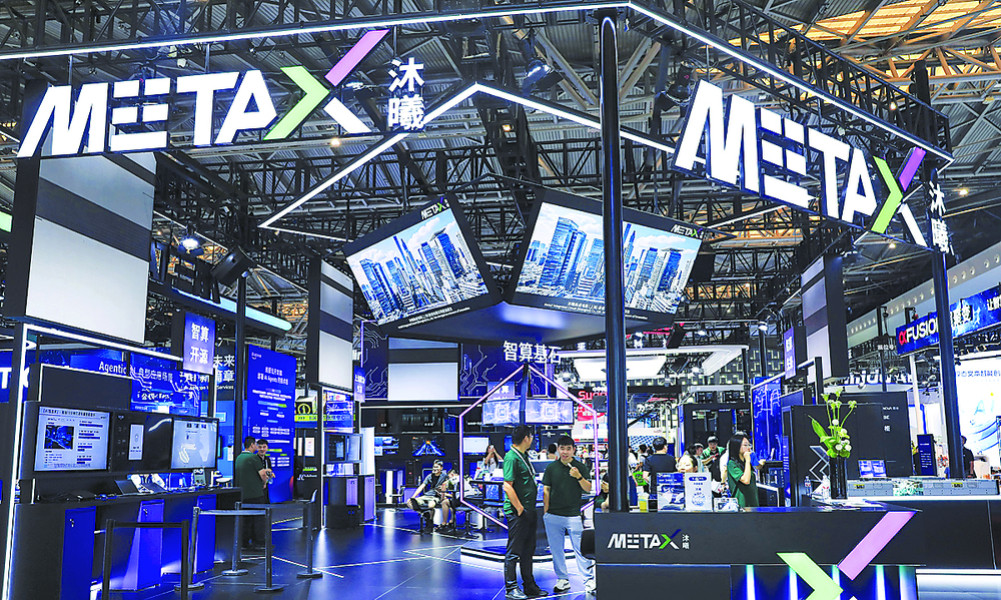
Chipmaker MetaX's impressive debut on the Shanghai Stock Exchange last week has sent the local AI sector into a tailspin. The company's shares jumped nearly 600 percent on the day of its IPO, trading at 700 yuan. MetaX raised about $600 million through the IPO. This shows growing investor interest in Chinese domestic companies in the AI hardware space.
Market research firm Frost & Sullivan has estimated that China's AI chip sales will be about $54 billion in 2025 and reach $189 billion by 2029. Not only MetaX, but many Chinese startups and technology companies have announced significant progress in the past few weeks. This indicates China's extensive efforts to develop alternatives to Western-made AI hardware. The share price of domestic GPU maker Moore Threads, which has been compared to Nvidia, rose more than 400 percent on its first trading day.
According to Reuters, the IPO has propelled Moore Threads' market valuation to 123 times its earnings in 2024. It is expected to grow by 242 percent to 1.5 billion yuan in 2025. Meanwhile, Biren Technology, known for its AI GPUs such as the BR100, is preparing to issue an IPO on the Hong Kong Stock Exchange. It aims to raise about $620 million, journalist Sheri Shin said in the Wall Street Journal. “Biren Technology, one of China’s four small powers in the graphics processing unit sector, is issuing 247.7 million shares,” she wrote, “and the attraction of AI companies on the Hong Kong stock market seems to have increased.”
Such a boom is not limited to startups but is also starting to be seen in large Chinese companies. Baidu’s AI chip unit Kunlunxin recently reached a market valuation of about $3 billion and has begun listing efforts. Alibaba, listed in Hong Kong and New York, has seen its share price rise this year by 80 percent, the most in the last four years. The company has announced plans to invest $53 billion in AI infrastructure and AI-general intelligence or human-level intelligence over the next three years.
Analysts say the recent progress of these Chinese AI-chip companies is also linked to the instability seen in the global AI hardware supply chain. American company Nvidia, which has long dominated the AI GPU market, has been under pressure due to US government export controls. US President Donald Trump recently allowed the export of Nvidia’s H200 chip, saying that restricting the export of American companies’ chips to China would make local chipmakers stronger.
According to Euronews, in April, the US tightened restrictions on advanced chip exports to China, which cost Nvidia $5.5 billion in losses when it could not sell H20 chips. Nvidia CEO Jensen Huang called such export restrictions a “failed” strategy. “This move has given local companies the energy and confidence to move forward more quickly,” he told Fortune Magazine. According to the Wall Street Journal’s Rory Johns and Trancy Chu, US investors are pouring money into Chinese AI companies even as competition between Beijing and Washington in AI technology continues to grow.
According to The Guardian, Nvidia’s share of China’s AI chip market was about 95 percent when the US ban began in 2021. This has now fallen to about 50 percent. Chinese domestic companies are racing to take advantage of the opportunities created by export controls. Meanwhile, some large companies in the US are also trying to challenge Nvidia’s dominance from 2025. However, due to Nvidia’s size and influence on a global scale, they have not been able to significantly confront it.
In China, AI startups are expanding rapidly due to policy support at the government level and investor enthusiasm. In the latest IPO environment, MetaX, Moor Threads, Biren Technology and Kunlunxin have attracted significant investor interest in a short period of time. According to Reuters reports, this momentum seems to be driven by the government's strategy to reduce dependence on foreign technology and the commercial potential of China's huge AI market. The rapid growth of demand for AI hardware around the world has put significant pressure on production capacity and supply. According to AI industry estimates, global demand for advanced chips is expected to grow by more than 9 percent in 2026 to about $126 billion. According to Reuters, China is expected to lead the expansion of new production capacity. Since 2020, the United States has been trying to control advanced semiconductor chips and related technology and investment in China, citing reasons such as the use of AI chips in military equipment and the risk to national security. Although the Trump administration has recently shown interest in allowing the sale of American advanced chips to China, China itself has been reluctant to rely on Nvidia at the same level as before. The growing demand for technological self-reliance within China and the growing appetite for AI hardware globally have brought the sector to a critical juncture.