In 2025, national elections were held in 65 countries. In which about 3.7 billion people around the world voted. It is a rare event that almost half of the world's population voted in elections in so many countries in one year. This participation proves that periodic elections are indispensable for the survival of democracy. For a long time in history, only a limited number of religious leaders, aristocrats, and landowners had the right to determine the policies and rules of the state. Revolutions and struggles of various times have reversed this situation and made the intervention of ordinary citizens in politics meaningful. Since the 1970s and 1980s, many countries around the world have made the right to vote a universal right. In most countries, everyone who has reached the age of majority has the right to vote.
We use Google Cloud Translation Services. Google requires we provide the following disclaimer relating to use of this service:
This service may contain translations powered by Google. Google disclaims all warranties related to the translations, expressed or implied, including any warranties of accuracy, reliability, and any implied warranties of merchantability, fitness for a particular purpose, and noninfringement.
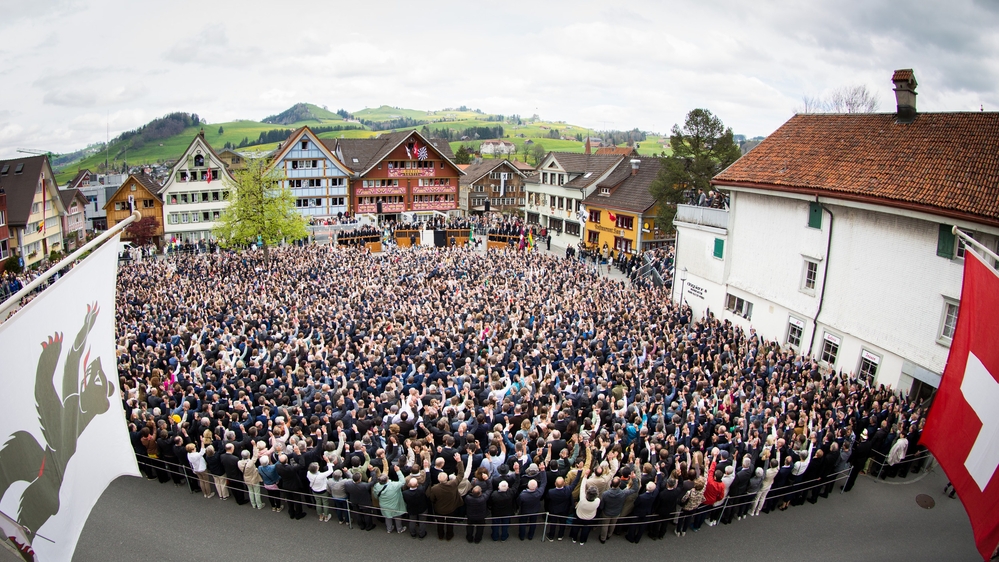
Of Switzerland's 26 autonomous cantons, Galar and Appenzell Innerrhoden are known for their open voting process. Here, adults gather annually in the square and elect the budget, policies and leadership of the cantonal government.
Anyone present can declare their candidacy for local government . Those who want to agree to it raise their hands . This open meeting approves the leadership, budget and policy for each year .
According to the 2024 census, the population of Galar is around 42,000 and that of Appenzell is around 16,700 .
The practice practiced by these two cantons is called Landsgemeinde in German. Land means country and Gemeinde means community, assembly or town . This practice has been going on since the 1300s . Although the rest of the cantons have switched to secret ballots in modern times, this vibrant tradition in these two cantons has preserved the centuries-old history of elections for future generations to experience . The history of elections dates back to ancient times . And, Different historians have discussed different electoral practices in different parts of the world .
Ancient period
Although ancient global civilizations (Mesopotamia, Egypt, MesaAmerica, China, India) were mostly hereditary, historians have pointed out that some city-states within them had a republican system .
There were some republics in Mesopotamia, MesaAmerica (Mayan and Aztec) and ancient India . Where, the people could vote on the selection of leadership and on advisory committees . Usually, such rights were enjoyed only by the elite class . On the other hand, in the indigenous communities here, it was also common for all the villages to gather to elect the chief.
Historians say that republics like Vaishali in ancient India provided all adult male members with the right to vote to elect their lords. The book ‘How India Votes: Election Law, Practice and Procedure’ written by VS Rama Devi (former Election Commissioner of India) and SK Mendiratta mentions that at that time, multi-coloured symbols like arrows were used for voting.
‘The republics lost their sovereignty after being absorbed into the empire. Despite this, the management of daily work in local communities survived for a long time through popular assemblies,’ the book says.
In ancient China, hereditary succession was considered the basis for governance. But intellectuals were consulted in law-making and administrative matters.
In ancient Greece, the constitution of Sparta had determined the governance and military system. This was There is a myth written by Lygurgus. According to historians, at this time, the citizens of society were divided into three classes: military citizens, civilian citizens, and slaves. Among these, slaves had no rights and no matter how much they abused them, the owner did not apply the law.
In ancient Rome, in the sixth century BC, the aristocrats developed a unique democracy by abolishing the monarchy. Where, the Senate was arranged for policy-making.
The senators elected by the votes of the aristocrats would select two consuls here and the government would be run on the mutual advice of the two consuls. If their votes differed, the Senate would vote again. The practice of secret voting used in the world today also started in Rome.
In Athens, Greece, in the sixth century BC In 574, Solon introduced a new constitution, which gave members of the upper class the right to vote.
Athenians could also vote on issues such as making war and electing generals. Socrates, who was born in the third century BC, believed that such nominal elections could not bring about change in society.
He opposed democracy, saying that it brought unfit people to power. In the Apology and other dialogues with Plato, he argued that justice and knowledge were more important than popular opinion. Socrates' disciple Plato compiled these dialogues into a book.
Plato also gave the form of his own theory. Among them, the Statesman, the Republic, etc. are important. He believed that people are unfit to govern themselves because they display their will, emotions, and behavior.
In the society of Athens at that time, the punishment given to criminals was also determined by the vote of the common people. The decision to execute Socrates was also approved by the vote of the people of Athens. This left many of his disciples, including Plato, deranged.
After this incident, Plato, who had spent a long time in various regions, returned to Athens in the latter part of his life and succeeded in opening the first institutional formal school in the Western world, the 'Academy'.
In his book, Plato has called democracy a weak system. In this book, he has pointed out the danger that leaders can sabotage popular opinion and impose a dictatorial regime. But some historians argue that Plato, deranged by the decision to execute Socrates, opposed every decision made by the Athenian society.
Plato envisioned the ‘philosopher king’ in the book Republic. Where, it is mentioned that an intellectual king with wisdom and compassion will rule by rejecting the tendency to kill power under the guise of hereditary succession and power. In it, he envisioned women’s rights and a communist society. Over time, this was rejected by his disciple Aristotle.
Aristotle argued that citizens should fulfill certain responsibilities. He argued that the right to vote should be limited and given only to those whom the state considers worthy. He argued that democracy should be balanced through laws and institutions.
He believed that a better and more practical system could be developed by combining democracy and aristocracy. ‘Some people do not have the logical capacity to govern themselves completely. It is better for such people to be governed by others,’ he said. His relevance in the modern era has also decreased due to his advocacy of aristocracy and slavery.
Different ideas about elections came to the fore in Athens at different times. At one time, leadership was also selected through a lucky draw as the ruling class became more powerful and the electoral process became corrupt.
Political representation in the Middle Ages
The waning Roman Empire had already collapsed by 476. Many feudal states came into existence in Europe. Political participation declined with the decline of emperors. Power began to be vested in kings, landlords, and the church.
At this time, the expansion of the state was the priority of the monarchs rather than giving rights to the people. The Icelandic parliament, Althing, established in 930, is considered the oldest parliament in the world. Iceland, which was an independent state, had many districts.
The chiefs from each district gathered once a year in the Althing. Where the work of making laws, interpreting them, and resolving disputes was done.
In 1215, the English feudal lords captured King John and forced him to sign the Magna Carta treaty. This treaty limited royal power. Similarly, a system was made for decisions to be made by a common assembly on matters of taxation and law. This laid the foundation for a constitutional monarchy with a parliamentary system for the future. However, the kings repeatedly violated the treaty, and in 1649 the people of England overthrew the monarchy.
King Charles was hanged at this time. 11 years later, his son Charles II was restored to the throne. Even then, the conflict between the king and parliament did not end. As a result, in 1689, King James II was overthrown and the ‘Bill of Rights’ was passed, completing the Glorious Revolution. Which developed a parliamentary system with a constitutional monarchy.
In Europe, until the 18th century, the state treated citizens based on their social and economic status. A vivid example of this can be taken from the elections in France before the Revolution. Where, of the three houses, the clergy were represented in the first house, the nobility in the second house, and the common people in the third house.
In a country where almost 97 percent of the population was peasants and common people, it was natural for the third house to have more representatives. However, each house was given one vote each. The king usually brought the plan to the house after consulting the clergy and nobility, and even if the third house was in opposition, he would decide by a 2: 1 score. The situation was almost the same in other countries in Europe.
The French Revolution reversed this situation and gave everyone equal rights. After the revolution was successful in 1789, the voting power was determined based on number, i.e. representation, rather than status. This revolution, which believed that all people are equal by birth, brought state power from the hands of the nobility to the hands of the middle class. Slavery ended in 1794.
But the failure seen in the management of the revolution and the rise of Napoleon as a dictator did not allow the revolution to be fulfilled. As a result, even after such great upheaval, the right to vote for women and the backward classes of society could not be ensured.
Modern suffrage
In the modern era, only a fair election is called a situation where citizens who have reached a certain age can exercise their discretion without fear.
People of all genders, races, religions, and social statuses of adult age can vote. Elections are held at certain times according to legal criteria and representatives are selected. Voting is usually secret. Although various methods such as direct election, indirect election, proportional representation, majority system and so on have been used, the main feature of elections is the respect for public opinion.
In the last three centuries, many experiments have been carried out in the world to make the electoral system participatory and effective.
After the abolition of slavery in 1865, the United States introduced the 15th Amendment to the Constitution five years later, allowing African-Americans (former slaves) to vote. However, this law was not implemented in many states until the 20th century.
In 1893, New Zealand women first voted in a national election. Australia did not give women such a right until 1902, Britain in 1918, and the United States in 1920. In 1948, the Universal Declaration of Human Rights declared that all adults have the right to participate in government. Third world countries also began to grant women the right to vote. In 1969, Britain lowered the voting age from 21 to 18. A year later, the United States followed suit, and many other countries followed suit. In the 1970s and 1980s, many countries in Asia, Africa, and Latin America reformed their electoral processes and gave everyone the right to vote. Today, elections are considered the lifeblood of democracy. But practices such as fraud, the influence of money and power, and the abuse of state power pose serious challenges to the fairness of the voting process and the overall democratic structure. Critics of the parliamentary electoral system have long accused it of being too reformist but incapable of structural transformation. In recent years, the rapid use of social media and artificial intelligence has made the electoral process more complex and controversial. Despite all its shortcomings, The ability to face questions, admit mistakes, and the process of discovery and improvement are the hallmarks of true democracy.

