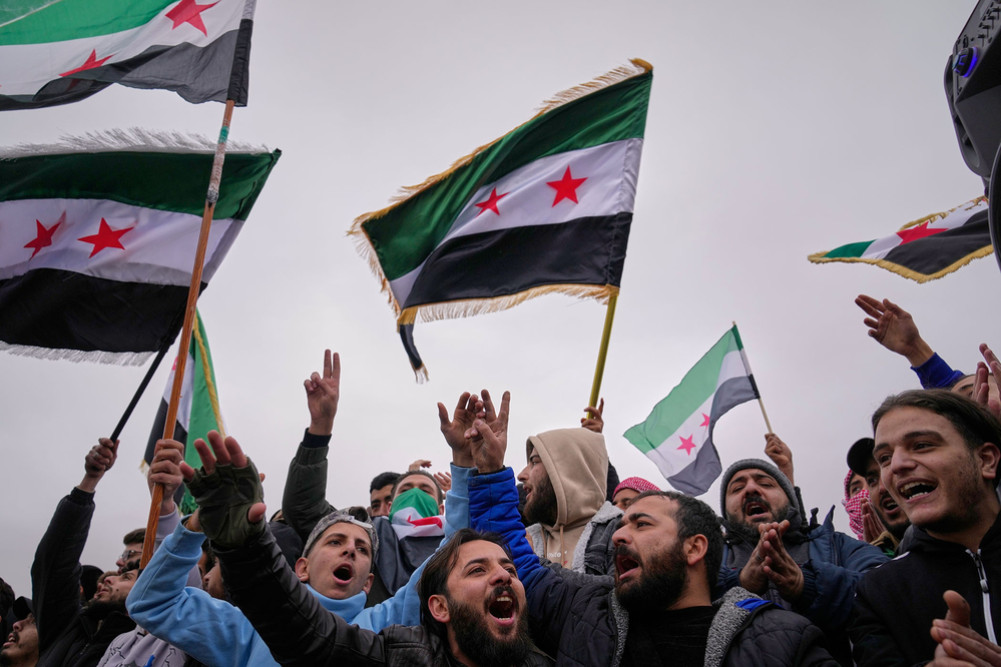
A large crowd gathered in Damascus to celebrate the one-year anniversary of the coup, waving national flags. There has been no loss of life here from helicopter bombs for the past year. Living without fear is a celebration in itself.
We use Google Cloud Translation Services. Google requires we provide the following disclaimer relating to use of this service:
This service may contain translations powered by Google. Google disclaims all warranties related to the translations, expressed or implied, including any warranties of accuracy, reliability, and any implied warranties of merchantability, fitness for a particular purpose, and noninfringement.
Exactly one year ago, on December 8, 2024, rebels marched towards Damascus. Ahmed al-Sara, of the Hayat Tahrir al-Sham (HTS) group, led the crowd.
The national army had no power to stop them. The army had been on the defensive since the HTS rebels launched a decisive movement from their base in Idlib on November 27.
In Aleppo at the end of November, the Assad regime had unsuccessfully tried to weaken the rebels by closing the airport and main roads and launching a search operation. However, as the people turned out in protest, the regime's days began to count.
Finally, the rebels reached Damascus via Homs and waved the flag of victory. 'The evil Assad has been overthrown,' the rebels declared. The angry crowd was asking: 'Where is Assad??' The Russian news agency answered that in a few moments. 'Bashar al-Assad and his family have arrived safely in Russia.' The Russian government had decided to grant him asylum.'
The crowd burned Assad's effigy. They tore down statues in his name and burned down some places. In a fit of anger, on December 10, the rebels set fire to the tomb of Assad's father and former president Hafez al-Assad.
Bashar al-Assad was not an ordinary president, he was the successor to Hafez al-Assad, who had ruled Syria for three decades. He was the leader of the Arab Socialist Ba'ath Party - the legacy of Syria and the Assad family's 53-year history of power. Military coup and the rise of Hafez?
The Ba'ath Party came to power in 1963 through a military coup. The plan was hatched by officers who were secretly supporting the Ba'ath Party while serving in the military (also known as the Ba'ath Party's military committee). Bashar's father, Hafez, was one of the planners. Immediately after the coup, the Ba'ath Party made him head of the Syrian Air Force.
A power struggle had already begun in the party. Meanwhile, extremists led by Salah Jadid staged another coup in 1966 and overthrew Prime Minister and Army Chief Amin al-Hafiz. Hafez remained neutral at this time. He staged another military coup four years later. And then, he himself became president.
He appointed his loyalists and relatives to key state bodies. He brutally suppressed opponents. Now the 'Ba'ath socialist system' had been transformed into the Assad regime. The judiciary and all state institutions were made puppets.
Hafez, who was at the helm of the Soviet Union during the Cold War, had invested the money he earned by selling oil in Eastern Europe in the country's industrial development. Hafez increased investment in nationalized industries and accelerated infrastructure construction in 1963.
By the 1980s, Syria's economy was improving. The direct impact of this was beginning to be felt in people's daily lives. However, political freedom was limited. Protests were held in various places in protest.
The largest uprising in 1982 was in the city of Hama, near the capital. The army killed between 10,000 and 40,000 people in the process of taking control. The army bombed the city. The goal of this repression was to silence dissent across the country.
Hafez ruled for the rest of his life through fear, intimidation, and violence. Despite its oil wealth, Syria never became as wealthy as other Gulf states. However, the economy remained stable in the 1990s and 2000s.
Five elections were held during Hafez's tenure. All of them were shams. He was the only candidate as opposition parties were barred from contesting elections due to various cumbersome provisions.
The rise of Bashar
After Hafez's death in 2000, the Syrian government passed into the hands of his son Bashar. An unexpected turn of events created this situation. Hafez had appointed his eldest son Basil as his successor and had been involved in politics for a long time. His younger son, Bashar, who was studying ophthalmology in London, aimed to return to his country and serve the poor.
However, Basil died in a car accident in Damascus in 1996. Hafez then recalled Bashar from London and introduced him to politics.
Bashar was the only candidate in the presidential elections of 2000 and 2007. However, Syria could not remain untouched by the emergence of the largest revolution in the Arab world in the 20th century at the end of 2010. This revolution changed the regime in Egypt, Tunisia, Libya and Yemen.
Bashar al-Assad did not want to be removed from the power inherited from his father. He repressed the revolution. Western countries have even accused his government of using chemical weapons on the rebels. With this repression, the government and the people became enemies of each other.
By 2014, the Islamic fundamentalist organization (ISIS) had captured about 40 percent of Syrian territory. Similarly, the Kurdish forces had captured 10 percent and other rebels had captured 15 percent of the territory. The United States initially supported various rebels there to fight ISIS. Although they were given the name ISIS, they were also challenging the Assad regime. Similarly, the United States also carried out airstrikes. Turkey, Britain and other NATO member countries also participated in this.
Seeing that all these activities would weaken Assad's regime, Russia also launched airstrikes here in 2014. It also sent military equipment and weapons to protect Assad's regime. Thus, Syria suddenly became a place to demonstrate the power of the international power center. Here, every country tried to bake its own bread. The price of every bullet The Syrian people had to pay.
Millions were killed, millions were injured. Tens of millions fled their homes. The number of people seeking asylum in Europe through illegal routes increased. As the statelessness increased, drug traffickers from North Africa and other Arab countries began to use Syrian territory as a transit point. Here, they were active in storing drugs and supplying them to Europe. The United States and European countries even accused President Assad of protecting the traffickers.
Human traffickers began to smuggle people into Europe through illegal routes using Syrian shores. The increase in the number of migrants affected European politics. Populists such as Sebastian Cruz in Austria, Viktor Orbán in Hungary, Matteo Salvini in Italy, and Marine Le Pen in France, all served their political interests by raising the slogan of 'nationalism' against immigration.
How many people have been killed in this horrific war that has shocked the international community? The answer is different for everyone. According to the United Nations, more than 300,000 civilians have been killed in the 10 years since 2011. According to the United Nations, 83 people, including 18 children, were killed daily during the war.
This does not include the number of people killed as a result of the war (indirect deaths) and the number of rebel and government soldiers. Studies by various organizations have put the death toll at more than 650,000, including soldiers and rebels.
The Syrian Network for Human Rights has reported that more than 100,000 people have disappeared since March 2011. People whose families have not received any information or news for more than a month are on the network's list of missing people. After killing civilians, the Assad regime dug mass graves to hide their bodies.
According to the International Commission on Missing Persons (ICMP), there are at least 71 such graves
identified
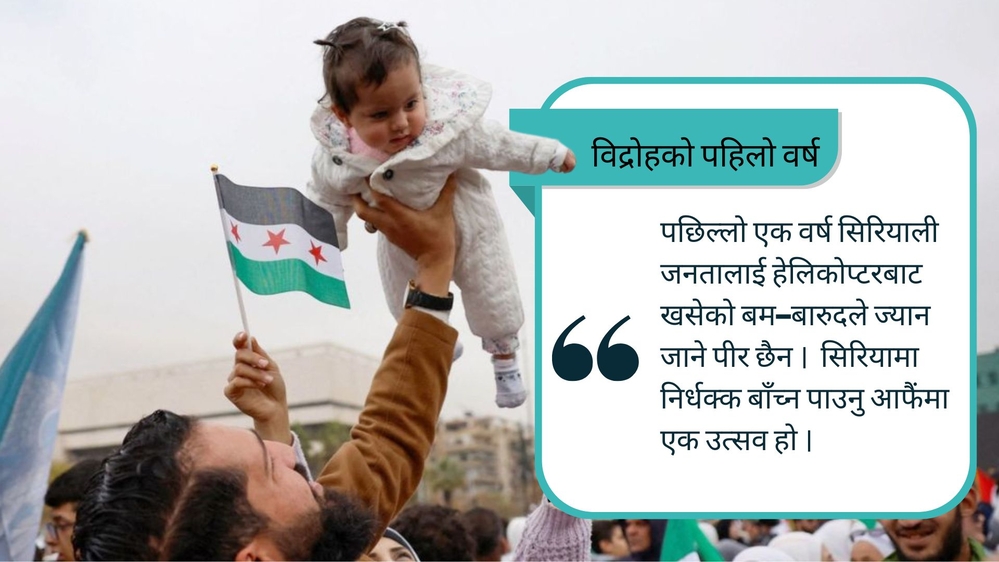
in Syria. Researchers initially estimated that at least 100,000 bodies were buried in a cemetery in Al-Qutefah, 37 kilometers north of Damascus. Human rights activists say that government agencies secretly bury those who were killed by extreme torture. December 8, 2025 (First year of the coup) Something is constantly exploding in the sky over the Syrian capital Damascus. Ordinary people have set off firecrackers to mark the first anniversary of the fall of Assad's regime. They have come to celebrate carrying national flags. In the past year, they have not been killed by bombs dropped from helicopters. There is no longer any concern about Russian airstrikes on health facilities. In Syria Living without fear is a celebration in itself.
President Ahmed al-Sarrah said at a program organized at the Umayyad Mosque in Damascus that a strong and just Syria will be built by including everyone. He said that everyone's cooperation is needed to take the country that has been destroyed into the process of reconstruction.
However, the United Nations Security Council has stated that clashes between various parties in Syria are continuing. Especially families close to the former Assad regime are being targeted with various accusations. It is not possible to predict that the wounds of the 14-year-long civil war will end all at once. The Kurdish and Druze minorities are still in rebellion. The challenge facing the current Syrian government is to manage this situation and move forward.
To prevent such a situation, the transitional justice process must be concluded fairly and all parties involved in serious crimes during the civil war must be brought to justice, experts say. Last May, the government decided to establish two separate independent commissions to investigate the disappearances and crimes committed during the civil war. Although the search for the disappeared has accelerated, the investigation of crimes is lagging, according to the analysis of the independent monitoring organization ‘Syria Justice and Accountability Center’ in Washington. The organization believes that the commission has not been able to conduct independent investigations into crimes due to the lack of sufficient support from the central government.
Groups such as Human Rights Watch (HRW) have also questioned the impartiality of the proceedings of the Syrian National Transitional Judicial Commission.
Although the commission has exposed crimes committed by the Assad government, HRW has accused the HTS (the current ruling party) and its allies of ignoring crimes committed during the civil war.
Syria held parliamentary elections this year. They were relatively fair. However, direct There was no . There was an arrangement to select MPs through the electoral college . On the other hand, President Al-Sarrah is also set to remain in office on an interim basis until a new constitution is drafted .
A national-level debate and dialogue are currently underway to draft a new constitution
. However, not all communities in the country are happy with the interim government . President Al-Sarrah is being criticized for concentrating power and showing signs of becoming a dictator .
Foreign policy
The biggest change has been seen in foreign policy . In the international world, Syria is not as alone as it was before (like during the Assad era). Arab countries and Western countries have also said that they will support the reconstruction of Syria .
Embassies that were closed at one time are opening up . President Al-Sarrah and many other leaders are appearing on the world stage to raise Syria's problems . While they have ties to Al-Qaeda, international powers have Many leaders were listed as terrorists. The US had put a $10 million bounty on al-Sarrah's head. On June 28, 2016, al-Sarrah publicly declared that he had no ties to al-Qaeda. Eight years later, he became president after leading a successful uprising in Syria and has now established a powerful presence on global forums. He addressed the UN General Assembly last month, becoming the first Syrian leader since 1946 to visit the White House. Syrian officials have met with all five permanent members of the UN Security Council, including Russia and China. This also shows that Syrian foreign policy is becoming more pragmatic. Russia was Assad's ally in the past and may have targeted al-Sarrah and his political allies. But mature diplomacy puts the future agenda ahead of the past. People say his past is bad. छ । हामी सबैको विगत खराब हुन्छ । र, विगत खराब नभई मौका आउँदैन,’ अमेरिकी राष्ट्रपति डोनाल्ड ट्रम्पले सारासँग ह्वाइटहाउसमा भेट गरेपछि भनेका थिए, ‘हामी सिरिया सफल देश भएको हेर्न चाहन्छौं । र, यसको नेतृत्व गर्न उनी सक्षम छन् । उनी निकै बलिया छन् ।’ अहिले सिरियाको सबैभन्दा ठूलो चिन्ता, आफ्नो सीमा क्षेत्रमा इजरायली सेनाको बढ्दो घुसपैठ हो । ‘इजरायली सेनाको अपरेशनले सर्वसाधारणलाई खतरामा पारेको छ । क्षेत्रीय तनाव बढाएको छ । सिरियाको विभाजित सुरक्षा अवस्थालाई नजरअन्दाज गरेको छ र राजनीतिक संक्रमणमा चुनौती थपिदिएको छ,’ सिरियाका लागि संयुक्त राष्ट्र संघका विशेष उपदूत नाजाद रोच्दीले गत नोभेम्बरमा भनेका थिए । आर्म्ड कन्फ्लिक्ट लोकेशन एन्ड इभेन्ट डाटा ( एसिएलइडी) का अनुसार प
छिल्लो एक वर्षमा इजरायल
ले सिरियाका विभिन्न क्षेत्रमा ६ सयपटक हवाई हमला वा ड्रोन आक्रमण गरिसकेको छ ।
पारिवारीक पुनर्मिलन
युद्धका देश छाडेर हिंडेकाहरु फर्कदैंछन् । पछिल्लो आँकडाअनुसार विदेशिएका १० लाख र आन्तरिक रुपमा बिस्थापित भएका १९ लाख गरेर २९ लाख मानिस थालथलो फर्किएका छन् । तर, गाउँमा बिजु्ली, पानी, पूर्वाधार सबैतिर क्षति पुगिसकेको छ । भग्नावशेषमाझ नयाँ जीवन सिर्जना गर्नुपर्ने चुनौती उनीहरुलाई छ ।
१४ वर्षे लामो युद्धका घाउ बाँकी नै छन् । भत्किएका स्कुल र अस्पताल बनेका छैनन् । इन्टरनेशनल रेस्क्यु कमिटीले गत नोभेम्बरमा सार्वजनिक गरेको एक रिपोर्टअनुसार आधाभन्दा धेरै पानी आपुर्ति सञ्जाल काम नलाग्ने अवस्थामा छ । ८० प्रतिशत विद्युत ग्रिड या त काम गर्नसक्ने
अवस्थामा छैनन् वा ध्वस्त छन् ।
बेपत्ता परिवारका सदस्यहरु आफ्ना आफन्त जीवित रहेको वा मृत भएको निक्र्यौल गर्न चाहन्छन् । घाइतेलाई उपचारको खाँचो छ ।
सिरियामा पुनर्निर्माणका लागि २ सय ५० खर्बदेखि ४ सय खर्ब अमेरिकी डलर वा त्यसभन्दा पनि बढी खर्च हुनसक्ने अनुमान लगाइएको छ ।
सुस्त नै भएपनि सुधारका केही काम भएका छन् । अमेरिकी संस्था मर्सी कप्र्सका अनुसार विद्युत उत्पादनमा सुधार भइरहेको छ ।
गत नोभेम्बरमा सिरियाली न्युज एजेन्सी सानाले ८ सय २३ वटा स्कुलहरु पुनर्निर्माण गरिएको जनाएको थियो । त्यस्तै, ८ सय ३८ वटा विद्यालय पुनर्निर्माणको काम चलिरहेको छ । रोजगारीको अभाव घर फर्किएका धेरैले रोजगारी पाएका छैनन् । गृहयुद्धले अर्थतन्त्र थला परेको थियो । आज झन्डै एक चौथाई सिरियालीहरु अति गरिबीमा बाँच्छन् । यी सारा निराशाका बाबजुद २०२५ मा सिरियाली अर्थतन्त्र १ प्रतिशतले बढ्ने अनुमान विश्व बैंकले लगाएको छ ।
असद कार्यकालमा अन्तराष्ट्रिय समुदाय लगाएको नाकाबन्दी स्थायी वा अस्थायी रुपमै भएपनि खुलेको छ । साउदी अरेबिया र कतारजस्ता देशले आर्थिक सहयोग पनि गरिरहेका छन् । उनीहरुले खर्बौ डलर लगानी गर्ने सम्झौता गरिसकेका छन् । यद्यपी, यी सबै कुराको प्रभाव दैनिक जीवनमा देखिन अझै केही समय लाग्नेछ ।
समग्रमा सिरिया अत्यन्तै महत्वपूर्ण समयबाट गुज्रिएको छ । सबै पक्षलाई मिलाएर समाजलाई शान्ति–सुव्यवस्थातर्फ लैजान अवसर एकातर्फ छ । अर्कोतर्फ, साम्प्रदायिक विभाजन बढेर फेरि अर्को युद्ध निम्तने खतरा पनि छ ।