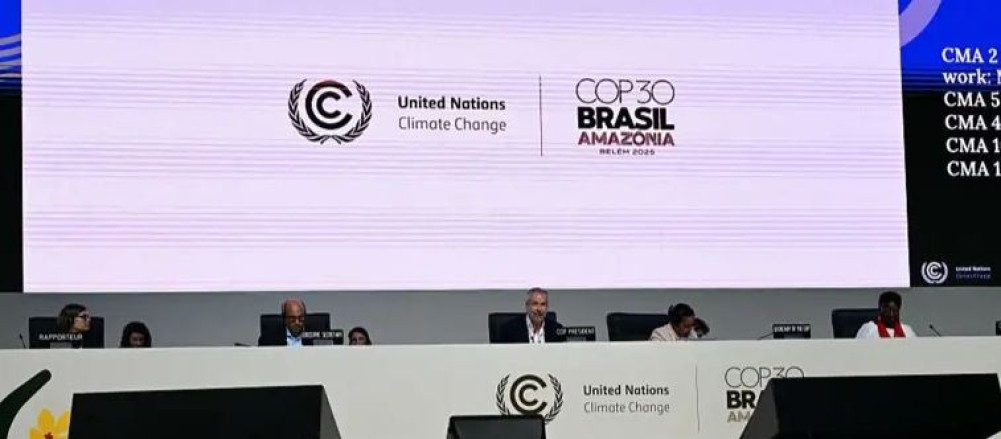
A Colombian delegate said her country would not support an agreement made without science.
We use Google Cloud Translation Services. Google requires we provide the following disclaimer relating to use of this service:
This service may contain translations powered by Google. Google disclaims all warranties related to the translations, expressed or implied, including any warranties of accuracy, reliability, and any implied warranties of merchantability, fitness for a particular purpose, and noninfringement.
COP30, the United Nations' biggest climate change conference, has concluded in Brazil without a new resolution to cut fossil fuels. The conference, held in the city of Belém on the banks of the Amazon River, agreed to increase financial aid to poor countries affected by global warming.
The two-week discussion on the future course of action to limit global warming was deeply divided. COP30 president Andrés Correa do Lago told delegates that the discussions had become increasingly fractious. “I know some of you have big ambitions on some issues,” he said. Some countries had complained that the conference had ended without a strong solution on greenhouse gas emissions or fossil fuels. President Correa suspended the plenary session for consultations after three Latin American countries – Colombia, Panama and Uruguay – repeatedly objected. He resumed the plenary session about an hour later, saying the decisions would stand. A Colombian delegate said that the overuse of fossil fuels was the biggest factor in global warming. She said her country would not support an agreement made without considering the science. “An agreement imposed without considering the climate will be a failed agreement,” she said. Meanwhile, Russian delegate Sergey Kononuchenko said, “Some delegates are showing childish behavior in the discussions, wanting to have all the chocolates in their own hands.” What was the fossil fuel issue ?
COP 28, held in Dubai, adopted an ambitious plan to dramatically reduce the use of petrol, gas and coal, make extensive use of renewable energy and “reduce fossil fuel emissions to net zero” by 2050. It was signed by 198 countries.
However, shortly after the signing, countries including Saudi Arabia, Russia, China, and India backed out of their commitments. They claim that fossil fuels will continue to be needed to meet global energy needs.
The US, which played a key role in getting signatures on the issue at the time, has not shown interest in it since Donald Trump returned as president. Trump has accused the issue of climate change of being the ‘world’s biggest scam.’ He did not send any official representatives to Belém this time. In Belém, 90 countries from Europe, Latin America, Asia, and Africa had agreed to create a clear roadmap to implement the COP 28 commitments. However, countries such as China, India, and Russia, led by Saudi Arabia, blocked the issue from moving forward. As a result, the issue of fossil fuels was not mentioned in the final agreement. ‘We are not saying we are winning the battle on climate.’ But, of course, we are still in this fight and will continue to fight,’ said UNFCCC Executive Secretary Simon Steele in a statement issued after the conference.
Understanding to increase investment in the financial fund
Developed countries have agreed to increase investment in the Climate Change Financial Fund at this conference held in the city of Belém on the banks of the Amazon River.
They have expressed a commitment to contribute $300 billion to the financial fund by 2035, which is three times more than previous commitments. However, experts have been saying that this investment is insufficient to solve the problems caused by climate change.
Accepting the proposal made by developing countries, the United Nations has included in its report the need for a total of $1.3 trillion annually from 2035 to work in the field of climate. It is said that cooperation, unity and investment are necessary between countries to achieve this ambitious goal. However, concrete commitments have not been made.
Developing countries are already facing various problems from sea level rise, extreme heat, droughts, floods and storms . They pointed out the urgent need for funds to combat these challenges .
Abinash Persaud, special advisor to the Inter-American Development Bank, a multilateral financial institution for Latin America and the Caribbean, told international media outlet Reuters that the financial sector needs to be given priority as the impact of climate change increases.
The 'Global Implementation Accelerator' plan has been put forward to support developing countries in their climate adaptation goals . According to this plan, rich countries will cooperate with developing countries in financial, technical and knowledge transfer for climate adaptation .
There has been an agreement to continue the ambitious effort to limit global temperature rise to 1.5 degrees Celsius above pre-industrial levels. However, experts have concluded that a massive reduction in fossil fuels is necessary to achieve this plan, as global temperatures have already temporarily crossed the 1.5 degrees Celsius threshold. COP30 failed to take any decision on this.