The ruling National Democratic Alliance (NDA) won 202 seats, reducing the grand alliance to 35 seats.
We use Google Cloud Translation Services. Google requires we provide the following disclaimer relating to use of this service:
This service may contain translations powered by Google. Google disclaims all warranties related to the translations, expressed or implied, including any warranties of accuracy, reliability, and any implied warranties of merchantability, fitness for a particular purpose, and noninfringement.
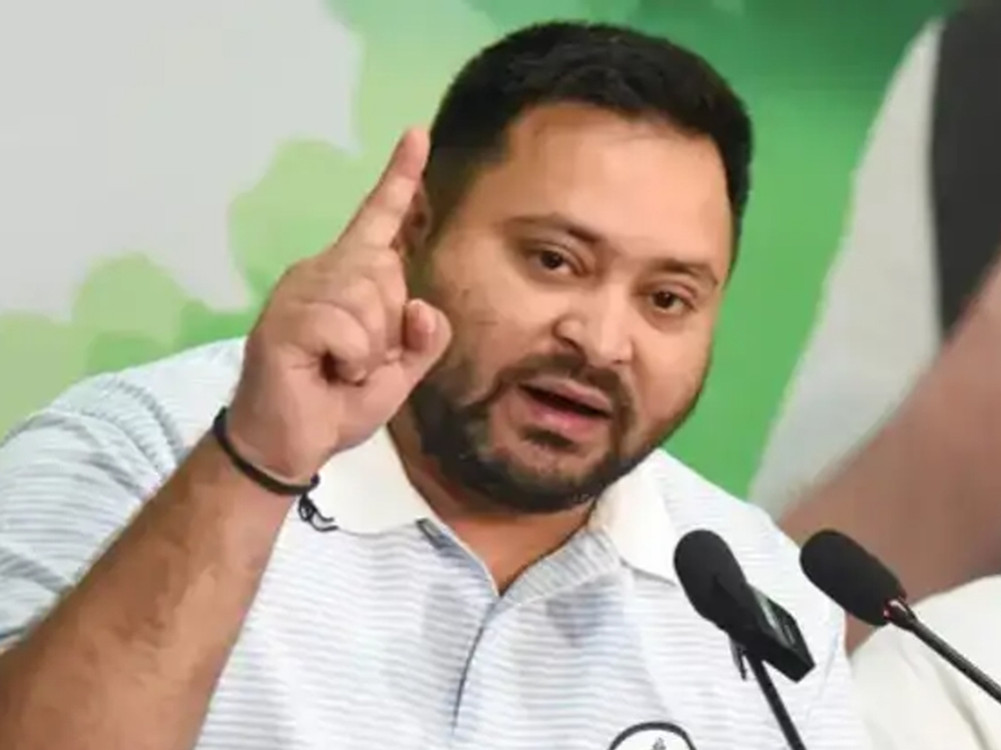
Tejashwi Yadav was the leader of the largest party in the Bihar Assembly and a strong face of the opposition. However, according to the new results released on Friday, the Rashtriya Janata Dal (RJD) has been reduced to 25 seats in the 243-member assembly.
Tejashwi himself won from Raghopur by a slim margin. The situation of other components of the grand alliance is worse than that of the RJD. The Congress-I won only 6 seats. The Communist Party of India Marxist-Leninist (Liberation) won 2 seats, the Indian Inclusive Party (IIP) 1 seat and the Communist Party (Marxist) 1 seat. The ruling National Democratic Alliance (NDA) won 202 seats, reducing the grand alliance to 35 seats. Among the NDA components, the Bharatiya Janata Party (BJP) came first with 89 seats and the Janata Dal United (JDU) led by Chief Minister Nitish Kumar came second with 85 seats. The Lok Janshakti Party (Ram Vilas) led by Chirag Paswan managed to win 19 seats. Other allies of the same alliance won 9 seats.
Family and political tension
In 2020, RJD became the first party in the Bihar Assembly under the leadership of Tejashwi Yadav by winning 75 seats. However, the other components of the alliance were not able to produce good results in this election. When all the seats of the grand alliance were added, it was 110. On the other hand, the NDA had 125 seats. On August 10, 2022, Chief Minister Nitish Kumar resigned after internal turmoil in the alliance. Then, RJD and Congress joined hands to form a new government. At this time, Tejashwi got the opportunity to become the Deputy Chief Minister for the second time in Nitish Kumar's government.
But this alliance also did not last long. Nitish Kumar, who is a master at changing alliances, resigned again in January 2024. The NDA government was formed again under his leadership. Since then, as the leader of the main opposition party, Tejashwi has been continuously pointing fingers against the good governance, political chaos and instability in Bihar.
Since he played the role of a strong opposition, it was expected that he would get good votes in the upcoming elections. Which proved to be wrong.
For Tejashwi, who has taken over the political legacy of his father Lalu Yadav, both the family and political situation are currently unfavorable. After his brother Tej Prasad Yadav was taken into action by the party, he had launched the Janshakti Janata Dal and contested from Mahuva. However, he suffered a bitter defeat.
On the other hand, sister Rohini Acharya has also rebelled within the party and family. As soon as the election results were made public, she announced on social media that she had severed ties with the party and family. Her displeasure was expressed on social media during the election itself.
Rohini was not happy with RJD leader Sanjay Yadav sitting in the front seat of the vehicle during RJD's 'Voter Rights Yatra' last September. Dissatisfied with Sanjay's growing influence within the party, she shared a post by party worker Alok Kumar on social media.
It was written, 'The front seat is always reserved for the supreme leader. If someone starts seeing himself as bigger than the supreme leader, then this becomes an even more serious issue.' She immediately unfollowed many RJD leaders, including Lalu Yadav and Tejashwi, on X. Four of Lalu-Rabri's five children are in politics and the tussle between them has been clearly seen by all the people of Bihar. Lalu's politics of dynasty and legacy has become a hot election spice for the opposition. ‘The person who spread misrule in the state. When he was about to leave office, he made his own wife the Chief Minister,’ Chief Minister Nitish Kumar had said sarcastically at a gathering organized in Samastipur in October, ‘But his character has not improved yet. Now he is taking his children forward.’ After being implicated in the fodder scam in 1997, Lalu
swore in his wife Rabri Devi as the Chief Minister. She served as the Chief Minister till 2005. Lalu is now the protector of the RJD president. And, his sons and daughters are competing for influence in the party. Despite emerging as a young leader in Bihar, leaving behind his brothers and sisters, Tejashwi does not have support from within his family.
Alliance and problems within the party While the NDA alliance continued to promote the corruption and kidnapping cases of the Lalu-Rabri tenure (1990-2005) as 'Jungle Raj', the other components of the grand alliance did not seem to stand united in opposition to it. They were in a dispute over the issue of ticket distribution and seat security. The RJD, which spent a lot of time in finalizing the seat distribution, had to face accusations of not being able to include the feelings of all communities in the party despite fielding candidates in a total of 144 seats.
This time, 52 Yadav candidates were in the fray from the RJD. Which was 36 percent of the seats won by the RJD. While only 11 percent of the candidates from the Extremely Backward Classes (EBCs), which were around 37 percent, were in the fray.
The non-Yadavs were shocked when many candidates were fielded to secure the 14 percent Yadav vote bank. Both the upper castes and the most backward castes seemed to be distancing themselves from the RJD. On the other hand, the BJP continued to impress the middle class and rural voters by showing the threat of 'Yadav Raj'.
The manifesto of the grand alliance was named 'Tejashwi's Pran'. It seemed to give less importance to other parties. Tejashwi's photo dominated the election campaign as well. While his activism was less than in the past. He mostly remained focused on the RJD's assembly constituencies.
In 2020, he addressed rallies in 200 places. This time, he addressed only 100 election rallies. His absence did not convey the message that the grand alliance was strong to the voters of many areas. Although popular slogans such as employment for one person in every household, pension scheme, review of liquor ban, etc. were included, there was no rational basis for implementing them. It is necessary to provide employment to every household. There was no plan to get the money from. Tejashwi had announced that he would not implement the Waqf Bill for political gain.
The bill, which was passed by both houses of India in April, has been signed by the President.
The law aims to increase government control and monitoring over Islamic religious property (including mosques and land) donated for charitable purposes. He had made an election promise to trash it if he wins in the state of Bihar.
The NDA has circulated a video of Lalu Yadav's address to the Lok Sabha in India in 2010 on social media as a counter-offer, where Lalu is advocating for a strict Waqf law. Carrying his father's controversial image as a legacy has been a challenge for Tejashwi.
He has carried his father's social justice agenda. But in an effort to stay away from the accusations of Jungle Raj, Lalu's photo was used less . The opposition interpreted this as a double character . As a result, Muslim voters did not seem to be attracted to RJD this time .
Instead, Asaduddin Owaisi's party
All India Majlis-e-Ittehad-ul-Muslimeen
won 5 seats in Muslim-majority areas. In many other places, Muslim voters' votes were divided between this party and the grand alliance .
Nitish's good governance-Modi's image
The NDA used the development and construction works done by Indian Prime Minister Narendra Modi at the center with pleasure in the Bihar elections . Plans such as opening industries, increasing investment in Bihar, and building infrastructure were put forward by the alliance . Even though Nitish Kumar has been in power for 20 years, Bihar still has the image of being the poorest state in India . But it is not as bad as it was before he came to power. Nitish campaigned for the situation before he came to power. In the last election,
J
DU
could win only 43 seats, Nitish understood well that the people needed economic and social development and security. For that, he brought forward new welfare schemes. He promised to give 35% reservation to women in the state police.
In the run-up to the elections, various schemes were introduced targeting voters. The Chief Minister's Employment Scheme was one of the powerful strategic schemes. Under this scheme, which was implemented last September, Rs 10,000 was directly transferred to the accounts of about 75 lakh women to start small businesses. He announced that electricity up to 125 units would be free from September 1. Similarly, the allowances given to senior citizens and people with disabilities were also increased. The opposition grand alliance opposed these plans brought at the very beginning of the elections, but could not stop them. Instead, they put forward plans that seemed impossible to attract public opinion. For example, the slogan of one house, one job. There are about 27.6 million families in Bihar. The Bihar state government does not have the necessary financial resources and capacity to create jobs for them.
On the other hand, the ruling coalition did propaganda-oriented work like opening vacant posts and distributing employment certificates to youth at public programs. Nitish did not campaign for himself as the Chief Minister in the elections. Instead, he kept the option open. Which helped to unite the NDA alliance.
Voters also maintained their trust in him because he worked for crime control and administrative reforms during his long rule. It worked to convince voters that Modi's support from the Center and Nitish Kumar's governance in the state could change the picture of Bihar.