The shutdown has halted the salaries of 1.4 million employees, affected nutrition and food assistance programs, and air services, while soldiers have not been paid on time.
We use Google Cloud Translation Services. Google requires we provide the following disclaimer relating to use of this service:
This service may contain translations powered by Google. Google disclaims all warranties related to the translations, expressed or implied, including any warranties of accuracy, reliability, and any implied warranties of merchantability, fitness for a particular purpose, and noninfringement.
The 40-day shutdown in the United States is set to end. Senate Republican Leader John Thune has expressed hope that the government will formally reopen in about a week.
A group of Democratic senators has helped the US government bring in a new budget. With the support of 8 moderate senators, the vote on Sunday night reached 60 votes in favor of the new budget. Leader John said that the budget bill will be sent to the lower house (House) soon after it is finalized by the Senate and will be sent to the president for approval within a week after it is passed.
Meanwhile, the leader of the opposition Democratic Party, Chuck Schumer, said that the party is firm on its agenda. “We have been fighting for months to address America’s health crisis. We will continue to fight for poor families deprived of health care and cancer treatment,” he wrote on the social network ‘X’.
Discussions have been going on since last Friday between the ruling Republicans, which have 53 seats, and the 8 leaders of the opposition Democratic Party on passing the budget bill. According to the agreement, there will be a separate vote in December on maintaining the Affordable Care Act subsidies (ACA). The US media outlet CNN reported that the two sides also agreed to reinstate federal employees who were laid off during the shutdown and to prevent such actions from happening again in the future.
How did the shutdown happen?
Although the fiscal year ended on September 30, no agreement could be reached on a new budget for the current fiscal year. As a result, the shutdown began in the US on October 1, 2025. There is a difference of opinion between Republicans and Democrats in the House over budget priorities and health provisions. In the US, the president sends a budget proposal to the House. The House has the power to accept, reject, or amend it. Discussions were ongoing in the House and Senate Budget Committees on the budget proposal. However, despite the resolution being passed by the lower house, the budget could not be passed in the Senate.
Air travel cut, military pay delayed
All functions of the federal government have been affected by the shutdown. Nearly 1.4 million federal employees have not been paid. Critical services such as the National Institutes of Health, the Centers for Disease Control and Prevention, and the Infant, Child, and Women's Nutrition Program have been affected. The food stamp program, which benefits about 42 million Americans, has been affected in many places due to the government's inability to make payments. The Supreme Court has already ordered the program to be temporarily shut down. In some places, its service has become slow. National parks are closed due to lack of proper management. And, the Federal Aviation Administration (FAA) has reduced flights due to problems with air controllers. The shutdown has slowed gross domestic product growth. Experts are also finding it difficult to estimate the damage because economic data reporting is affected. State and local governments have been cut off from the federal government. Revenue collections have also decreased due to the disruption to public life. As a result, local services and budgets have also been affected. Soldiers are working, but their pay is also being delayed. Concerns have been raised that the economic stress could weaken the morale of active-duty soldiers and reserve forces. The federal government has stopped providing assistance and loans to small businesses. Overall, its economic impact is spreading across the country.
Top 5 Contradictions
Affordable Care Act (ACA) :
Democratic senators have demanded an expansion of the Affordable Care Act (ACA) Premier Subsidies to provide affordable insurance to 24 million Americans. This plan, introduced by Barack Obama when he was president, is also known as 'Obamacare'. Republican senators who have been seen opposing its expansion have said that they will discuss the issue after the 'shutdown' ends. The agreement with 8 Democratic lawmakers states that a vote will be held after the 'shutdown' opens.
Food Assistance: Democrats are demanding that benefits under the Food Assistance Program (SNAP) be fully paid to protect the poor. Republicans are in favor of examining the financial situation.
Employee Reinstatement: Democratic senators are demanding that employees who were laid off during the ‘shutdown’ be reinstated and paid. Discussions are also underway on this issue. Spending Limits and Policy: The two parties are at odds over spending limits on defense and domestic programs and provisions related to government spending. This includes military spending, services provided to veterans and various other issues.
‘Filibuster’, ‘Shutdown’ and ‘Closure’: The Republican Party has a clear majority in the Senate. However, the Democratic Party has continued to drag out time by ‘filibustering’ (creating delays or obstructions). As a result, the new budget could not be passed within the September 30 deadline, and the US went into a 'shutdown' from October 1. After the vote on Sunday, the 40-day 'shutdown' is finally coming to an end. US President Donald Trump had been saying that the 'filibuster' should be removed and the budget should be passed by the Senate. 'Remove the filibuster. Not just for the 'shutdown', but for everything,' he wrote on the social network 'Truth' on November 2. He also claimed that the Democratic Party would remove the 'filibuster' practice as soon as it got the chance.
But Republican lawmakers were not ready to go this far. 'Filibuster' is not a special law. There is no mention of it in the US Constitution and Senate rules. But it remains as a practice. Molly Reynolds, a fellow at the non-profit organization 'Brookings' in Washington, DC, says, 'Previously, decisions were made by a simple majority in the Senate, just like in the House. Vice President Aaron Burr, during his term (1801–1805), advised against this rule and to listen patiently to the issues of minorities. This was done specifically to facilitate the Senate process. As a result, the way was opened for unlimited debate.
It was used extensively during the American Civil War (1861–65) and the subsequent Reconstruction period. Dissatisfied lawmakers would drag out every policy introduced by the government by debating it. This made it very difficult to make solid decisions. During World War I, on March 8, 1917, the US Senate issued the ‘closure’ rule to end delay and unnecessary debate. This rule, mentioned in Article 22, states that a time limit can be set when a bill or other matter is being debated protractedly. The ‘closure’ rule was first used in 1919, when senators used a ‘filibuster’ against the Treaty of Versailles. Until now, the rule was that two-thirds of the senators had to support ‘closure’. ‘The history of prolonging the Senate the most is in the name of Senator Strom Thurmond of South Carolina. He, who was against the Civil Rights Acts, began speaking at 8:54 pm on August 28, 1957, and continued to speak continuously for 24 hours and 18 minutes until 9:12 pm the next day. In the process, he interpreted the Declaration of Independence, the ‘Bill of Rights’, the election laws of the states, and everything else in his own way. He used many forces to kill time and prevent him from going to the vote. However, after he was defeated, the bill was passed by the Senate by a vote of 72 to 18.
In 1975, the ‘closure’ threshold was lowered from two-thirds to 60 percent. That is, if 60 percent consider the debate pointless, the debate can be stopped and direct action can be taken. Now, with the support of 8 members of the Democratic Party, President Donald Trump is about to move the budget process forward.
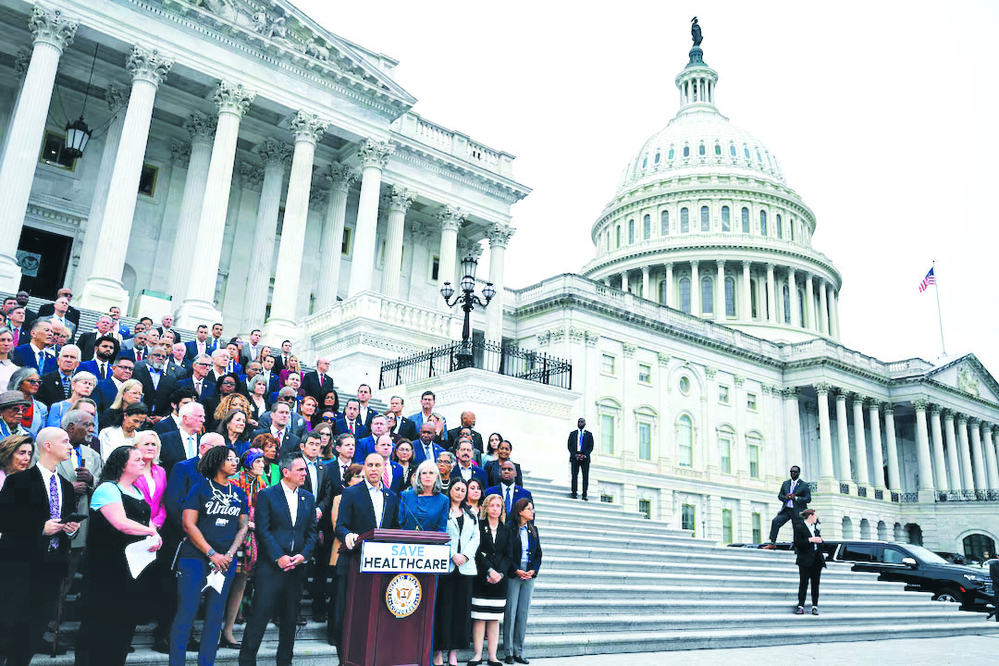
Another possible way to break the 'filibuster' rule in the Senate is the 'nuclear option'. Using this rule, it is possible to end the 'filibuster' and move forward on the basis of a simple majority. Trump had urged Republican senators to do this to end the deadlock. But they were not ready for this. Because, when the Democratic Party lobbied to remove the 'filibuster' rule in the Joe Biden administration, Republicans stood against him.
There are many disadvantages to going this way. For example, the party that is currently in the majority may be in the minority next time and then the majority can again filibuster it in this way. Although the 'filibuster' remains in place in budget and economic policy, it has been removed in many areas. For example, its use has begun to decrease in presidential or judicial appointments.
When was the 'shutdown'?
This is not the first time in American history that a budget dispute has led to a 'shutdown'. There have been 10 'shutdowns' since 1976. This time, the 'shutdown' is the longest of them. Previously, during President Trump's term, there was a 'shutdown' for 35 days from December 2018 to January 2019. During his first term, Trump had to backtrack on his election promise after his opponents rejected his plan to build a border wall. Before that, there was a 'shutdown' for three days from January 20, 2018 during Trump's term. There were three 'shutdowns' each during Obama's two terms (2008-2016) and Bill Clinton's two terms (1992-2000).
(with the help of the agency)

