According to Trump's new tax list, Nepal, Maldives and Bhutan are not in South Asia. On Nepalese goods, the customs duty will be maintained at a minimum of 10 percent.
We use Google Cloud Translation Services. Google requires we provide the following disclaimer relating to use of this service:
This service may contain translations powered by Google. Google disclaims all warranties related to the translations, expressed or implied, including any warranties of accuracy, reliability, and any implied warranties of merchantability, fitness for a particular purpose, and noninfringement.
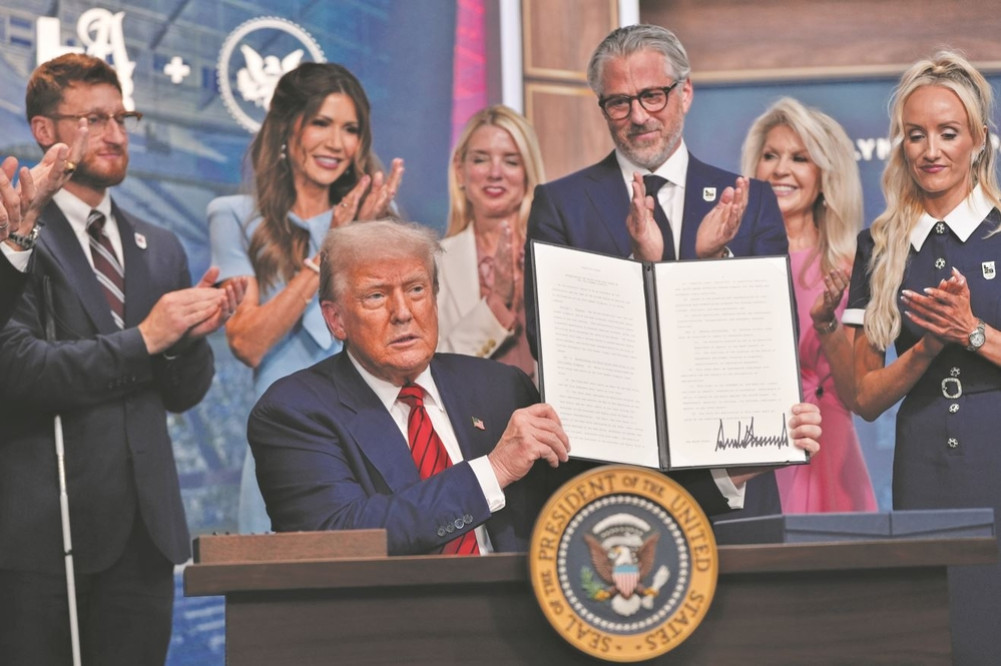
The tariff policy announced by US President Donald Trump has been implemented since Thursday. In a press conference at the White House, Trump said that this decision is necessary for the security and industrial defense of the United States. According to CNN, the impact of this policy will have a profound effect on the entire world's supply system, value chain and diplomatic relations.
According to Trump's new tax list, Nepal, Maldives and Bhutan are not in South Asia. A minimum of 10 percent customs duty will be maintained on Nepalese goods.
Controversial decisions since the beginning
President Trump has been in the limelight for his controversial decisions since he was elected to his second term. They are attracting the attention of the whole world by making some decisions daily, be it for the country or at the global level. But not in a positive way but as a concern. Even now, his 'tariff diplomacy' with powerful countries in the world has given him the likeness of a Sanki ruler.
Analysts have been giving warnings that not only the global economy and politics but also the situation within the country may be destroyed due to the decisions made by the US government since taking over the leadership. At the start of his second term, Trump announced heavy tariffs on foreign goods. Its direct impact was seen in the US stock market at that time. As a result, Americans were worried about the increase in prices and the impact on business.
Due to this fear, investors accelerated the sale of shares. Suddenly the US stock market fell. Market indices such as the Dow Jones, S&P and Nasdaq fell below 100 percent in two days. Such a fall in the US stock market was the highest during the Corona period in March 2020. He suspended his tax policy for three months due to market decline and citizen criticism.
Now Trump's 'tariff attack' has started again. Analysts have warned that his move, which began on August 9, could again have a heavy impact on the US market. His campaign to impose taxes on countries around the world is also increasing the threat of economic recession. According to estimates by the Yale University Budget Lab, the average tariff rate in the US has reached 18.3 percent. This rate is the highest in the last century. Prior to this, in 1909, the average tax rate in America was 21 percent.
The average American family will be burdened with an extra $2,400 this year due to higher taxes. That is, the price of foreign goods available for 100 dollars will now be 118.3 dollars. According to Wedong Zhang, an economist at Cornell University, the price of steel and aluminum used in the US will be higher in the coming days. According to Budget Lab, current tax policies could cause US GDP to decline by as much as 0.5 percent. This would mean a $140 billion loss to the $28 trillion US economy over the course of a year.
Similarly, according to the Tax Foundation, the impact of tariffs (taxes) will directly affect daily food items. Prices of fruits, fish, meat and alcoholic beverages will also increase. However, Trump claims that his tax policies will strengthen the US economy. But analysts have been warning that such a policy will increase inflation and unemployment. According to government data, 73,000 Americans lost their jobs in July alone. The government has estimated that 190,000 jobs will increase. But there was a sharp decline in employment in May and June as well. According to government data, an average of 35,000 people got new jobs in a period of three months. This figure is the lowest since 2010.
Infuriated by such data, Trump fired Erica McAnterfer, commissioner of the Bureau of Labor Statistics, on August 1. Trump alleges that the report had to be removed because it had political motives. He was appointed by former President Joe Biden in 2024.
The danger of 'trade war'
The entire world has been enduring Trump's arbitrariness since he took over the second term. Although there have been some responses, no country has yet been able to give a convincing answer. Trump will change his policy as soon as there is a threat of that happening. But the 'tariff attack' that has started now is not going to stop. America, once a threat with weapons, is now threatening the whole world with its tax policies. When one tax policy after another hits the US, other countries are no longer silent. This is increasing the risk of starting a trade war between the countries. So far, retaliatory tariffs on American goods have not started, but it does not seem that this process will not start to increase pressure on America.
When Trump imposed additional tariffs on Chinese goods during his first term in 2018-19, China also launched a retaliatory tariff war. Tariffs were imposed on soybeans, automobiles, and many other American goods. China consumes a lot of American soybeans. Exports of soybeans fell by 50 percent after China imposed additional tariffs, and American farmers suffered heavy losses. The American government had to give relief of 7.3 billion dollars to cover the losses of farmers.
Warning of economic recession
Analysts have been saying since the beginning that there is a danger of economic recession in the world market due to Trump's tax policy. In a report published by the IAF on April 22, if the US and other countries engage in a 'tariff war', the global growth rate may drop to 3 percent from 3.3 percent this year. Similarly, in a report published on June 3 by the Organization for Economics' "Operations and Development", decisions related to tax policy will have a serious impact on the economic system of not only America but also Europe and Asia. A reduction in production and imports may bring the threat of a 'synchronized slowdown' in the entire world economy. The report warned that the impact of this will be first in America and then in countries like China, India, Canada, Italy and Ireland.
Allied countries are dissatisfied
Not only China and India, Trump has yet to hit his close allies with his tax policy. Neighboring countries are getting irritated with the US due to his aggressive expressions. Even close allied countries like Canada, Japan, South Korea, France are not happy with this policy of Trump.
tax policy also has an increasing negative impact on old relationships. Also, because of Trump's unstable nature, they are not in a position to trust America blindly. Canada and the US have been allies for decades. But recently, due to Trump's behavior, the tension between the two countries is increasing. Tension between the two countries has continued ever since they expressed that they would make a sovereign country a state of their country.
The situation is the same in the Asia region. In particular, Japan and South Korea have been depending on the US for security. But due to Trump's unstable nature, both countries are afraid of what decision he will take. For the same reason, they are trying to strengthen internal investment in the defense sector. At this time, America's ability to connect the world with "soft power" has declined. This decline can be seen most clearly in the South Pacific. Where China and the US appear to be in direct competition. (with help from agencies)