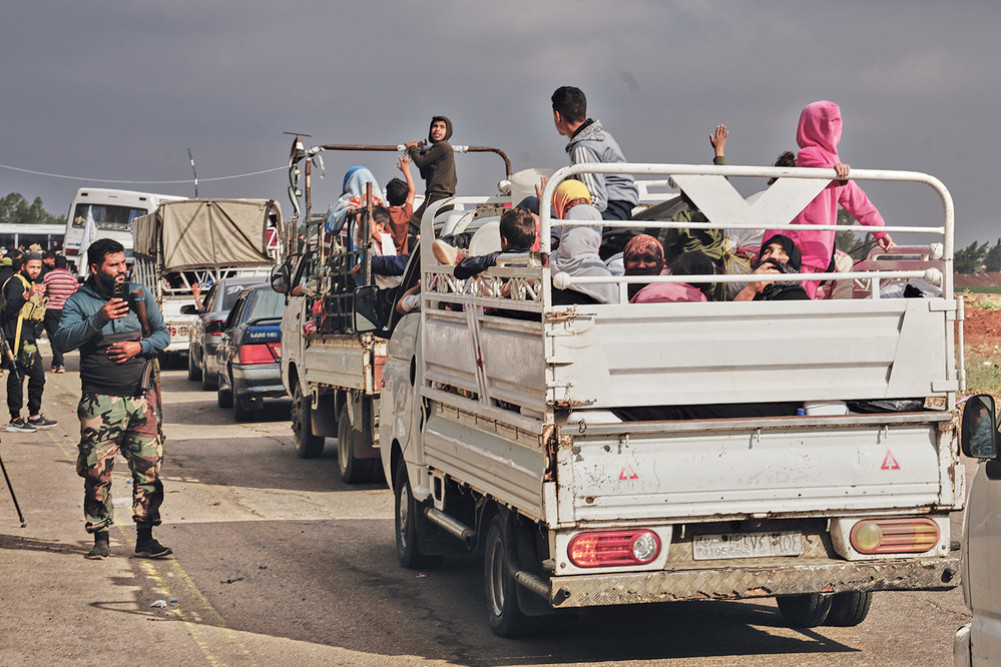
The government has sent buses since Sunday to evacuate about 1,500 Bedouins from Sweida, where the Druze community is the majority.
We use Google Cloud Translation Services. Google requires we provide the following disclaimer relating to use of this service:
This service may contain translations powered by Google. Google disclaims all warranties related to the translations, expressed or implied, including any warranties of accuracy, reliability, and any implied warranties of merchantability, fitness for a particular purpose, and noninfringement.
The Syrian government began evacuating Bedouin families trapped in the southern Druze town of Sweida on Monday. The US announced a ceasefire between Israel and Syria last Saturday, ending the week-long fighting.
The day after Bedouin fighters announced their withdrawal from Sweida in accordance with a US-brokered ceasefire agreement, the government also began evicting Bedouin families from the area.
However, clashes between Druze militia and Bedouin fighters continued on Monday. Israel has also carried out dozens of airstrikes targeting government forces in Sweida province to protect the minority Druze community. In Sweida, where the Druze are the majority, Israel accuses the government forces of taking the side of the Bedouins and attacking the Druze.
At least 940 people have died in clashes between the militias of the Druze religious minority and the Sunni Muslim community. The United Nations' International Organization for Migration has said that around 128,571 locals have been displaced in the hostilities that began a week ago with a series of kidnappings and attacks.
The Syrian government, in coordination with the authorities of Sweida, sent buses on Sunday morning to evacuate about 1,500 Bedouins, according to the Syrian state-run media. According to the Syrian Minister of Interior Ahmed Al-Dalati told the media "Sana", after the Bedouins are expelled from Sweida, it will be easier for the displaced Druze to return home. He added that the fighting had largely stopped and that efforts for a complete ceasefire were continuing. "We have established a security cordon around the city to protect Sweida and stop the fighting there," al-Dalati told the Syrian state news agency, "which will restore harmony and stability in the province." Although talks on a hostage exchange deal failed on Saturday, Syrian officials have made no mention of the terms of the deal.
However, the Syrian Observatory for Human Rights (SOHR), a UK-based organization that monitors the war, said that as part of the deal, the Bedouin fighters must release the Druze women they held hostage and leave the province. Bedouin fighters suddenly retreated from the town of Sweida on Sunday. According to SOHR, clashes broke out between Bedouin and Druze militias in some places after the talks failed, and Israeli airstrikes were also carried out there. But the Israeli military said it was "not aware" of any overnight strikes in Syria.
The situation of displaced people is miserable
It is said that after the communal riots broke out in Syria, the displaced people had to struggle a lot for food and water. Bedouin families who fled Sweida province and reached the neighboring Daraa are sheltering in abandoned buildings, and there is a lack of clothes for them to sleep and wear at night.
Saif al-Haj, who fled with his family of 11 from western Sweida countryside to the town of Busra al-Harir in Daraa province, lamented that despite bringing chickens and ducks with him, they still struggle for lack of sufficient water and food. He said, "There is no drinking water here even if you are thirsty." Schools and private homes in the neighboring village of Salkha are now overcrowded due to the shelter of the Druze community. They said they had come to seek refuge in the neighborhood after being displaced by Bedouin fighters who abducted many of their community.
More than half of the world's approximately one million Druze live in Syria, accounting for only 3 percent of Syria's population. Most other Druze live in Lebanon and Israel. The Druze also live in the Golan Heights, which Israel captured from Syria in the 1967 Middle East War. The area was later captured by Syria in 1981.
In Syria, the political instability caused by the ouster of President Bashar al-Assad in December 2024 by rebel forces increased. Then a vegetable merchant from the Druze community was abducted and looted by Bedouins on the highway to Damascus, which led to communal riots. The violence began in southern Syria's Suwayda province and spread to the Bedouin settlement of al-Maqwas. The violence spread to other parts of Suweida province after Druze fighters seized the area. Bedouin fighters have been carrying out one attack after another in areas inhabited by the Druze community.
The Islamic group Hayat Tahrir al-Sham (HTS) has gained influence in Syria since the fall of the Assad government, creating religious and sectarian pressure on the Druze community. Tensions are believed to have escalated after Sunni Islamic groups began pressuring the Druze community to convert. Due to the weak security system as well as the lack of control capacity of the interim government of President Ahmed al-Shara, sectarian violence seems to be increasing in Syria recently.
According to SOHR, 326 Druze fighters and 262 civilians from the Druze community have died in the last week-long violent clashes. According to SOHR, 182 people were executed by the personnel of the Ministry of Defense and Interior of Syria. Likewise, 312 government security personnel and 21 Bedouin fighters have also died in the clashes. SOHR reported that 4 more Bedouin civilians were executed by Druze fighters and another 15 government soldiers were killed in Israeli attacks. Israel also carried out dozens of airstrikes in the Druze-dominated Sweda province, targeting the government forces that sided with the Bedouins.
Syria's interim president, Ahmed al-Shar'a, tried to sway the Druze community by criticizing his militias for being more sympathetic to the Bedouins. He later asked the Bedouins to leave the city to "manage the affairs of the country and restore security." "We thank the Bedouins for their heroic stand but demand that they fully commit to the ceasefire and obey the state's orders," he said in a speech broadcast on Saturday.
Bedouin fighters and government forces have reportedly targeted Druze civilians and killed dozens. According to the media, they broke into Druze houses, burned pictures of religious leaders and prominent figures of the community, and forced elderly Druze people to shave their mustaches.