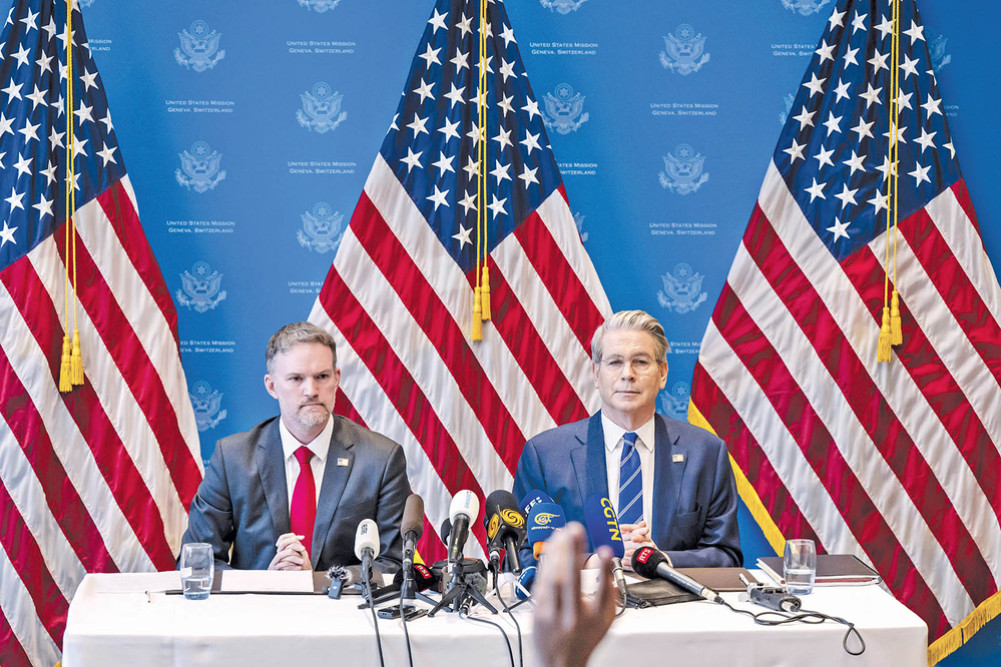
Both sides agreed to reduce their customs duties by up to 115 percent
We use Google Cloud Translation Services. Google requires we provide the following disclaimer relating to use of this service:
This service may contain translations powered by Google. Google disclaims all warranties related to the translations, expressed or implied, including any warranties of accuracy, reliability, and any implied warranties of merchantability, fitness for a particular purpose, and noninfringement.
The US and China have agreed to suspend tariffs for the next three months. Both countries issued a joint statement on Monday and announced the suspension of customs duties.
US Finance Minister Scott Besant has informed that there is an agreement with China to suspend tariffs for 90 days and bring about a significant reduction in customs rates. The Chinese Ministry of Commerce has also confirmed the suspension of all "retaliatory tariffs" against the US since April 2. BBC reported.
At present, the United States imposed a tariff of 145 percent on goods imported from China and 125 percent on some goods imported from China. According to Minister Besant, both sides have agreed to reduce their tariffs by 115 percent.
In the talks held in Geneva, Switzerland, the American team was led by Besant and the Chinese team was led by Vice Premier He Lifeng. According to the BBC, the US tariff on Chinese goods has been reduced from 145 percent to 30 percent.
Similarly, Chinese tariffs on US goods have been reduced from 125 percent to 10 percent. According to the agreement between the two countries, it is said that the decision to suspend the tariff will be implemented from May 14, i.e. this Wednesday.
China's Ministry of Commerce has expressed its expectation that the US will cooperate with China in trade-related matters in the coming days. According to the BBC, the ministry has said that the reduction of customs duty is "in the common interest of the world".
It is mentioned in the joint statement that in the future there will be further talks in one of China or the United States. The statement acknowledged the importance of bilateral economic and trade relations for both countries and the global economy.
"Both the United States and China believe that continued discussions have the potential to address each side's concerns in their economic and trade relationship," the statement said. It is said that both countries will move forward in the spirit of mutual openness, continuous communication, cooperation and mutual respect.
China has also agreed to continue discussions on further opening its markets to US products and goods, and to continue serious discussions about the serious impact of Chinese-made fentanyl in the US.
Likewise, the White House of the US President's Office said that the US-China agreement was an extraordinary step. White House Press Secretary Caroline Levitt told Fox News that the US-China trade deal is an extraordinary first step in the right direction. "President Trump will continue to negotiate with China, we hope, to reach an essentially fair and comprehensive, major trade agreement," she said.
The agreement between the two countries has also been welcomed by the World Trade Organization (WTO). The head of the organization, Ngozi Okonjo-Iweala, said that she had spoken with the Chinese vice-premier saying that she was watching the talks closely. Issuing a statement, he said that he was "happy with the positive outcome of the talks". She emphasized that cooperation between the two countries is important for the global economy.
Lately there has been a discussion about how to reform the WTO to suit the modern global economy. The organization warns that if the global economy is divided into two groups by the WTO, the real gross domestic product of the world could decrease by about 7 percent in the long term.
With the agreement between the two countries, there has been an increase in the global stock market. Likewise, the value of the US dollar and the Chinese yuan has increased. The value of the dollar has increased against the pound, euro and Japanese yen, while the value of the yuan has also risen against the dollar along with these three major currencies.
US President Donald Trump announced a 10 percent tariff on almost all Chinese goods entering the US on February 1. In response, China announced on February 4 that it would impose 10 to 15 percent tariffs on some American products. Shortly after the
, Trump imposed 20 percent tariffs on Chinese goods on March 4. The US announced an additional 34 percent tariff on Chinese imports on April 2, bringing it to 54 percent. In response, China imposed a 34 percent tariff on most American goods.
China announced on April 9 that it would impose an 84 percent tariff on US goods, effective the next day. The rate was increased from 34 percent. Trump announced "reciprocal" tariffs after China raised US tariffs by 84 percent to 104 percent. According to which, Trump increased the tax on Chinese goods by 125 percent to 145 percent. On April 11, China raised the tariffs on goods from the US to 125 percent and said it would not respond to further increases.
After the trade talks between the two countries in Switzerland on May 12, the 'reciprocal' tax has been suspended with effect from May 14. With the new agreement, US tariffs on Chinese goods will drop to 30 percent and Chinese tariffs on US goods will drop to 10 percent.