We use Google Cloud Translation Services. Google requires we provide the following disclaimer relating to use of this service:
This service may contain translations powered by Google. Google disclaims all warranties related to the translations, expressed or implied, including any warranties of accuracy, reliability, and any implied warranties of merchantability, fitness for a particular purpose, and noninfringement.
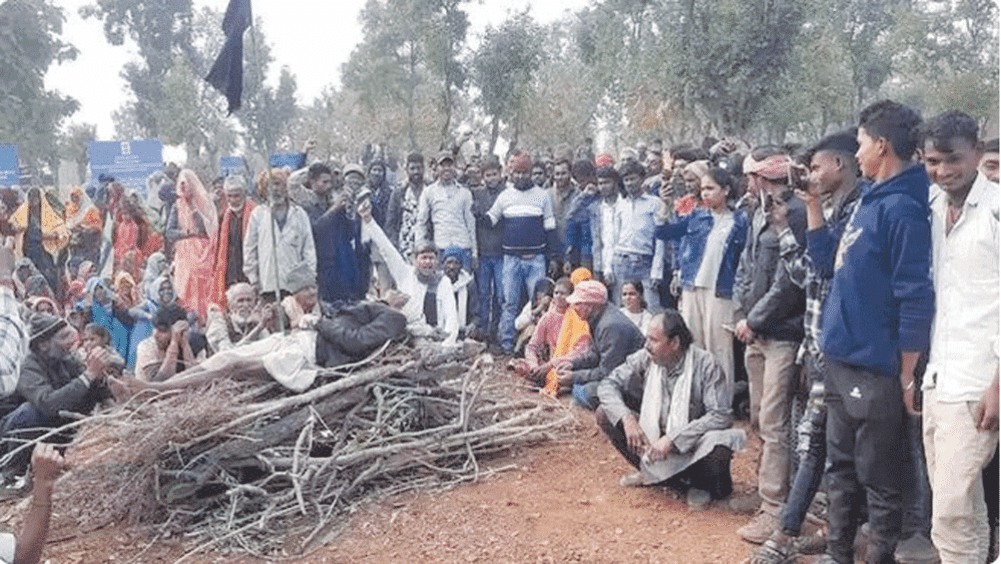
In India's Madhya Pradesh, locals are protesting against the river-linking project. Concerned that the 'Ken-Betwa Project' will lose their homes and livelihoods, they protested.
In the ``Ken-Betwa Project'' with a total budget of 440 billion rupees, the goal is to send excess water from the Ken River in Madhya Pradesh to the neighboring Betwa River in Uttar Pradesh through tunnels, canals and dams.
The project is the first of 16 river-connection projects proposed for water resource development under the 1980 National Perspective Plan for Water Resource Development. But after years of delays due to environmental concerns and political disputes, the project was finally approved by the government in 2021.
Prime Minister Narendra Modi laid the foundation stone of this project in December last year. The project is being constructed with the aim of providing support to the drought-affected Bundelkhand region. It includes parts of Madhya Pradesh and Uttar Pradesh.
It has been poor and underdeveloped for years due to its dry climate and erratic rainfall system. According to the Government of India, this project will be completed by 2030. On completion of the project, it is said to provide irrigation facilities to 10.6 lakh hectares of land and provide drinking water to 6.2 lakh population. Also, this project will produce 130 megawatts of hydropower and solar energy.
According to district officials, at least 10 villages will be inundated due to this dam. It also includes large areas of important forests. Also, it is said that more than 7 thousand families will be directly affected due to relocation of 11 more villages for canal construction.
Protester Tulsi Adivasi says, 'Our livelihood is connected with this land. Now what will happen to our future, we do not know anything. Most of the protestors belong to tribal Gond and Kol communities. Most of the people of this community live near the forest and earn their living by farming. According to environmentalists, the project will submerge an area of about 98 sq km of the 'Emerald Tiger Reserve'. Spread over an area of 543 square km, this place has successfully revived tigers from being locally extinct in 2009.
Environmentalists argue that this will thwart years of conservation efforts. Environmentalist Amit Bhatnagar says, “This is unprecedented. We have never seen a core area of a national park being used for such a large infrastructure project.' They questioned its economic viability and the impact it would have on the area's wildlife. They recommended that the government should explore alternative irrigation methods in the river basin. Other studies on river-linking projects in India have drawn similar conclusions.
According to a study published in the journal 'Nature Communication' in 2023, such efforts are likely to exacerbate the water crisis across the country. Which can make projects ineffective or even harmful. Baleshwar Thakur, head of the National Water Development Agency, defends the project and says, "The government has done a thorough investigation on this issue."
has also obtained all necessary environmental clearances for this project. We have allocated more land as compensation for the loss of tiger habitat and will also rehabilitate other species affected by the project.'
Government official admits the project will affect biodiversity. However, Thakur claims that its benefits outweigh its negative effects.
There is extreme poverty in this area. There are no basic facilities like clean drinking water and electricity. In the river connection project, the villagers have a question, 'Why are we being asked to leave our houses to supply electricity to other areas?' This project is being built to provide electricity to 13 other districts. While electricity has not come to our own village.' Local Mahesh Adivasi says, 'We have lived without progress for generations. Now, we are called to sacrifice our lives for the advancement of others. Who will think about us?'
The government has also offered an alternative compensation to the villagers, in which they have been given an opportunity to choose a lump sum of Rs 750,000 and a piece of land or take a lump sum of Rs 12 lakh 50,000. Individuals who own land will also be given an additional amount based on the value of the land. According to Thakur, about 90 percent of people want to take the amount at once. "Meanwhile, the government has started looking for alternative government land to resettle the villagers," Thakur said.
But according to locals, the proposed amount is insufficient. In a government notice Tulsi Adivasi showed to BBC Hindi, the value of her house was assessed at Rs 46,000. He asks, 'How can a house be built with this much money?' They also complain that the locals have not been given any information about when the house should be vacated and where it will be resettled. 20-year-old tribal Lakshmi says, 'This project was supposed to be a boon for our village but the reality is, it will push us further into darkness.'
Locals have also questioned the claim that the project will use excess water from the Ken River. Critics say the government used old data from 2003 to calculate the river's annual flow. However, Adhikari Thakur denied the allegation, saying, "We have all the data we need to take the project forward." According to
environmentalist Amit Bhatnagar, the government is setting a "dangerous precedent" for implementing similar development programs in other geographically sensitive areas by going ahead with the project. For those affected, it confirms once again that development in India is often only possible at the sacrifice of the most marginalized communities.