Polling for the 543-member Lok Sabha will begin in phases from April 19 to June 1
We use Google Cloud Translation Services. Google requires we provide the following disclaimer relating to use of this service:
This service may contain translations powered by Google. Google disclaims all warranties related to the translations, expressed or implied, including any warranties of accuracy, reliability, and any implied warranties of merchantability, fitness for a particular purpose, and noninfringement.
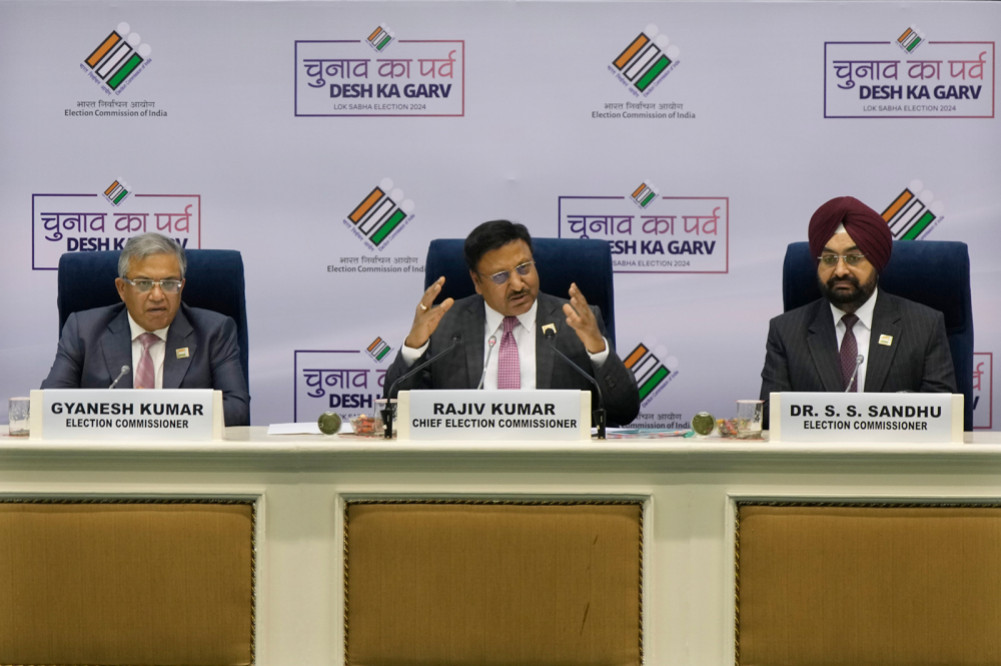
Lok Sabha elections in India will be held in seven phases. The Election Commission of India announced on Saturday that the elections to the 543-member Lok Sabha will be held in phases starting from April 19. The 5-year tenure of the current Lok Sabha will end next June.
According to the commission, the process including registration of nominations will start from March 20 for the first phase of voting to be held on April 19. The second phase of voting will be held on 26 April, the third on 7 May, the fourth on 13 May, the fifth on 20 May, the sixth on 25 May and the seventh phase on 1 June. The seven-phase voting will be completed in one and a half months. Chief Election Commissioner Rajeev Kumar said that the counting of votes will begin simultaneously on June 4. According to the Commission, voting will be held for 112 Lok Sabha seats in the first phase, 89 in the second phase, 94 in the third phase, 96 in the fourth phase, 49 in the fifth phase, 57 in the sixth phase and 57 seats in the seventh phase.
States of Uttar Pradesh, Bihar and West Bengal are scheduled to vote in all seven phases. All these three Indian states share a border with Nepal, due to which the Nepal-India border area will be affected for about one and a half months based on security sensitivity.
Only 34 days before the first phase of voting, the commission announced the date of the election. According to Chief Election Commissioner Kumar, the commission had been preparing for the election for two years. However, two other commissioners were appointed to the three-member commission only last Friday. The commission did not announce the date of the election, but the political parties had started preparing for the election. Parties have been announcing candidates in phases.
Along with the Lok Sabha elections, assembly elections are also taking place in the states of Andhra, Odisha, Sikkim and Arunachal. Similarly, Chief Commissioner Kumar informed that the by-elections for 26 vacant seats in the Legislative Assembly will also be held during this period. Citing security reasons, the assembly elections in Jammu and Kashmir will be held after the Lok Sabha elections. He said that polling stations and necessary facilities have been arranged to facilitate voting. Chief Election Commissioner Kumar informed that those above 85 years of age and 40 percent physically challenged who want to vote from home will be provided with facilities accordingly.
There are 968 million 21 thousand 926 voters in India for the Lok Sabha elections. Out of that, 49.7 million are male and 47.1 million are female voters. Compared to the previous elections, 184,81,610 new voters have been added this year. It is said that 1.5 million polling stations will be set up for those voters across the country. 5.5 million electronic voting machines will be used for voting.
This is the voting schedule
In the first phase, Arunachal Pradesh, Assam, Bihar, Chhattisgarh, Maharashtra, Manipur, Meghalaya, Mizoram, Nagaland, Rajasthan, Sikkim, Tamil Nadu, Tripura, Uttar Pradesh, Uttarakhand, West Bengal, Andaman Nicobar, Voting will be held in 102 constituencies of Jammu and Kashmir, Lakshadweep, Puducherry. In the second phase, voting is scheduled for 89 seats in Assam, Bihar, Chhattisgarh, Karnataka, Kerala, Madhya Pradesh, Maharashtra, Manipur, Rajasthan, Tripura, Uttar Pradesh, West Bengal, Jammu and Kashmir.
In the third phase, elections will be held in 94 seats in Assam, Bihar, Chhattisgarh, Goa, Gujarat, Karnataka, Madhya Pradesh, Maharashtra, Uttar Pradesh, West Bengal, Dadar Nagar Haveli and Daman Diu. In the fourth phase, voting will be held in 96 seats in Andhra Pradesh, Bihar, Jharkhand, Madhya Pradesh, Maharashtra, Odisha, Telangana, Uttar Pradesh, West Bengal and Jammu and Kashmir. Similarly, in the fifth phase, voting is scheduled for 49 seats in Chhattisgarh, Jharkhand, Maharashtra, Odisha, Uttar Pradesh, West Bengal, Jammu-Kashmir, Ladakh.
57 seats in Bihar, Haryana, Jharkhand, Odisha, Uttar Pradesh, West Bengal and Delhi will be voted in the sixth phase. Finally, voting is scheduled for the remaining 57 seats in Bihar, Himachal Pradesh, Jharkhand, Odisha, Punjab, Uttar Pradesh, West Bengal and Chandigarh.
Seven phases before
Earlier in 2019, the 17th Lok Sabha elections were also conducted in seven phases in India. However, this time the period has been kept longer than the previous time. Last time it started on 11 April and ended on 19 May. The election results were announced on 23 May. Uttar Pradesh is the largest state in terms of number of Lok Sabha seats. There are 80 Lok Sabha seats. It is followed by 48 seats in Maharashtra, 42 in West Bengal and 40 in Bihar. There are 39 Lok Sabha constituencies in Tamil Nadu, 29 in Madhya Pradesh, 28 in Karnataka, 26 in Gujarat, 25/25 in Andhra Pradesh and Rajasthan.
There are 21 Lok Sabha seats in Odisha, 20 in Kerala, 17 in Telangana, 14/14 in Assam and Jharkhand. There are 13 Lok Sabha seats in Punjab, 11 in Chhattisgarh, 10 in Haryana and 7 in Delhi. There are 6 seats in Jammu and Kashmir, 5 in Uttarakhand and 4 in Himachal Pradesh. Arunachal Pradesh, Goa, Manipur, Meghalaya and Tripura have 2 seats each. Andaman and Nicobar Islands, Chandigarh, Dadar Nagar Haveli, Daman Diu, Lakshadweep, Mizoram, Nagaland, Puducherry and Sikkim have 1/1 seat each.
Modi's attempt for a third term
The ruling Bharatiya Janata Party won consecutive majorities in the 2014 and 2019 Lok Sabha elections. Since then, Narendra Modi, who became the Prime Minister, is completing his two terms. He has been the prime minister for 10 consecutive years and has been claiming to win more seats in the Lok Sabha this time than in the previous two elections. He claims that the BJP alone will win 370 seats in this election and the alliance with the BJP will win 400 seats.
In 2014, the BJP won the majority by defeating the Congress. At that time BJP won 282 seats. In 2019, the BJP alone won 303 seats with better results than that. Motivated by the two elections, Modi has increased his party's target for the upcoming elections. The BJP is going to the elections by implementing agendas such as construction of Ram temple in Ayodhya, repeal of Article 370 of the Constitution, granting special rights to Jammu and Kashmir, and giving citizenship rights to non-Muslims who came to India from Afghanistan, Bangladesh and Pakistan, mentioned in their manifesto. The BJP seems hopeful that all three issues will polarize Hindu voters further in its favour. After announcing the election date, Prime Minister Modi said through social media X that the alliance of BJP and NDA is ready to enter the election contest. He has expressed confidence that he will receive the love and blessings of the voters for the third time in a row.
An alliance of opposition parties including the Congress is preparing to challenge Modi. A few months ago, two dozen parties including Congress, Rashtriya Janata Dal, Samajwadi Party, Aam Aadmi Party, Trinamool Congress and Left Party announced an alliance. An alliance was formed with the preparation of joint candidacy for at least 450 seats. However, Nitish Kumar's Janata Dal United's departure from the alliance in Bihar, Trinamool Congress leader Mamata Banerjee's announcement to contest alone in West Bengal has not resulted in close cooperation between the opposition alliance.
Congress leader Rahul Gandhi is trying to reduce Modi's image at the national level by tearing the country apart and winning public opinion in his favor. A simple majority of 272 seats is required to form a government in the Lok Sabha. Congress, the largest opposition party, won 44 seats in 2014 elections and 52 seats in 2019.
In 2019, BJP won good seats in big states which are considered decisive. Uttar Pradesh, the largest state, won 62 of the 80 seats. 18 out of 42 seats in West Bengal, 17 out of 40 seats in Bihar by BJP alone and 39 seats by alliance. Congress was reduced to 1 seat. BJP had a clean sweep in all 26 seats in Gujarat, 10 in Haryana, 7 in Delhi and 4 in Himachal Pradesh. Out of 28 seats in Karnataka, BJP won 25 seats and Congress won 1 seat. Similarly, out of 29 seats in Madhya Pradesh, BJP won 28 and Congress 1. While the BJP won 23 of the 48 seats in the large state of Maharashtra, the Congress won 1 seat in Khumchin.