The committee formed under the coordination of Ram Bahadur KC, Chief of the Response Division at the National Disaster Risk Reduction and Management Authority, has recommended the immediate removal of private and government structures built over drainage systems as a long-term solution.
We use Google Cloud Translation Services. Google requires we provide the following disclaimer relating to use of this service:
This service may contain translations powered by Google. Google disclaims all warranties related to the translations, expressed or implied, including any warranties of accuracy, reliability, and any implied warranties of merchantability, fitness for a particular purpose, and noninfringement.
In Kathmandu, areas such as Maitighar being submerged after even light rainfall has now become almost routine. This recurring problem not only causes inconvenience to the general public, but also raises questions about the performance of the government and local authorities.
To identify the real cause of the flooding, a joint technical committee was formed comprising representatives from the National Disaster Risk Reduction and Management Authority, Kathmandu Metropolitan City, Road Division Kathmandu, and Kathmandu Valley Water Supply Limited.
The report submitted by the committee on the 7th of Saun concluded that the main causes of flooding in the Maitighar area are encroachment on the drainage system, narrow drains, garbage accumulated inside the drains, surface-level imbalance with the Tukucha River, and lack of coordination among the concerned agencies.
The committee, formed under the coordination of Ram Bahadur KC, head of the Response Branch of the National Disaster Risk Reduction and Management Authority, recommended the immediate removal of private and government structures built over the drainage system for a long-term solution. According to the report, it was also suggested that the drains should be kept open and visible from the outside.
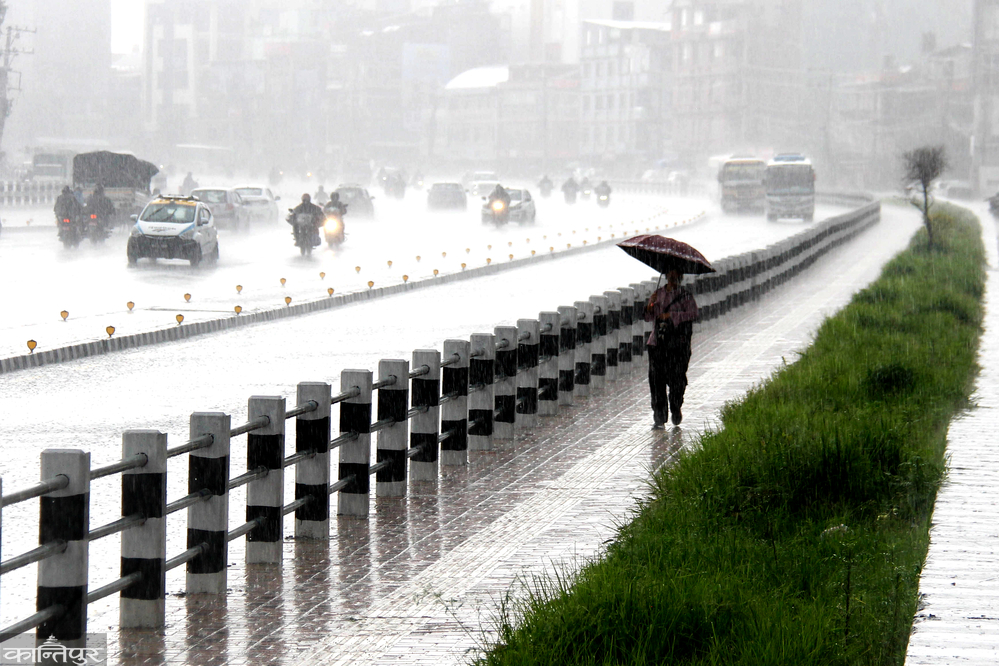
Encroachment Blocks the Drains
According to the report, rainwater and sewage collected from the Maitighar area enter the Thapathali Campus premises via the Military Transport Battalion. From there, one outlet goes towards the Central Bureau of Statistics, where the drain is particularly narrow. Another outlet goes towards the Tukucha River.
The committee concluded that structures built over the drainage outlets have obstructed the flow of water. The Thapathali Campus administration has also stated that it is ready to remove such structures if they are found to be the cause of flooding.
The report mentions that structures such as Thapathali Campus, Rastriya Banijya Bank, and the Central Bureau of Statistics have encroached on the drainage outlets. In some places, shops and even toilets have been built over the drains.
The Disappearance of Natural Reservoirs
The committee also pointed out that another significant cause of flooding in Maitighar is the destruction of natural reservoirs that existed in the past.
Previously, a low-lying vacant plot next to Maitighar Chowk acted as a natural reservoir, temporarily collecting rainwater. Water flowing down from higher areas such as Thapathali Height, Singha Durbar, and Babarmahal used to accumulate there first, and then gradually flow towards the Tukucha through the drains, preventing sudden pressure on the main drain.
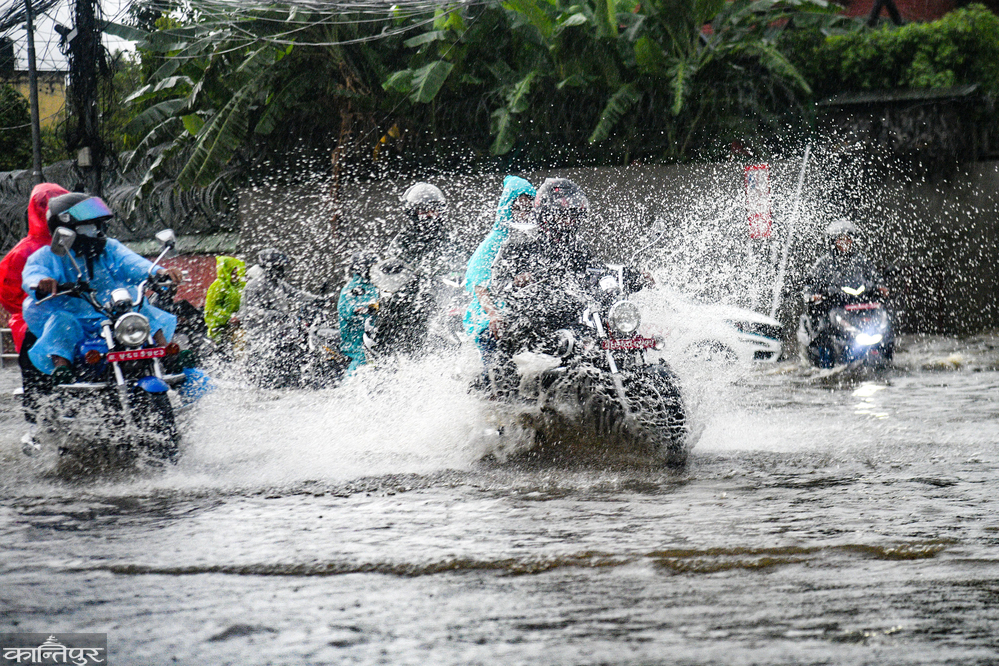
However, after the construction of the Kathmandu Police Complex and the District Government Attorney's Office on that very site, the natural process of water collecting and being absorbed by the ground has ended. The report states that since then, all the rainwater has started flowing directly towards Maitighar Chowk.
Lack of Coordination Also a Problem
The report notes that the drainage system has also been obstructed because service providers such as the Nepal Electricity Authority, Nepal Telecom, and the Water Supply Office have not coordinated adequately when laying or repairing pipes, cables, and other structures.
The committee concluded that the difference in elevation between the drainage outlets and the Tukucha River, as well as the accumulation of solid waste inside the drains due to lack of regular cleaning, has also obstructed the flow of water.
Need for Scientific Study
The report recommends that, for a long-term solution to flooding in Maitighar and other flood-prone areas of Kathmandu Valley, a scientific and detailed study should be conducted to comprehensively reorganize the entire drainage system.

