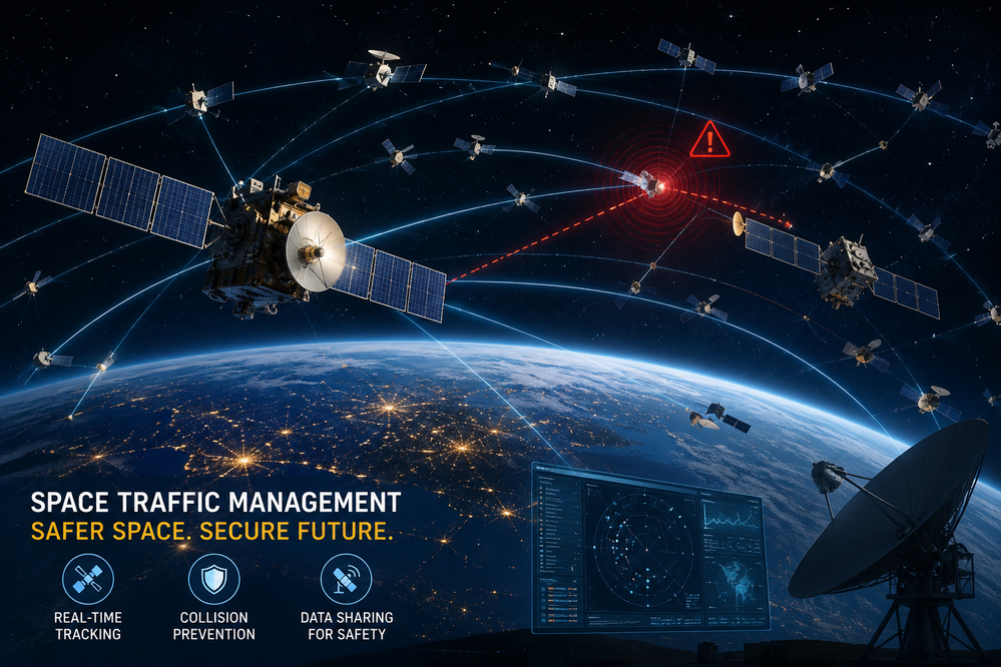
There are more than 18,000 active and inactive satellites in Earth's orbit. To reduce the risk of potential collisions and space debris, the United States has implemented a new rule requiring the real-time disclosure of their positions.
We use Google Cloud Translation Services. Google requires we provide the following disclaimer relating to use of this service:
This service may contain translations powered by Google. Google disclaims all warranties related to the translations, expressed or implied, including any warranties of accuracy, reliability, and any implied warranties of merchantability, fitness for a particular purpose, and noninfringement.
With the development of technology, the world’s powerful countries are in fierce competition in the space race. In nearly six decades, this space race has not only provided information about what lies beyond Earth, but the structures used for it are pushing the planet itself toward serious security challenges.
At night, the sky looks deserted. Apart from one or two spacecraft that appear to move like stars, space seems completely empty. But outside Earth’s atmosphere, there are thousands of satellites orbiting the planet at marathon speed.
A recent study found that the number of these satellites is so high that the risk of collisions between them is increasing. Such collisions could generate a large amount of debris in space, raising concerns that some areas of orbit could become unusable for future purposes.
Such incidents have occurred before. Although they have been rare so far, there are now more than 18,000 active and inactive satellites in Earth’s orbit. It has been more than six decades since humans expanded their reach into space. However, the number of satellites in Earth’s orbit has doubled in just the past six years.
Most of them are concentrated in low Earth orbit, increasing congestion there. Experts in the field have warned that the probability of collisions between these satellites is also rising numerically.
Currently, the US Federal Communications Commission has passed rules to modernize the satellite licensing process and implement new space safety measures, taking into account the risk of future satellite collisions, the increasing amount of debris in space, and the security risks that may arise from it.
According to the new rules, satellite operators will be required to disclose real-time data on the position of their satellites. This is expected to provide agencies managing space traffic with comprehensive information about objects in orbit and make it easier to predict potential collisions.
Although these FCC rules have broad industry support, they have reignited the debate over who should have regulatory authority over space. Because of its authority to manage radio frequencies, the FCC has played the role of satellite regulator for decades. But as the space industry has expanded, US lawmakers have argued that this responsibility should be given to the Department of Commerce. According to them, the Department of Commerce can coordinate more closely with the industry and make the US space sector globally competitive.
Lawmakers from both major political parties have also supported this proposal. In February, Republican member of the House Science Committee Brian Babin and Democratic member Zoe Lofgren wrote to the FCC, urging it to suspend or amend the new rules. They claimed that the FCC does not have clear legal authority to regulate space activities other than space safety, space traffic management, or communications.
The FCC has not publicly responded to that letter. However, on Wednesday, the commission unanimously passed the new rules.
Rapid Expansion of the Space Industry
As companies like SpaceX, OneWeb, and Amazon continue to launch hundreds to thousands of new satellites, the debate over space regulation has intensified.
According to Tom Stroup, president of the Satellite Industry Association, not enough has been done to ensure the sustainable use of space and prevent collisions. He says time is of the essence. For example, SpaceX has proposed a plan to build a massive constellation that could include not just over 100,000, but up to 1 million satellites in the future.
According to Stroup, such safety rules should have been implemented five years ago. “We can’t afford to wait another five years,” he said.
What Changes Will the New Rules Bring?
Currently, objects in space are monitored by government and private company telescopes and radar. But these systems have limitations. On the other hand, although satellite operators have real-time information about their satellites’ positions, they have been reluctant to share this data with third parties due to privacy and commercial interests.
According to Adam Marsh, Vice President of Technical Solutions at commercial space monitoring company LeoLabs, most operators are now willing to share data. But the new FCC rules make this mandatory and require that the shared information be accurate and timely.
According to the FCC, in the absence of quality data, monitoring systems must rely solely on their own observations, which can miss even small or sudden movements of satellites. Therefore, the new system is expected to make risk assessment of potential accidents more reliable.
Licensing Process Also Simplified
The new rules aim not only to improve space safety but also to simplify the satellite licensing process.
The industry has complained that the current system is lengthy and expensive due to excessive paperwork, technical reviews, and strict standards. The FCC has now announced that, instead of the old system that forced companies to follow a detailed process, it will implement a “performance-based” system where companies can demonstrate that they meet safety standards.
According to Derek Huerter, former SpaceX official and founder of Eclipse Space, this will provide significant relief especially to small companies and startups. He said that since the current licensing process requires a security deposit worth hundreds of thousands of dollars, it has made market entry difficult for new entrepreneurs.
According to him, the new rules will make the licensing process faster, clearer, and less expensive, which will further accelerate the development of the space industry.
According to Stroup, the rapid expansion of the space industry has also increased its national importance. “With the industry’s growth, new challenges have emerged,” he said, “but these are challenges that must be addressed.” (With agency assistance)