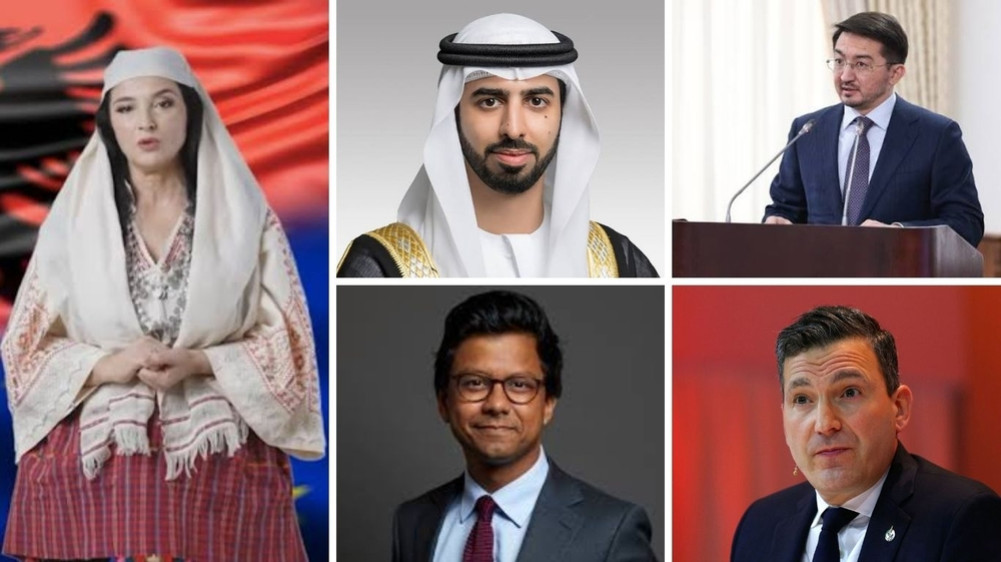
Countries including the UK, UAE, Canada, Kazakhstan, and Albania have begun appointing AI ministers and are competing in government services and digital transformation.
We use Google Cloud Translation Services. Google requires we provide the following disclaimer relating to use of this service:
This service may contain translations powered by Google. Google disclaims all warranties related to the translations, expressed or implied, including any warranties of accuracy, reliability, and any implied warranties of merchantability, fitness for a particular purpose, and noninfringement.
Giving special importance to artificial intelligence (AI), the United Kingdom has appointed Kanisk Narayan as the country’s first AI minister. Prime Minister Andy Burnham assigned him this new responsibility, placing him at the highest level of the cabinet.
Narayan will now lead the UK’s AI strategy and the AI Safety Institute. Previously, he served as Minister of State for AI and Online Safety in former Prime Minister Keir Starmer’s government.
Narayan, who was born in Muzaffarpur, Bihar, India, moved to the UK with his parents when he was 12 years old. According to The Print, after becoming minister, he described AI as the most important technology in human history and said its impact would be greater than many other things. “The proper use of AI will help reindustrialize the UK, strengthen national security, and improve public services,” Narayan said. “There are also risks with AI. The public’s concerns and fears about the acceleration of job changes and transformation are legitimate.”
Minister Narayan noted that there is now very little time left for countries to decide whether to shape AI or let AI shape them, and that the UK has reached this decisive moment. However, the UK is not the first country to establish a separate ministry for AI. In 2017, the United Arab Emirates (UAE) became the first country in the world to appoint an AI minister. There, Omar Sultan Al Olama has been handling this responsibility. In 2023, Time magazine included Omar in its list of the 100 most influential people in AI.
Minister Omar is implementing the “AI Strategy 2031” with the goal of making the UAE a global leader in the AI sector. He has introduced a policy requiring every government ministry to appoint a “Chief AI Officer.” In addition, under his leadership, there are programs to train 100,000 programmers and to encourage tech startups.
Canada appointed Evan Solomon as AI minister in 2025. Solomon has prioritized building Canada’s own AI infrastructure and data centers. His main objective is to retain skilled AI researchers in Canada and maintain economic independence. He is also preparing rules for the use of AI in the private sector and standards for data privacy.
Similarly, Kazakhstan appointed Zhaslan Madiyev as Minister of AI and Digital Development in September 2025. According to local media outlet Astana Times, Madiyev has been working to establish the largest supercomputing center in Central Asia. He aims to fully digitize government services and increase the use of AI in e-governance systems. He has also been actively participating in global forums such as the United Nations AI Conference, which sets international standards and governance for AI.
European country Albania, however, has taken a different approach by introducing a virtual AI minister named “Diella.” Prime Minister Edi Rama introduced the digital minister to control corruption in government services. Diella is responsible for monitoring government tenders and ensuring that contracts are free from corruption. This AI minister also answers citizens’ questions through the government portal and helps streamline administrative processes.
After Diella was appointed as a cabinet-level minister in October 2025, Albania’s opposition party criticized it as “propaganda fantasy” and responded by saying they would take the matter to court, according to a Time magazine report. “Some have described me as unconstitutional because I am not a human,” Diella responded via video at the time, “and that has hurt my feelings.”
Time’s analysis is that appointing AI as a minister in Albania is no longer just a show or political drama, and that governments in various countries have started incorporating AI into their systems. “Governments are increasingly using AI to reduce administrative hassles, speed up service delivery, and assist in decision-making processes,” wrote Time editorial fellow Tharin Pillay. “With appointments like Diella, will we one day reach a point where AI is not just a supporting tool but is actually given the authority to make decisions in running the government itself? That question has now arisen.”