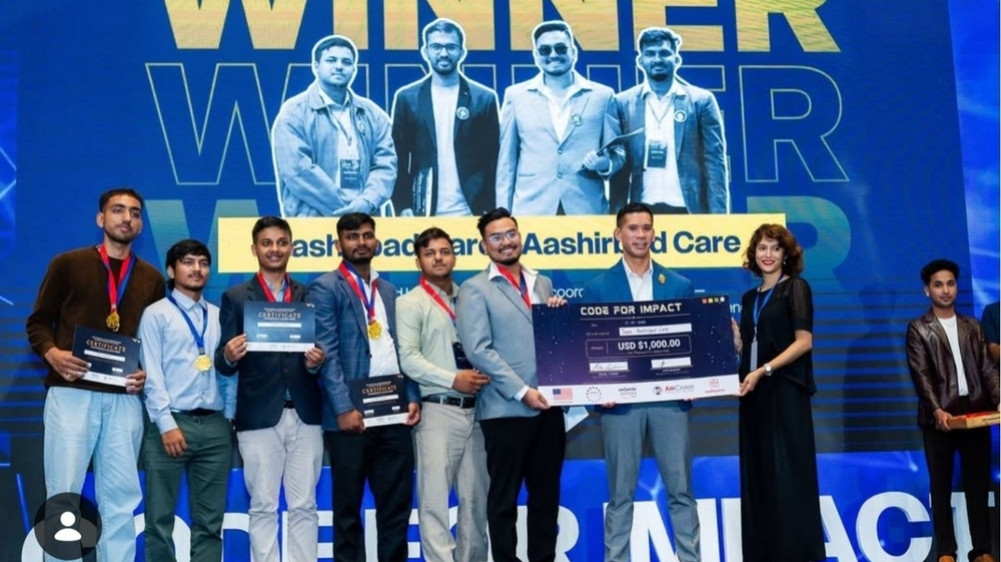
Four of the top seven teams in the 'Code for Impact' hackathon have won cash prizes and additional resources for their innovations in AI, tourism, and education.
We use Google Cloud Translation Services. Google requires we provide the following disclaimer relating to use of this service:
This service may contain translations powered by Google. Google disclaims all warranties related to the translations, expressed or implied, including any warranties of accuracy, reliability, and any implied warranties of merchantability, fitness for a particular purpose, and noninfringement.
Four teams have won $1,000 each as the best out of 190 teams participating in the six-month innovation journey ‘Code for Impact’ for young entrepreneurs in Nepal.
Neptu, Data Hitti, Synaptic and Aashirwad Care won cash prizes in the competition, which was supported by the US Embassy and organized by Adyanta Advisory.
The top seven groups and four national winners were announced at the event held on Friday. These teams have received cash as well as Amazon Web Services Cloud credits and ongoing mentorship opportunities.
Other teams that made it to the top seven of the competition include Access Code, CAD Coder and Mithila Coder. The winning teams are working on ideas such as elderly care, AI-based tourist destination identification and developing a learning system for children with disabilities through augmented reality (AR) technology.
Speaking at the awards ceremony, Mike Harker, the US Embassy's Chief of Public Affairs, said that the creativity of Nepali youth and the collaboration of American technology will create new opportunities. He compared entrepreneurship to climbing Mount Everest, noting that reaching the summit is not the only success, but only half of the journey. 'Success requires strong partnerships and preparation,' he said.
Stuti Basnyat, co-founder of Adynta Advisory, said that the program is not just a hackathon but a bridge to turn new ideas into sustainable businesses. She said that the main achievement of the program is connecting technology to solving real problems of people.
'AI is changing the equation of economic success, now a small team can sit in Kathmandu or Janakpur and create a product for the global market,' she said, 'But, technology alone is not everything, understanding people's problems, gaining trust and collaborating is a big thing.'
American Chamber of Commerce (AMCham) Nepal President Kailash Bijayanand said that technology is not an end in itself but a means to an end. He encouraged entrepreneurs to find solutions that will have a positive impact on people's lives. He said that collaboration and coordination between multiple organizations is necessary to build a strong business system.
At the event, Global Impact Collective founder James Barnard suggested that investors look for a strong business model rather than just technology. According to him, any startup can succeed only if it can strike a balance between users, customers, and investors. The teams participating in the competition presented innovative technologies to solve problems in the agriculture, health, education, tourism, and financial sectors.