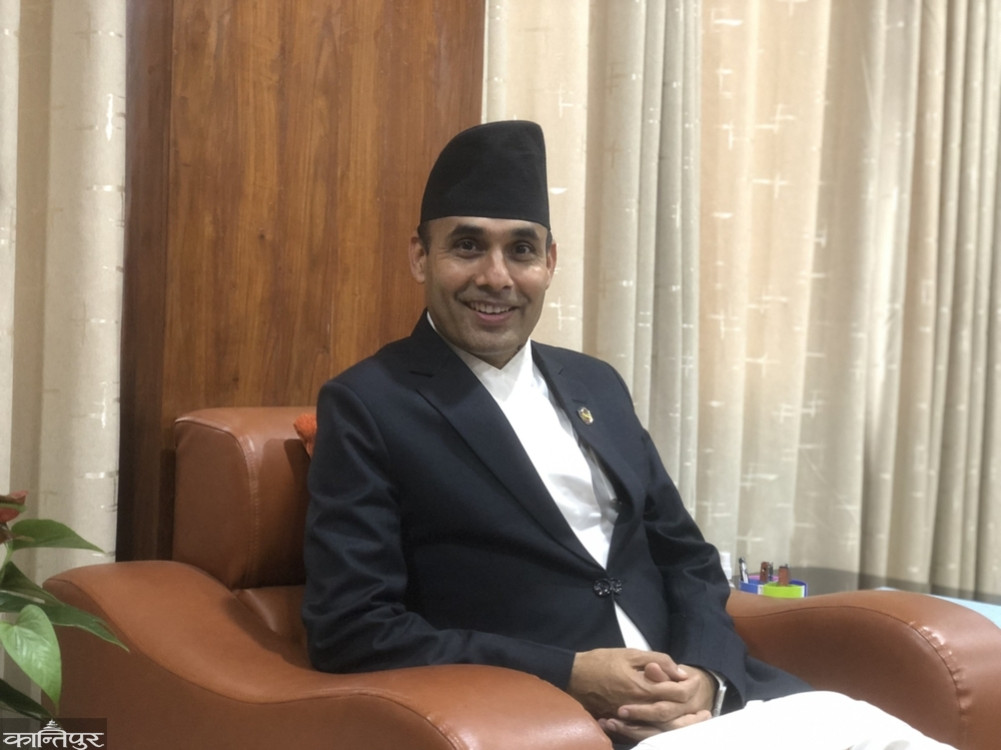
Communications Minister Timilsina's time was spent on portfolio management, policy confusion, and few efforts, along with the pressure to introduce new programs.
We use Google Cloud Translation Services. Google requires we provide the following disclaimer relating to use of this service:
This service may contain translations powered by Google. Google disclaims all warranties related to the translations, expressed or implied, including any warranties of accuracy, reliability, and any implied warranties of merchantability, fitness for a particular purpose, and noninfringement.
Although the Rashtriya Swayamsevak Sangh (RSS) government has been announcing that it would give special priority to the information technology and communication sector since the election, it decided to transfer the important part of the Ministry of Communications, 'Technology', to another ministry after the government was formed. As a result, the first 100 days of Communications Minister Bikram Timilsina, who is also a former journalist, were spent in portfolio management, policy confusion and some efforts, along with pressure to bring new programs.
Since the formation of the RSSW government, the form, scope and role of the former Ministry of Communications and Information Technology have been continuously revised. When Prime Minister Balendra Shah selected ministers on Chaitra 13, those who knew him as a former media person and communication teacher looked at him with interest. He was also automatically portrayed as the government's spokesperson. However, breaking the tradition of the Minister of Communications being the government's spokesperson, Prime Minister Shah gave this responsibility to Education Minister Sasmit Pokharel.
Then, on Baisakh 30, through the work division regulations, 'Technology' was removed from the name of the ministry and it was limited to the 'Ministry of Information and Communications'. Along with this, important bodies under the ministry such as the Department of Information Technology, National Cyber Security Center, Integrated Data Management Center have also been abolished and brought under the Prime Minister's Office. Important projects such as the Nepal Digital Transformation Project, Nagarik App, and Hello Government have also been transferred under the Prime Minister's Office. Some have been sarcastic about the removal of technology from the Ministry of Communications in the digital age, while others have pointed out that it is necessary.
Minister Timilsina has his own argument about the removal of technology from the ministry and the reduction in scope. 'Information technology was not removed from the ministry because it was not important, but rather it was taken under the Prime Minister's Office to work with more seriousness and special priority,' he told Kantipur. 'Those projects were transferred to the Prime Minister's Office because special efforts are required for the Digital Nepal Framework and e-governance work.' He said that work on AI governance and cyber security is being carried out from there.
The budget of the Ministry of Communications for the coming fiscal year has shrunk to Rs 5.93 billion compared to the previous year. The employees say that Minister Timilsina has continued to fulfill the commitments he had made amidst these challenges without much fuss and has built an image of a 'gentle minister'.
Compared to the previous year, the budget of the Ministry of Communications for the coming fiscal year has shrunk to 5.93 billion rupees. The employees say that Minister Timilsina has continued to fulfill the commitments he had made amidst these challenges without much fuss and has built an image of a 'gentle minister'. 'The commitments were not very big and ambitious, he is doing well,' said a senior employee of the ministry, 'But, the role of the ministry is nothing these days. It has become clear why a separate ministry is needed to regulate the postal, telecom and film sectors. When the Ministry of Communications should be made effective and big, the technology-friendly government has shrunk it. The minister could not take a stand on this.'
Stakeholders in the telecommunications, internet and information technology sectors have also viewed the ministry's 100-day activities in a mixed light. Although the government seems to be trying to work honestly, there is no relief in the internet sector, said Sudhir Parajuli, president of the Internet Service Providers Association Nepal (ISPAN). “The government still considers the internet as a luxury item and has not reformed the tax structure,” he said. “The laws are old-fashioned. There has been no effort to reform it.” However, he noted that the Security Printing Center of the Ministry of Communications has improved the printing and distribution of licenses.
The government had started printing driver’s licenses using its own printing machine since last Kartik. The Ministry of Communications had set a target of printing 2.9 million licenses by mid-Asad 2083, and so far 2.389 million smart licenses have been printed, Minister Timilsina said. This number is 82.4 percent of the total target. He said that work is being done to complete the remaining printing by mid-Asad. He mentioned that in the case of the newly received 217,968 applications, the data was completed and made available within 24 hours of receiving it from the Department of Transport Management.
The ministry also said that 86,310 licenses printed from the printing center have been transported to the transport offices of the respective districts. 1,089 driving licenses have been delivered to the homes of service recipients in 7 districts including Kaski, Morang, Banke, Sunsari, Baglung, Kalikot and Parsa. The system has been linked so that applications for driving licenses can also be made through the Nagarik app. The system for receiving police reports through the app has been implemented and 836 media and web portals have been monitored and 46 have been sent to the Cyber Bureau for action, the ministry said.
Despite the much talk of information technology by the Rashtriya Swayamsevak Sangh (RSS) government, Vice President of the Asian-Oceania Computing Industry Organization (Associated), Nawaraj Kunwar, comments that despite the much talk of information technology by the RSP government, it has not been implemented. ‘I don’t think a single work has been done in the 100 days of the Ministry of Communications,’ he said, ‘No matter how much the government has talked about digital, we haven’t been able to feel that a single work has been done yet. We haven’t seen any achievements in the media sector either.’ Kunwar believes that the ministry is trying to move forward without a basis. According to him, there has been talk of integrating all services. But there is no necessary infrastructure for that. ‘In a country like ours where electricity and internet access have not yet reached everywhere, the first task for digital transformation is to reduce internet fees and taxes,’ he said, ‘But, that has not happened. Despite all this, I am optimistic that we will see for some more time.’ Advertising experts and stakeholders have also commented that there has been no concrete achievement for the media sector in the ministry’s 100-day activities. Although the media sector is expected to get relief, especially in matters such as advertising policy and direct payment for advertising, they understand that the media sector is in crisis due to its lack of implementation.
Advertisers are somewhat concerned about the issue of establishing a fund envisaged by the advertising policy. Ranjit Acharya, head of Prisma Advertising, says that it is important to be clear about where the money in the fund will come from. “If additional taxes are imposed on advertising business or the facilities provided to agencies are reduced, it will discourage the market,” he said. “Since the burden of such taxes will be passed on to the consumer, it does not seem practical to collect money from advertising business.”
As the government abruptly canceled political appointments, many media-related organizations were left without leadership. Although this has affected daily administration to some extent, Minister Timilsina says that work has been carried out by untying the knots in the areas where there were obstacles. “The new appointment process was carried out with the aim of requiring a team that works according to the same spirit in the new situation,” he said. “Appointments have already been made in many places and work is progressing, so there is no major impact now.”
On Ashad 19, Minister of Communications Timilsina had given appointment letters to the newly appointed General Manager of Gorkhapatra Sansthan, Hikmat Bahadur Rawal, and the newly appointed Executive Director of Surakshan Mudran Kendra, Devraj Dhungana, and directed them to ensure institutional good governance, transparency, and lawful performance.
The ministry has stated that 26 betting apps and 248,676 domain links of illegal online betting operating in Nepal have been closed in the past 100 days. It said that 266,451 passports have been transported to the concerned District Administration Offices through post and 6,118 passports have been delivered to the doorsteps of service recipients in 75 districts.
According to the ministry, after providing an additional 5 MHz frequency in the 900 MHz band to improve Nepal Telecom's services, the speed of 4G internet has increased by 59.7 percent and data traffic has improved by 24.2 percent.
Some social media users criticized Minister Timilsina for linking the package announced by Nepal Telecom to the government's 100-day agenda. The criticism came after Minister Timilsina posted on Facebook that Nepal Telecom would provide various packages to prepaid service customers under a subscription-based model, eliminating the need to reactivate packages every month.