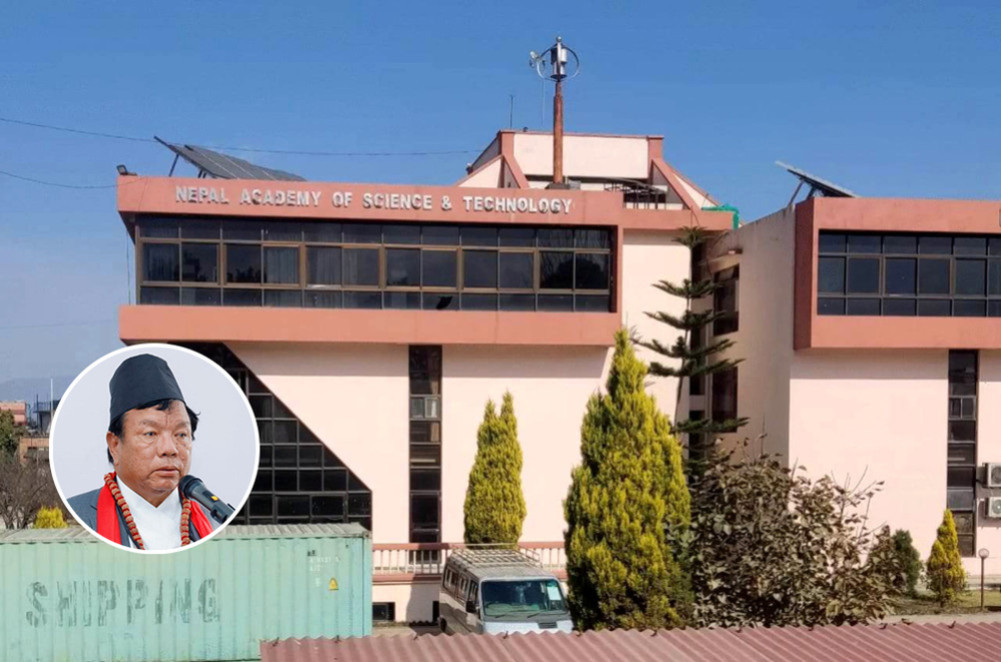
Minister Mahavir Pun has proposed a radical change plan, calling the 33-year-old NAST an institution burdened with 'administrative burden'. NAST employees have commented that the ministry is trying to move forward alone instead of coordinating when the leadership (vice-chancellor) is vacant.
We use Google Cloud Translation Services. Google requires we provide the following disclaimer relating to use of this service:
This service may contain translations powered by Google. Google disclaims all warranties related to the translations, expressed or implied, including any warranties of accuracy, reliability, and any implied warranties of merchantability, fitness for a particular purpose, and noninfringement.
The Ministry of Science, Technology and Innovation and the Nepal Academy of Science and Technology (NAST) have started to have differences over the issue of amending the act and restructuring. A complaint has also been filed with the Commission for the Investigation of Abuse of Authority against the restructuring plan.
Minister Mahavir Pun has put forward a plan for radical change, calling the 33-year-old NAST an institution burdened with an 'administrative burden'. NAST scientists and officials are unhappy that the ministry is trying to interfere with the autonomy of the academic institution.
Minister Pun has admitted to interfering in NAST. 'There will be interference, we did not try to interfere, the interference has already happened because they were drunk because they did not interfere,' Pun said, 'There was a lot of political maneuvering there, the institution was ruined because they were divided into political maneuvering.' Therefore, it will have to be improved by intervention.' Expressing dissatisfaction with the current state of NAST, he said that he is keen to make it free from politics.
Minister Pun said that out of the total budget of Rs 450 million, Rs 270 million, or about 75 percent, of NAST's total budget of Rs 450 million, NAST is being spent on employee salaries and administrative work. According to him, NAST has been emphasizing academic matters more than innovation. He pointed out that since its board consists mostly of academics, innovation work has lagged behind and the number of employees is now very high.
'We will do the exact opposite now, hiring more researchers and reducing administrative staff,' Pun said, '50 years ago, there was neither information technology nor were there as many universities as there are now.' Since the NAST Act was made in 2049, it is not relevant to the times now and I have tried to make major changes to it and move forward.'
While there is a provision in NAST that the Prime Minister is the Chancellor and the Minister of Science and Technology is the Pro-Chancellor, Minister Pun is now preparing to change that too. For this, the Ministry of Science has already sent a proposal to amend the provisions of the 'Nepal Academy of Science and Technology Act 2048' to the Ministry of Law, Justice and Parliamentary Affairs. Pun has concluded that the existing system has led to political division in NAST.
'Now, the position of Chancellor will be removed from NAST and a Director will be added,' he said. 'The institution will be run under the leadership of experts and new and energetic youth will be brought in after respectfully bidding farewell to the old ones who are occupying the post.'
Scientists and employees of NAST have viewed the minister's move with suspicion. NAST spokesperson Ramchandra Poudel said that although the restructuring of the institution is necessary, the path taken by the ministry is not the right one. ‘When he was the first minister, we had requested him to restructure NAST, but the path the ministry is taking in the name of restructuring now has us worried,’ said Poudel. ‘The ministry is said to do research work. Scientific research cannot be done through the bureaucratic system, work does not progress when files start circulating in the hands of employees.’
The issue of restructuring NAST is not a new issue that has only arisen recently. During the time of former Vice-Chancellor Dr. Dilip Subba, seminars were organized for the reform of NAST and various suggestions were collected, recalls academician Dhan Bahadur Karki. ‘NAST needs to be expanded to all seven provinces,’ he said, ‘We should not only focus on advanced technology, but also prioritize our own religion, culture and traditional local technology and take it to self-reliance.’
Another scientist at NAST complained that they were trying to jeopardize their existence by talking about restructuring outside and inside without any information or formal letter to them. According to the academic, the Division of Work Regulations 2083 have been amended to directly mention that the ministry should do research work, thereby weakening autonomous bodies like NAST. ‘Instead of giving more authority to NAST in the backdrop of the failure of universities and other research bodies, the ministry itself is trying to trap research in the clutches of bureaucracy,’ he said.
The ministry will form a group of experts from outside and discuss, but there has been no official coordination with them on what is happening within the institution and what the problems of the employees are.’ He said that daily work is often at a standstill due to the vacant posts of Vice Chancellor and Secretary at NAST. ‘The restructuring we want is to remove unnecessary pressure from employees and give full authority to scientists in research,’ said Spokesperson Poudel, ‘We want the Prime Minister to remain our Chancellor because scientists seek not only money from the state, but also appreciation and encouragement for their work. It is more effective to get encouragement from the Prime Minister.’ Minister Pun said that he has taken a stand to remove the Prime Minister from the position of Chancellor.
Ministry spokesperson Monica Jha said that interest groups have filed a complaint with the Authority while trying to bring transparency in the restructuring of NAST and the selection of awards. In the complaint filed this week, the ministry has been accused of trying to influence the autonomy of NAST and doing negative publicity. The ministry is accused of trying to seize the NAST Act and its autonomous status under the pretext of making the grants and awards given by NAST transparent.
Minister Pun responded that autonomy does not mean that it cannot be done arbitrarily. ‘Autonomy is only about doing work, you cannot do whatever you want after getting the government’s budget,’ Pun said, ‘Either you have to find your own budget and run it, or you have to be accountable after getting the government’s money. The trend of hiring unnecessary people, paying salaries without giving them work, and disobeying the ministry under the guise of political power will now end.’
When the leadership (vice-chancellor) was vacant, NAST employees say that instead of coordinating, the ministry tried to move forward alone. ‘This organization was established to be free from bureaucratic hassles and have complete autonomy in scientific activities,’ said Spokesperson Poudel. ‘However, after the advent of democracy, political interference increased and people with political beliefs started coming to the leadership rather than experts.’ This has resulted in a cumbersome administrative structure and increased the influence of administration employees over scientists, which has prevented young scientists from being attracted.'
Poudel says that to make NAST effective, the practice of nominating academics based on political affiliation should be ended and a provision should be made in the act to select them based on purely academic and scientific criteria. He pointed out that since the office bearers have been vacant at NAST for a long time, there has been an obstacle in the work, so a capable, high-academic profile and a Vice-Chancellor who understands the current needs should be appointed immediately. Poudel said that since skilled scientists with PhDs or post-docs cannot be attracted through the current cumbersome process, a separate and simpler method should be adopted for scientific selection. He said that innovation work can also be done through NAST.
NAST officials say that there is no need for the ministry to open such centers separately since NAST has currently opened innovation centers in all seven provinces. But Minister Pun pointed out that the innovation centers of the provinces are also just names. "It has only been a matter of spreading the budget by renting a room and hiring one or two people," he said. "Now the ministry itself will take the work forward by creating a separate innovation hub for the public and an innovation lab in the university for students."