Vibe coding is a method of creating software according to the needs of even those who do not know the complex language of computer programming. In recent times, its use has become widespread in the government and private sectors of Nepal.
We use Google Cloud Translation Services. Google requires we provide the following disclaimer relating to use of this service:
This service may contain translations powered by Google. Google disclaims all warranties related to the translations, expressed or implied, including any warranties of accuracy, reliability, and any implied warranties of merchantability, fitness for a particular purpose, and noninfringement.
The 'Vibe Coding' technology, which allows AI to create software within a few hours by giving the necessary instructions (prompts), has started spreading rapidly in Nepal. Government agencies and private companies have started adopting it.
The 'Software Wing' recently established by telecommunications service provider Nepal Telecom in its office has prepared about half a dozen portals and digital systems in a short time. The company has stated that it has created systems such as 'Demand Portal' to integrate demands related to telecom from wards to ministries, and 'Meeting Management Portal' to solve the problem of having many meetings but lacking space. These systems have been prepared by telecom engineers with the help of Artificial Intelligence (AI).
Prakash Chandra Sigdel, senior business officer of the company, informed that other systems such as unified ticketing system and customer care portal are also being developed. “We have automated our IP planning so that our system automatically assigns IP as soon as the request is received,” he said at a program on the current state of the telecommunications sector organized this week. “In some places, we also take the help of external vendors because we cannot compromise on quality and customer experience, but we are on the path to developing small and specialized software ourselves.”
He informed that studies are being conducted to prepare the billing system, which is considered the most important of telecom services, using similar new technology. The telecom billing system is very old and due to frequent problems, customers have been facing problems such as call drops, phone not working, balance deduction, and data not working. Not only Nepal Telecom, but recently government offices and private sector companies across the country have been generating code through AI and modifying it as per the requirements to create software applications. In technical terms, this is called vibe coding.
Vibe coding is a style of creating software according to one's needs even by those who do not know the complex language of computer programming in the general sense. Its use seems to be becoming widespread in the government and private sectors of Nepal in recent times. Its discussion has increased after large public institutions like Nepal Telecom adopted it. 'In-house coding has been found to be effective because the company itself knows the scope of what the company needs,' said Sigdel of Telecom.
It has also started to be widely used in private sector software companies. According to Nischal Shrestha, Chief Technology Officer of Amnil Technologies, the concept of 'agentic engineering' has emerged as an evolved practice of 'vibe coding' in the technology sector. In this, various AI agents do the entire work of software development themselves. ‘AI not only writes code, but also runs and checks it,’ he said, ‘These AI agents have started playing the role of project managers, architects and testers. AI can even prepare code to identify the needs of the company according to the sector in which the customer is.’
Shrestha believes that due to this ease of AI technology, Nepali engineers are now able to compete with Indian engineers. He points out that Vibe coding can increase productivity by up to 10 times. Coding and app development tasks that used to take weeks are now being completed in a few hours. However, experts point out that there are also challenges in Vibe coding. Shrestha said that those who do not understand coding will face security challenges while doing Vibe coding. According to him, not only understanding coding, but also being able to give good prompts to AI or give line-by-line guidance can increase productivity through vibe coding.
According to Rojesh Shikharkar, director of the AI Education and Talent Development unit of Fuse Machines, an American technology company that provides AI-related services, the risk of vibe coding is security vulnerabilities. He pointed out that if people without basic knowledge of programming work solely on AI, security can be seriously affected. ‘Some time ago, there was news that the Excel sheet data of a municipality was made public online, such security vulnerabilities are encountered while vibe coding,’ he said, ‘AI generates content, but if you do not pay attention to what packages it uses, the risk of cybersecurity increases.’
Recently, every company has started making it mandatory for its engineers to use AI tools. Engineers say this makes it easier to build complex systems and compete in the global market. However, some say that entry-level coders who are just entering the information technology sector are at risk of not getting jobs at all due to vibe coding. However, experts in this field point out that in Nepal, AI is not the only reason for not getting jobs, but rather the lack of skills. ‘Students in Nepal spend between 1.4 and 2 million rupees to complete their degree, but when they are interviewed, they are not even eligible for a job worth 30 thousand,’ said Gaurav Pandey, President of NAS-IT, ‘There is no coordination between the demand of the industry and the education provided by the university.’
Nowadays, the use of AI is not limited to coding. According to Naveen Jaiswal, Chief Product Officer of Coding Solutions, research work that used to take hours can be done in a few minutes using AI. He gave an example of how long documents like budget speeches can be analyzed in a short time with the help of AI to extract news points. He believes that as the capabilities of AI are improving in Nepali language as well, it will solve many problems at the local level.
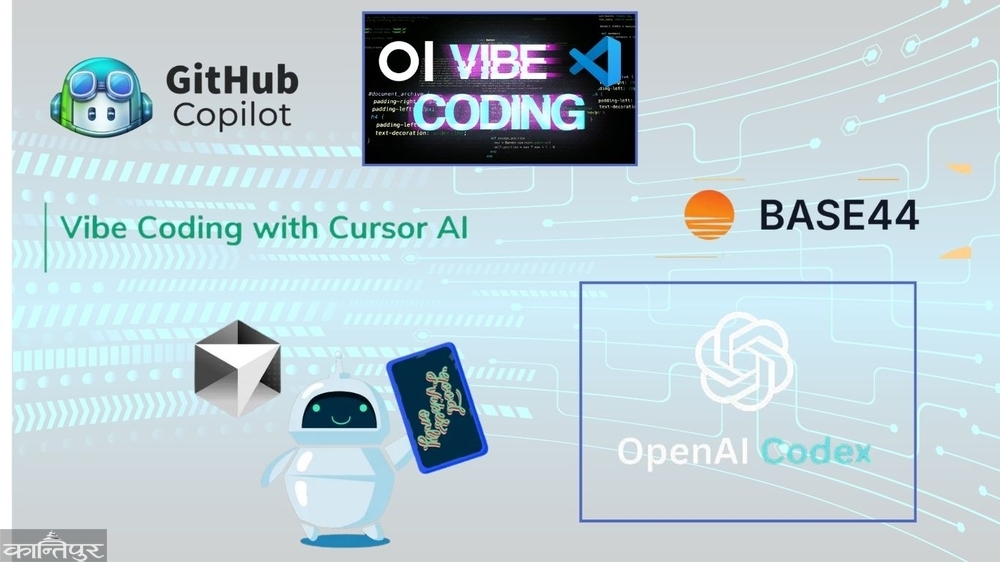
Although the journey of Vibe coding and AI engineering in Nepal has just begun, it is expanding rapidly. As its use increases, various modern tools are becoming popular. Currently, Nepali developers and engineers are mainly using tools like VS Code, GitHub Copilot, ChatGPT's Codex, Cloud and Google Gemini as coding partners. In addition, a tool called Cursor is also widely used. It not only writes code but also runs it and checks for errors and finds bugs. Vibe coding platforms like Loveable and Microsoft's Power Apps and Copilot are being used for commercial purposes. Tools like Ola are also popular as free alternatives. Similarly, AI app builders like Base44 are helping non-coding people build apps.
Internationally, large companies have also publicly stated that they are building applications using Vibe Coding and AI. Recently, Jiven Shu, the founder of an AI startup, is trying to create his own version of the popular game ‘Grand Theft Auto VI’ using a powerful AI model called ‘Cloud Max Twenty X’. He is testing whether such a big game can be built by simply giving prompts to AI without coding. Similarly, Elon Musk’s space technology company, SpaceX, recently announced plans to acquire Vibe Coding startup ‘Cursor’ for $60 billion. Journalist Maria Dutsar, writing for Silicon Angel, reported that SpaceX has given Cursor access to thousands of graphics cards to develop its model. Cursor is a platform that helps developers create complex software using simple language prompts. The fact that a company as big as SpaceX is spending such a large amount of money to buy the Viber coding platform is a good indication of where software development is headed in the future. Considering that even the world's biggest tech giants like Microsoft and Google have started writing more than 40 percent of their code with the help of AI, the journey ahead is towards agentic engineering.
'If the new generation of students do not know how to run AI agents and manage complex systems, it will be difficult for them to compete in the market,' says Shrestha, CTO of Amnil. 'It is essential for engineers to understand agentic engineering, which is a higher level of automation than AI.'