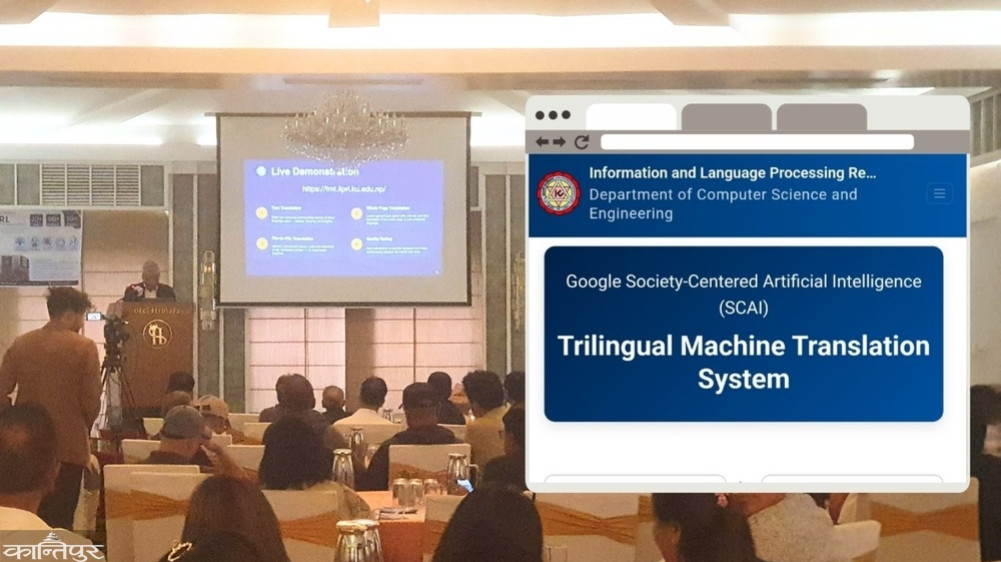
It is believed that the trilingual translation system based on AI technology will provide the Tamang community with access to the Internet's knowledge repository.
We use Google Cloud Translation Services. Google requires we provide the following disclaimer relating to use of this service:
This service may contain translations powered by Google. Google disclaims all warranties related to the translations, expressed or implied, including any warranties of accuracy, reliability, and any implied warranties of merchantability, fitness for a particular purpose, and noninfringement.
Kathmandu University has developed a trilingual machine translation system based on Nepali, Tamang and English. The university's Information and Language Processing Research Laboratory has developed this technology with the support of the Google Academic Research Award. The system will help translate information on the Internet into Tamang, said Balkrishna Bal, a professor at the university and the laboratory's chief researcher. For this, the system was prepared by collecting more than one lakh parallel sentences in Nepali, Tamang and English, he informed. The model in the translation system is currently being trained on materials from agriculture, health, education, tourism and mass media. The laboratory has stated that it will be gradually expanded to legal and other domains. It is believed that it will also act as a bridge in communication between government services and the community.
The Tamang National Library and the Department of Linguistics of Tribhuvan University have collaborated on the project. Professor Bal says that the goal is to take it to the community level and make it a useful tool, not just limited to the laboratory. Currently, this system can be run through Chrome and Firefox browsers.
‘Despite the fact that there is a population of more than 1.4 million people who speak the Tamang language, most of the knowledge available on the internet is limited to English or Nepali,’ said Professor Bal. ‘This system will help the Tamang community access that store of knowledge and spread their original culture and traditions in other languages.’
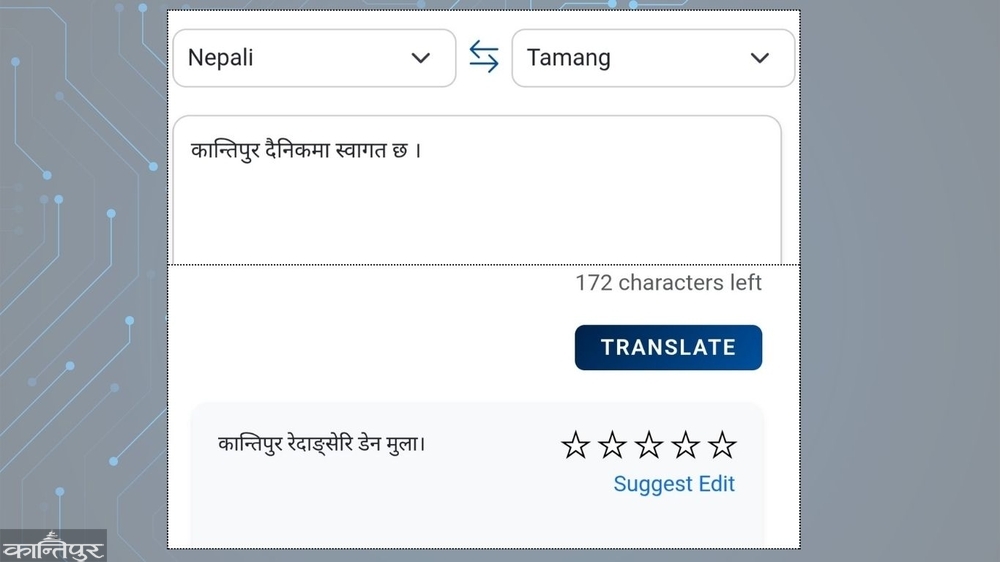
Modern artificial intelligence technology has been used in the construction of this system. For this, Meta AI’s ‘NLLB-200’ model has been trained on Nepali and Tamang data. Professor Bal informed that initiatives are being taken to include the Tamang language in Google Translate in the near future. It has a feature to read internet websites in Tamang language through a browser extension.
Tamang language and literature expert Amrit Yonjan mentioned that the digitization of Tamang language is a matter of joy for Nepali mother tongues. ‘The general public can now understand even complex materials like legal documents by translating them into their own language,’ he said. ‘Our technical team and the Tamang Language Library team worked continuously for 11 months for this project.’
Kathmandu University Professor Manish Bhattarai believed that this project was not limited to the development of the translation system but also gave a positive message to the entire community and the country.
‘We are often proud to collaborate with foreign universities, but this has shown that such a great contribution can be made to the country and the community by collaborating among universities within Nepal,’ he said. ‘This also shows how important the role of the community is in research.’