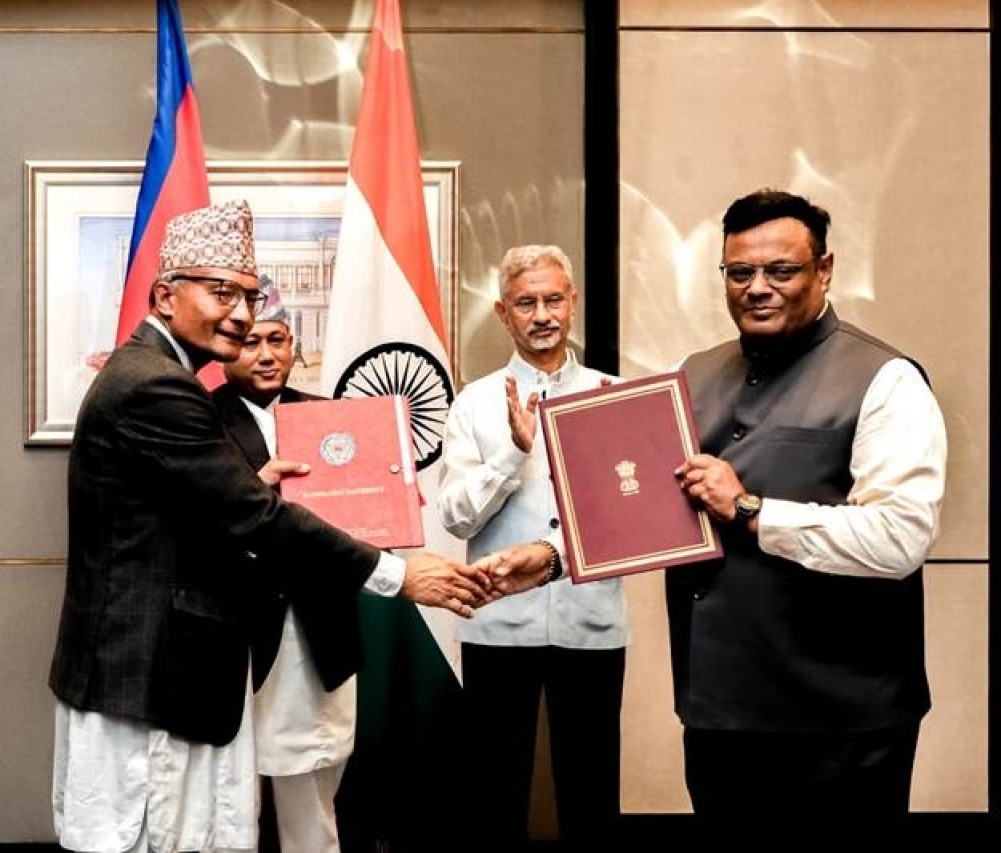
Kathmandu University and the Bhasini Division of India have signed an agreement with the aim of collaborating on digital datasets of the Nepali language, speech-to-text technology, and the preservation of endangered languages.
We use Google Cloud Translation Services. Google requires we provide the following disclaimer relating to use of this service:
This service may contain translations powered by Google. Google disclaims all warranties related to the translations, expressed or implied, including any warranties of accuracy, reliability, and any implied warranties of merchantability, fitness for a particular purpose, and noninfringement.
Nepal and India have signed an agreement between the Digital India Bhasini Division of India and Kathmandu University of Nepal with the aim of collaborating in the development of linguistic AI, multilingual digital public infrastructure and inclusive digital systems. Bhasini CEO Amitabh Nag and Kathmandu University Co-Dean Prof. Balkrishna Bal signed the agreement at a program organized in New Delhi on Saturday evening.
Indian External Affairs Minister S. Jaishankar and Nepal's Foreign Minister Shishir Khanal were also present on the occasion. The collaboration will promote language-related AI and multilingual digital systems, the statement said. 'Under this, the two entities will collaborate in the development of high-quality datasets of Nepali language and technologies such as speech-to-text and machine translation,' said a statement from the Ministry of Electronics and Information Technology of India.
It is also expected to help in the preservation and digitization of lesser-used and endangered languages in Nepal. The statement said that this initiative will play a major role in removing language and literacy barriers in digital medium. This will make it easier for Nepali citizens to access government services and education in their own mother tongue. It is believed that this agreement will further strengthen people-to-people ties and technology cooperation between the two countries. At the event, India Bhasini Division Chief Nag pointed out this partnership as an important initiative of India's commitment to building inclusive language technology. 'Bhasini's open digital public infrastructure model has the potential to bring about a radical change in digital access for millions of citizens in South Asia,' he said, 'This partnership will help expand its vision beyond India and strengthen our shared linguistic and cultural heritage.'
According to Kathmandu University's Co-Dean Prof. Bal, this understanding reflects the shared commitment between Nepal and India to harness the power of artificial intelligence for linguistic inclusivity and social impact. He said that the collaboration between Kathmandu University's Digital Public Infrastructure-AI Center and Bhasini aims to research, innovate and enhance capacity in multilingual AI. Kathmandu University has been taking various initiatives in the field of Natural Language Processing and AI.
Digital India Bhasini Division is an initiative under the Ministry of Electronics and Information Technology, Government of India. This platform, focusing specifically on Indian languages, uses AI and machine learning to instantly translate spoken or written text from one language to another, type spoken text and convert written text to voice, as well as translate and digitize files, government policies and documents in different languages.
Using its plugin, any website can be easily converted into different regional languages. It can recognize 36 languages, 23 voices and 35 international languages so far, the release states.