Huawei Nepal CEO Chester has responded positively to the government's policy, digital vision, and AI goals to make the telecommunications industry sustainable and quality.
We use Google Cloud Translation Services. Google requires we provide the following disclaimer relating to use of this service:
This service may contain translations powered by Google. Google disclaims all warranties related to the translations, expressed or implied, including any warranties of accuracy, reliability, and any implied warranties of merchantability, fitness for a particular purpose, and noninfringement.
Huawei Nepal's new CEO (CEO) Chen Keyang (Chester) says that despite Nepal having a sufficient number of skilled IT personnel, Nepal lags behind its neighboring countries in the overall communications and information technology sector. However, he described this situation as an opportunity to improve and move forward. Chester, 32, who took over as the head of Huawei Nepal in October, is optimistic about the current government's policies and initiatives in technology expansion and digital transformation.
Speaking at the 'Tech Forward: Media Dialogue 2026' program on Thursday, Chester sounded excited about the government's readiness to build Nepal's digital vision, artificial intelligence (AI), and data center. 'I am currently experiencing many positive changes, and the government's vision and 100-point program seem to have a clear vision for digitalization and its need,' he said. 'The kind of respect the government has shown towards the development of technology is a matter of joy for Huawei and the entire technology sector.'
Chester joined Chinese multinational technology company Huawei in 2015. After working in China for some time, he moved to the company's Ukraine office. There, he held positions as a solution manager, team leader, and account director. Before coming to Nepal, he worked as a 'country manager' in the Maldives for two and a half years. A graduate in physics, he believes that Nepal's telecommunications industry should be made 'sustainable' and of high quality. 'Telecommunication service providers (operators), technology providers like Huawei, and engineering partners are all going through a difficult time right now,' he said. 'If the industry itself is not healthy, no one associated with it can succeed.'
Chester told Kantipur that Huawei will focus on improving Nepal's 'technology ecosystem' in the coming days. As Nepal's telecom industry struggles to survive, the government here can learn from the Maldives about the business environment and policy clarity in telecommunications. 'Like Nepal, there are two operators there, one government-owned and the other wholly foreign-owned,' Chester said. 'Both are treated equally and fairly.' When 5G was expanded, free spectrum was given, with the condition that companies expand infrastructure. This has yielded good results.'
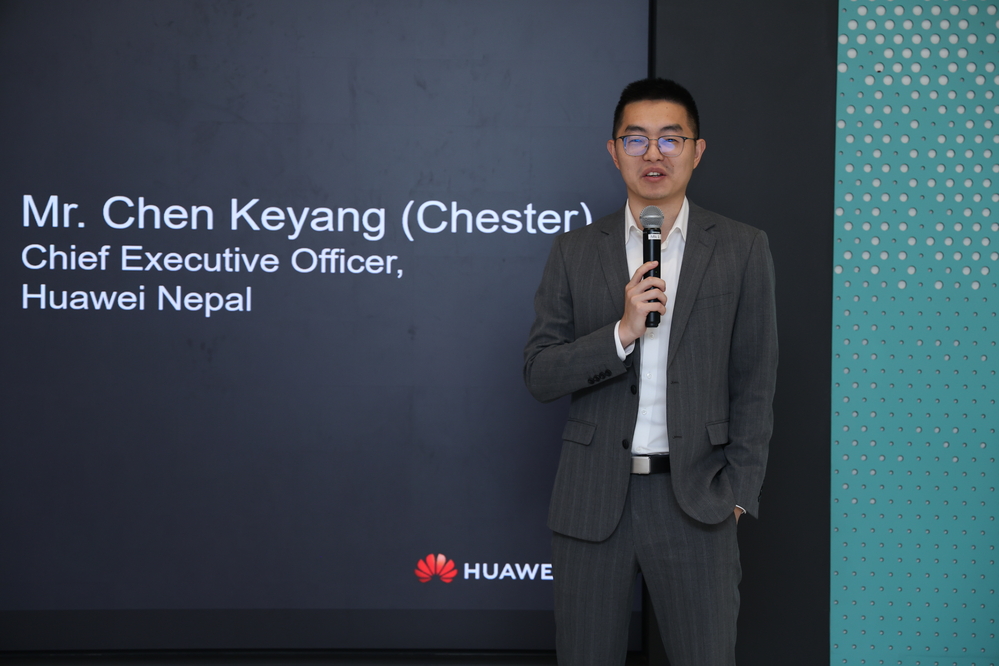
Chester says that the development of information technology should be seen not only as an expansion of a single technology like 5G, but as a basis for overall economic development. “Just as roads make people’s lives easier and productivity double, network connectivity can also contribute to the growth of a country’s GDP,” he said. “High spectrum usage fees, expensive equipment, high taxes and high electricity consumption have made the expansion and sustainable use of technologies like 5G difficult in Nepal.” According to Chester, the average cost per user of telecommunications in Nepal is one of the lowest in the world. If users want good quality service, they should be prepared to pay a little more. “In Nepal, an average user spends about $1.5 to $1.8 (about Rs. 200 to 250) on mobile per month,” he said. “In the Maldives, an average user spends about $20 per month. Since Nepal has a population of 30 million and the Maldives has only 550,000, it is not necessary to reach $20 per user in Nepal.” However, spending more than $2 is reasonable to make the industry sustainable and provide quality services.’
He says that Huawei has been working in Nepal for 27 years and the relationship is very strong. He is committed to continuing efforts to make Nepal more digital and connected under his leadership. Chester mentioned that his main goal is to raise the digital level of Nepal together with the new generation of technology enthusiasts. ‘Only by making the telecommunications sector sustainable can the foundation of the country’s digital transformation and economic future be strengthened,’ he said. ‘I feel that the new government’s activeness is creating an environment for improvement in the technology sector in Nepal.’
Chester has considered the implementation of the ‘subscription model’ in telecommunications as a major improvement. He also called the revision of the public procurement regulations a positive step. “This will create a balance between technical competence and business aspects,” he said, “and many foreign companies may be attracted to work in Nepal.” He also called the government’s goal of making Nepal a hub for AI and data centers a good one. He commented that a concrete action plan has not yet been released in the field of AI, but the government’s thinking is right.