Several Nepalis have been arrested for posting, liking, sharing, and commenting on content on social media that violates topics or information deemed sensitive by the local government.
We use Google Cloud Translation Services. Google requires we provide the following disclaimer relating to use of this service:
This service may contain translations powered by Google. Google disclaims all warranties related to the translations, expressed or implied, including any warranties of accuracy, reliability, and any implied warranties of merchantability, fitness for a particular purpose, and noninfringement.
Nepalis in exile are falling into legal traps due to a lack of basic knowledge about what is and is not allowed to be done on social media during times of emergency.
In recent times, the use of social media has become a major legal crisis for Nepali citizens, especially migrant workers, amid ongoing wars and other tensions in various countries.
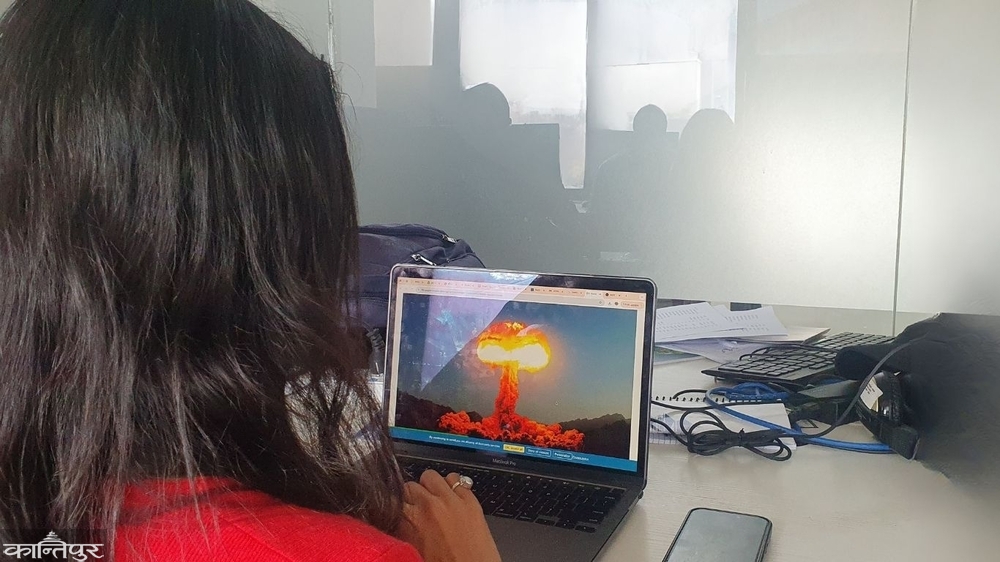
Recently, some Nepalis were arrested for taking photos and videos of explosions, missile strikes, and military activities in war or tension-ridden areas in West Asia and posting them on Facebook and TikTok. This incident has brought to the surface the lack of digital literacy among Nepalis working abroad and the dangers posed by the temptation to go viral. Questions have also been raised about the orientation training provided to those going abroad for employment and the responsible use of technology.
The Ministry of Foreign Affairs has informed that last week, three people were arrested from the United Arab Emirates (UAE), three from Saudi Arabia, and one from Kuwait. Earlier, several Nepalis had been arrested in cybercrime and scam cases. This time, two of those arrested in the UAE were arrested along with a group of 25 people on charges of damaging the country's defense system and posting misleading content using AI. Another person had already been arrested in a similar incident.
It has been found that some Nepalis have been arrested not only for posting content on social media, likes, shares, and comments, but also for sending private messages, violating the local government's sensitive issues or information.
Lok Bahadur Poudel Chhetri, spokesperson for the Ministry of Foreign Affairs, informed that in the latest incident, 7 Nepalis were arrested for posting videos and photos, ignoring the laws and security sensitivities of the respective countries. He said that the governments there have completely banned the making and sharing of videos on security-related issues.
According to him, the arrested people are in a serious situation where they could be fined a large amount of money, sentenced to a long prison term, and even deported after serving their sentences, according to local laws. He said that it is regrettable that such incidents are happening despite the ministry issuing advisories and warning repeatedly. He said that the ministry is awaiting further details from the concerned government and the Nepali embassy on this matter.
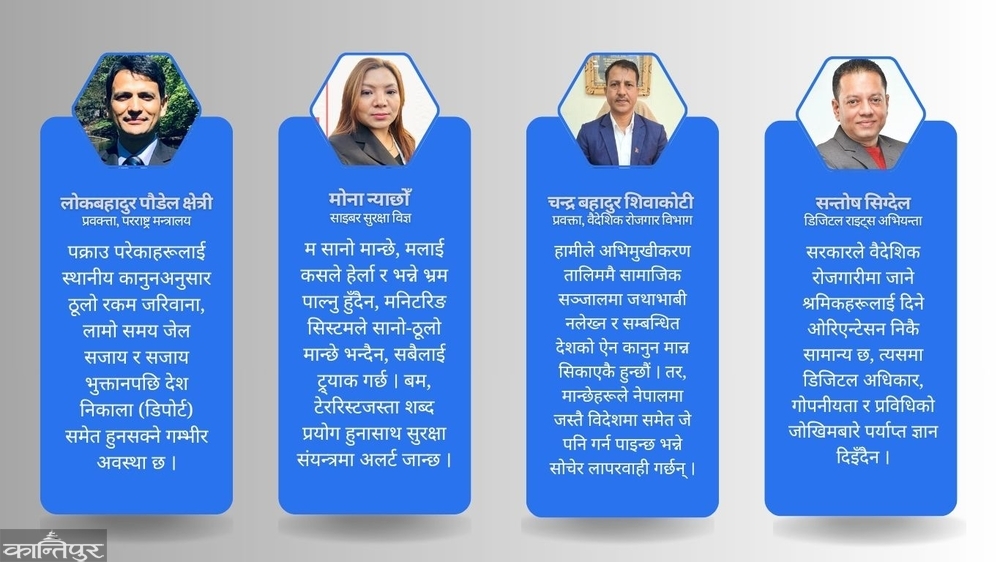
Security agencies can easily find out what kind of content is being posted from which geography and what its impact is through 'sentiment analysis,' says cyber security expert Mona Nyachon. 'I am a small person, who should not be confused about who will see me? The monitoring system does not distinguish between small and big people, it tracks everyone,' she said. 'Although private messages are not always viewed, if a person is in a suspicious situation or words like bomb or terrorist are used, the security mechanism is alerted. Even the personal chats of such users can be monitored.
She clarified that videos of explosions or misleading sound effects made using AI are considered a serious crime internationally as they create unnecessary fear and confusion in society.
According to cyber security experts, even if a user does not post anything on social media, sending sensitive content through personal messages is equally risky. ‘Security agencies in developed countries can easily find out who is sending what content and where,’ said another cyber expert. ‘Someone who sends a video or photo of their place of residence on Messenger or WhatsApp to inform their family or friends at home can sometimes be added to the digital chain and there is a possibility of arrest.’
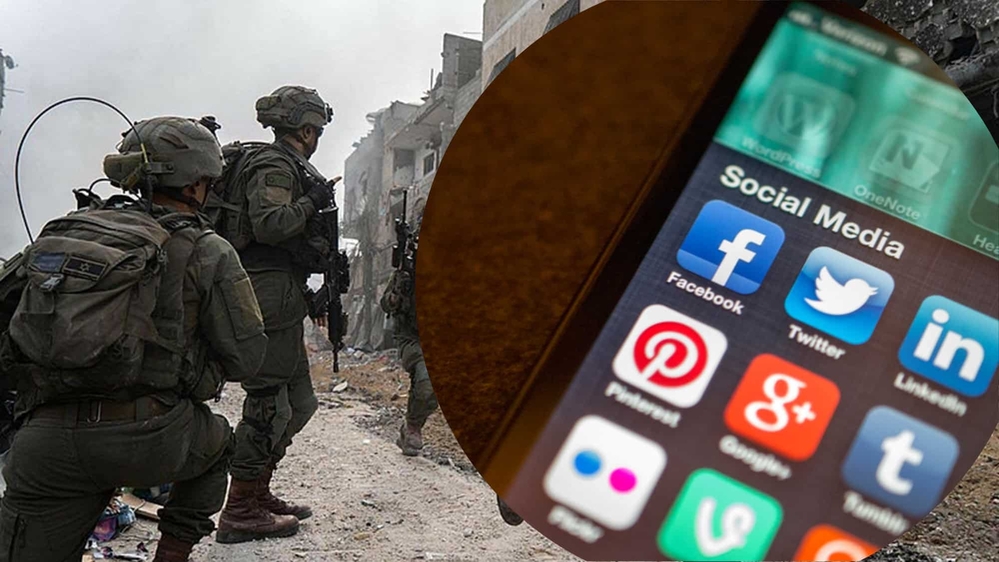
Cyber security experts point out that developed countries can easily track the digital activities of users within their country through ‘electronic monitoring’ during times of war or crisis.
Foreign Ministry officials have also warned about such incidents. “There are examples of our workers being arrested even when they send a video or sound effect of a bomb exploding, hoping that no one will notice,” said an official from the ministry. “This is not only a lack of digital literacy, but also negligence on the part of workers. Since there are exemptions in many such matters in Nepal, our citizens are making the mistake of thinking the same abroad.” Representatives of the Department of Foreign Employment say that workers have forgotten the ‘law of the land’, that is, the basic duty to follow the laws of the respective country. “We teach them not to write nonsense in orientation training and to follow the laws of the respective country,” said Chandra Bahadur Shiwakoti, spokesperson for the department. “However, people are negligent, thinking that they can do anything abroad just like in Nepal.” He complains that even though the government has provided access to information through WhatsApp and Viber so that people can talk in Nepal around the clock, some people have ignored it. He claims that embassies are also repeatedly warning against unnecessary comments and staying safe.
Digital rights activist and advocate Santosh Sigdel said that the issue should be seen as a balance between local security laws and freedom of expression. He pointed out that special sessions on digital rights, privacy and false and misleading information (mis/disinformation) are being missed in the orientation given to those going for foreign employment. ‘There is a unique practice in our society of giving breaking news so that others know what they know,’ he says, ‘due to this habit, Nepalis are ending up in jail abroad.’
However, instead of blaming only social media users, advocate Sigdel said that it is necessary to improve the weaknesses in our government policy and pre-departure orientation. According to him, the low digital literacy rate in Nepal and the lack of a clear legal framework on misinformation are unknowingly trapping workers in legal traps.
‘The orientation given by the government to workers going for foreign employment is very general, and does not provide sufficient knowledge about digital rights, privacy and the risks of technology,’ Sigdel said. ‘Unless workers are given sufficient information about the specific digital laws, privacy and the serious implications of the digital footprint of the country they are going to, they cannot understand what content to share and what not to share.’
He suggests that a policy is needed to make it mandatory for manpower companies and government agencies to provide such specific information. He said that platforms like TikTok and Facebook should also give ‘warnings’ to users in sensitive areas.
According to the recently released
‘Nepal Multi-Indicator Survey 2024/25’
by the National Statistical Office, 85.1 percent of Nepali households have smartphones and 82 percent have internet access. However, the survey shows that the state of technical skills and digital literacy is worrisome. According to it, although 57.6 percent of the population can perform at least one of 11 different computer-related activities, literacy in complex technical tasks seems to be very weak. Only 19.9 percent of those who know how to adjust privacy settings on their devices, accounts or apps can be estimated, which shows how weak technical and digital literacy is. 19.2 percent can verify the reliability or fact-check information on the Internet, while only 23.8 percent can adjust security features. Similarly, experts say that due to incomplete technical knowledge and lack of awareness, Nepalis who go for foreign employment are not sufficiently aware of the responsible use of social media and the legal complications it may cause. The traditional orientation provided by the government has not been able to alert them.


