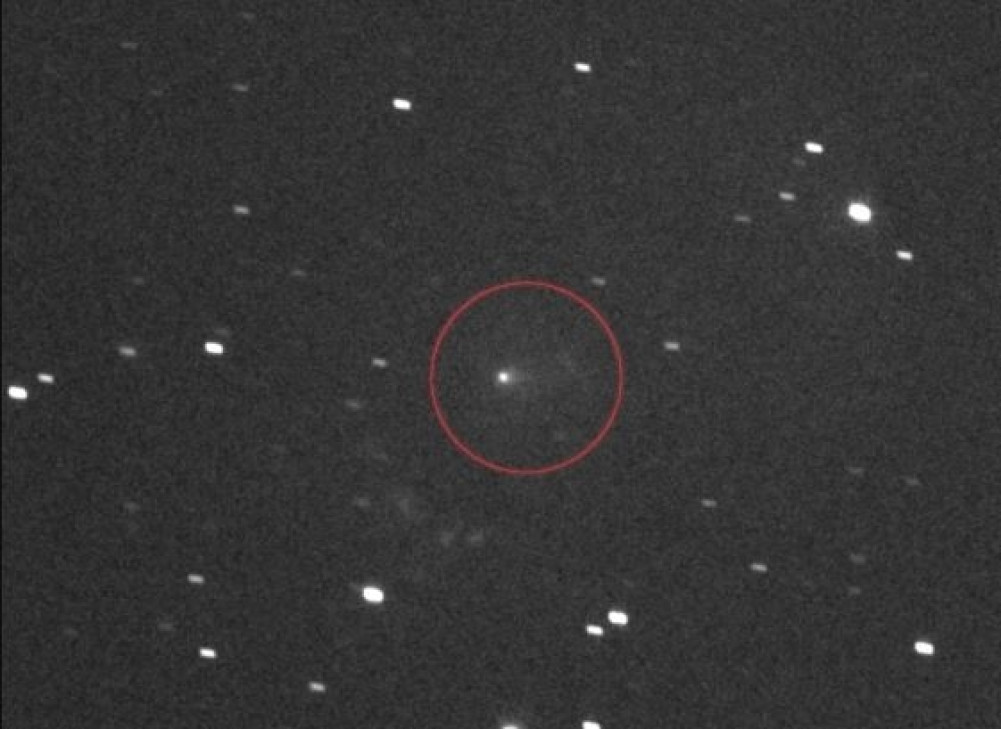
Scientists previously recorded 'Oumuamua in 2017 and 2I/Borisov in 2019.
We use Google Cloud Translation Services. Google requires we provide the following disclaimer relating to use of this service:
This service may contain translations powered by Google. Google disclaims all warranties related to the translations, expressed or implied, including any warranties of accuracy, reliability, and any implied warranties of merchantability, fitness for a particular purpose, and noninfringement.
The US National Space Agency (NASA) has just released new images of a comet traveling through our solar system.
It has been named ‘3I/Atlas’. After some time, it will go to another solar system and never return.
In English, it is called ‘comet’. According to NASA, A comet is a collection of cooled gas, rocks and dust. The speed and direction of ‘3I/Atlas’ do not appear to be tied to the Sun’s gravity. That is, this comet originated in another solar system and, while orbiting, arrived in our solar system.
Its journey has given researchers the opportunity to study objects outside our solar system. ‘It behaves like a comet.’ "All the evidence points to it being a comet," NASA associate administrator Amit Kshatriya said in a statement announcing the new images, "but it's from outside our solar system. That's why it's so unique and scientifically significant." Yes.
Last month, two European Space Agency (ESA) satellites and several NASA spacecraft zoomed in on Mars and took pictures of it.
At the time, the comet was only 29 million kilometers (18 million miles) from Mars. Scientists say its speed in space is faster than 61 kilometers (38 miles) per second. And, as it approaches the sun, its speed seems to increase.
Scientists say it can be seen in the sky just a few minutes before sunrise (Usha). However, for this, you need to use binoculars or a telescope.
Scientists have said that this comet will come closest to Earth in mid-December, at a distance of 269 million kilometers.
Its size is not yet clear. NASA has estimated that the size of this comet may be 440 meters to 5.6 kilometers in diameter.
‘We will be clearer about this later,’ said NASA scientist Thomas Statler.
Just a short time ago, NASA stated through the social network X that this comet will not pose any challenge to Earth. NASA scientists have estimated that this comet may have come from a solar system older than our own.
‘This is not only a glimpse of another solar system, but also a means of understanding the deep past.’ It gives a glimpse into a time before the formation of our Earth and Sun.
Scientists have only been able to identify three of the comets that have traveled through our solar system from elsewhere. Previously, scientists recorded Omua in 2017 and 2I/Borisov in 2019.