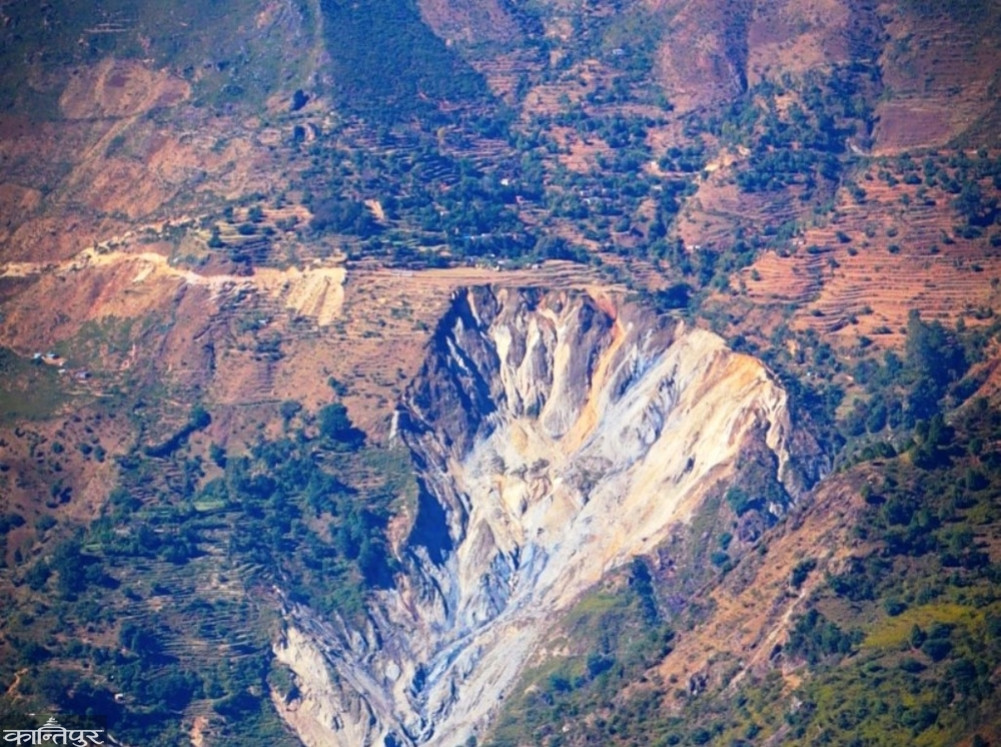
Every year, hundreds of families in Bajhang live in fear of landslides during the rainy season, with many families at high risk being forced to move elsewhere in search of safer shelter.
We use Google Cloud Translation Services. Google requires we provide the following disclaimer relating to use of this service:
This service may contain translations powered by Google. Google disclaims all warranties related to the translations, expressed or implied, including any warranties of accuracy, reliability, and any implied warranties of merchantability, fitness for a particular purpose, and noninfringement.
It has been almost 21 years since the landslide on Narugad River started. The landslide that occurred in a small area due to the erosion of the river at the bottom of Talbara, Kathkhet and Maitoli villages has spread and almost swallowed Kathkhet village.
Talbara and Maitoli villages are now the target of the landslide that is increasing every year towards the top of the village. When it rains, the residents of these villages lose their sleep at night and their peace during the day. Every night, crying, wailing and shouting have become a regular part of the villagers' daily routine. 'The landslide has reached the edge of the courtyard.' When there is heavy rain, the landslide starts rumbling. The houses shake. We are in danger,’ says Meena Bist of Talibada, ‘When the landslide starts, everyone in the village runs to the school grounds, picking up their children.’ She said that for the past three years, after hearing the landslide, they have been shouting and waking up the other villagers and running away. After the landslide started sweeping away one house after another, 68 families from these three villages in Kedarsyu-2 and 3 of Bajhang have been displaced.
76 families are living in this place amidst the risk of landslides. The landslide has left large cracks in the village. Some houses are cracked and uninhabitable. Most of the families displaced from here are living in the municipality. Locals say that some families have also been displaced to India. ‘Some of them, if they can, bought land and built houses in places where there was no landslide. Some have lived in the forest after the landslide took their houses. Some have gone to India (lost),’ said Bhujidevi Bist of Talibada, ‘We have not been able to make any arrangements . We are living in a place like Jebalajsa (like Dharap). We do not know when we will get stuck in a landslide.’
Since landslides continue to occur even in the dry season, locals say that families living here are in great fear of when an accident will occur. ‘Every year, two to four houses are washed away . Two to four families have to leave the village,’ says local Naray Bist, ‘It is a landslide like a ghost opening its mouth . When will all three villages be swallowed up We haven't been able to sleep/eat properly due to worry.' Stating that the village has been devastated due to this landslide, he said that more than 500 ropanis of land used for farming have also been swept away. 'All the fields for food have been swept away by the landslide. The houses are also being swept away by the landslide. We have no land to eat or a place to live. What to do? Where to go? We haven't been able to think of anything,' he said.
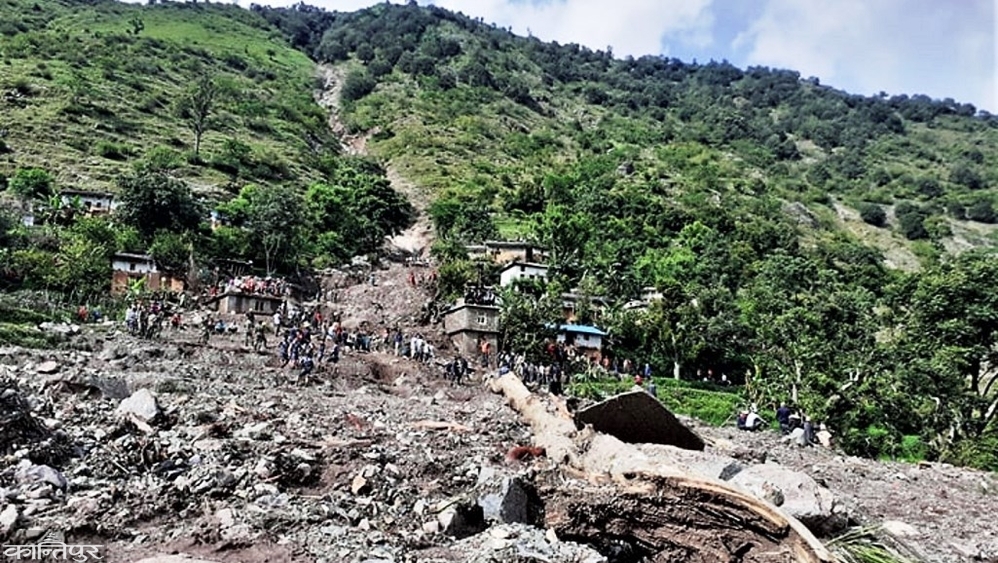
Although the locals at risk are looking for a safe place to live, they are forced to live at their own risk because they don't have their own land, he said. The risk of landslides is not limited to these three villages of Kedarsyu. It is throughout the rural municipality. A study conducted by the National Disaster Risk Reduction and Management Authority has shown that 1,356 families in 33 settlements of this municipality are at risk of landslides.
According to the study by the authority, 572 families from 18 settlements including Billi Bagar, Chaudam Bagar, Bakhet, Saisyu, Sudada, Baigad, Mallesi, Tyadigauna, Jasuda, Talikhet, Siradi, Seku are at high risk of landslides. On Asad 20, 2077, a landslide in Mallesi village in ward 8 here killed seven people, including four from the same family, and swept away 17 houses. In 2065 BS, four people lost their lives in a landslide in Bagthala, Kedarsyun.
Dikla village of Thalara rural municipality is visible just across from Maitoli, Kathkhet and Talibada in Kedarsyun. On the night of Kartik 1, 2078 BS, a landslide created a single grave for 24 people from two families. After more than 8 days of searching, only 4 bodies were found, while the remaining 19 who were not found were all declared dead. Among the missing were 18 members of Kalak Sarki's family and 6 members of Nare Parki's family. Despite losing everything, Kalak survived the horrific tragedy. He lost 18 family members in the incident, including his mother, wife, four children, brother, sister-in-law, and niece.
Kalak, who still shivers remembering the incident of 2078, is not left by the fear of landslides even after losing everything. His current house, which he built a little further from the place where the landslide occurred, is not safe either. Almost a kilometer of the road built just above Diklagaun was washed away at that time. The ground below the village towards Diklagad and in the village itself has also been torn apart in places. ‘The village was already flooded by then,’ said Kalak. ‘If it rains like that again, there will be nothing left here.’ He said that 12 families in this village have already died due to the fear of landslides. ‘Those who can afford it have packed up their houses and gone to the city market. Where should we go,’ he said.
A geological study conducted by the Disaster Authority has indicated that 23 families in his village, Lower Dikla, are at risk of landslides. The study found that 18 villages in Thalara-4, 5, 6, 8 and 9, including Regam, Dorgaun/Ainwada, Kuch, Bayal, Tallo Dikla, Toli, Duwali, Pikhet, Sunar Gaun, Bishket, Panditgaun, Ambgar, Jhyabagar, and Khani, are at high risk of landslides and the livelihoods of 542 families are at high risk. ‘If those at risk are not immediately relocated, a major accident can occur at any time,’ said Tej Bohara, who has worked in disaster risk reduction in Kedarsyu and Thalara for about three years. ‘The local and provincial governments need to think seriously about this.’ He said that some landslides can be controlled using methods such as bioengineering.
Landslides due to roads
The NEA’s study has shown that the risk of landslides has increased due to the haphazard construction of roads in areas with weak soil in terms of geology. The study found that the landslides occurred due to improper management of soil and gravel during road construction and lack of drainage system.
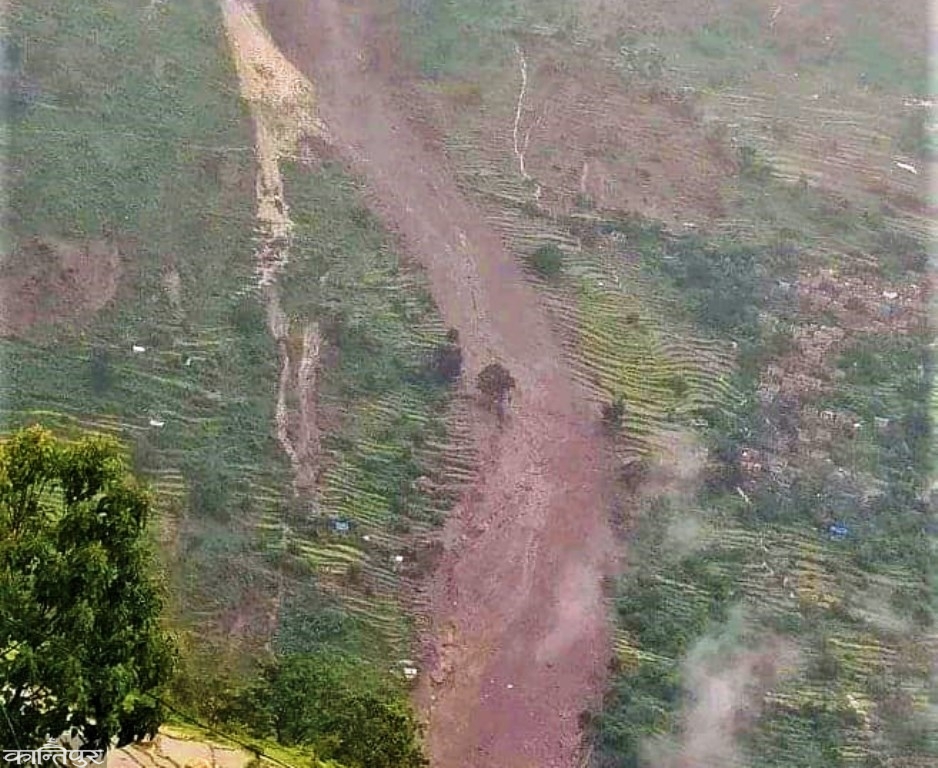
‘In some places, landslides have also started due to the loosening and breaking of underground rocks due to excessive rainfall.’ We found that landslides increased due to the landslides caused by the landslides and gravel along with gravel after heavy rainfall in these places due to steep terrain, weak geographical conditions, weak soil, and poorly constructed roads and drainage systems. We have also informed the municipality and the community about this,’ said geologist Bhatta. ‘We have submitted a report to the municipality with suggestions on what can be done to reduce the risk, including landslide control and relocation of those at high risk in these two municipalities.’
He said that if the municipality, the forest and watershed conservation offices working in the district and the provincial government do not make timely efforts to implement the suggestions given in the report, a major accident could occur at any time.
Even though the study warned of the risk, the affected people complain that the municipalities have done little to relocate those at high risk to safer places and reduce the risk. Both rural municipalities say that the number of families to be relocated is large, so it is not possible with the resources of the municipalities. ‘Many villages are in a state of uninhabitability.’ Since there may be a risk at any time, we have kept tents, utensils and other provisions ready for 1,300 families to live in after the disaster. We have also designated shelters in various places,’ says Lekhraj Rawal, disaster focal person of Kedarsyu rural municipality. ‘It is not possible with the resources of the municipality to relocate the settlements of those at risk.’
Similarly, Thalara rural municipality is also carrying out bioengineering and other works to control landslides in some places in collaboration with the NGO People in Need, but the municipality’s chairman Prakash Rokaya says that it is not in a position to relocate settlements and control major risks. ‘There is risk in many places. More than 600 families have to be evacuated. It is not possible with the resources and manpower of the municipality,’ he said. He said that he had informed the provincial and federal governments about the risk several times, but there was no response.
The risk is widespread throughout the district. According to the district disaster preparedness and response plan, 47 villages in 10 other municipalities in Bajhang are also at high risk of landslides. Earlier, a study conducted in 2018 by Geohazard International, an international organization that studies natural disasters, found that 6,630 places in 12 rural municipalities in Bajhang were at risk of landslides.
Chief District Officer Mukesh Kumar Kesari, who is also the chairman of the District Disaster Management Committee, said that there is a policy problem in risk management. ‘The government provides Rs 5 lakh as a relief after someone’s house is swept away by a landslide.’ "But it is not possible to spend 50,000 to make that house safe and adopt measures to prevent landslides," Kesari said. "It seems that the problem is getting worse in some places due to such policy problems."