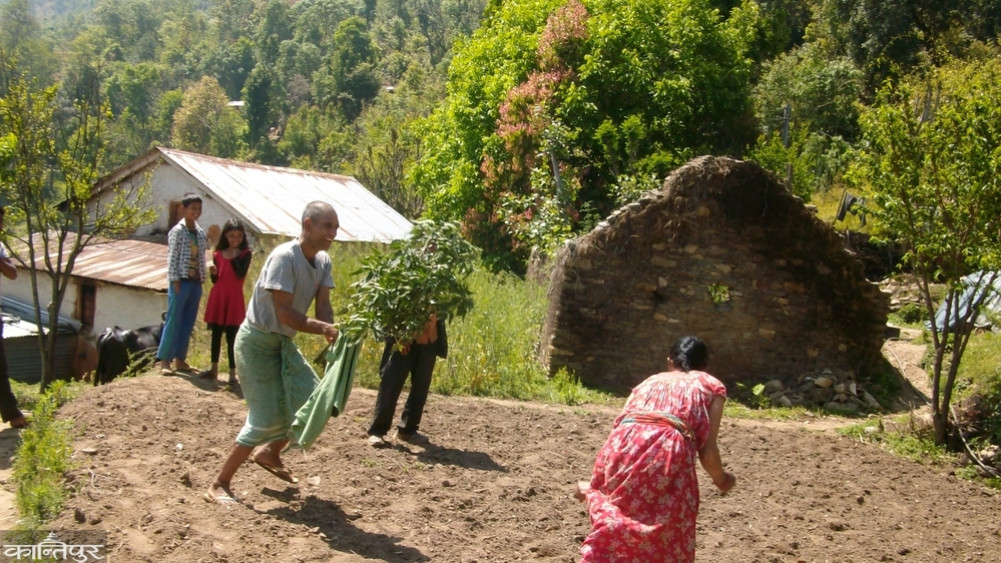
Stakeholders claim that the Sisno festival acts as a medium to make people aware of time and change. Bisu festival is being celebrated with original traditions in the Far West.
We use Google Cloud Translation Services. Google requires we provide the following disclaimer relating to use of this service:
This service may contain translations powered by Google. Google disclaims all warranties related to the translations, expressed or implied, including any warranties of accuracy, reliability, and any implied warranties of merchantability, fitness for a particular purpose, and noninfringement.
While the New Year is being celebrated as a modern festival across the country, the Far West is welcoming the Bisu festival with its own originality and ancestral heritage on its shoulders. In the Far West, the New Year is considered a special opportunity to renew nature, health, and relationships. The tradition of going to rivers and lakes and diving 20 times on the day of Sankranti is also prevalent here.
Recently, the culture of visiting new places, enjoying in hotels, and celebrating the ‘New Year’ in the Western style has covered the big cities. However, the old tradition is equally strong in the villages of the Far West. There is a tradition of welcoming the New Year in a different and somewhat surprising way. There is a special tradition of brother-in-law, sister-in-law, and sister-in-law exchanging greetings by blowing kisses to each other.
Another philosophical aspect of this tradition of burning incense is linked to the peace of the planet Bisu, i.e. the ‘equinox’. According to Udayaram Dhungana of Mangalsen Municipality-5, Achham, who is knowledgeable about this, there is a religious belief that the Bisu festival pacifies the equinox. ‘In the past, not all people were literate.’ It is believed that when the body burns and a person becomes agitated when wearing incense, only then would he remember that the new year has begun,’ he said. ‘The burning of incense served as a means of making people aware of time and change.’
However, this tradition also has its own limits and disciplines. According to Dhungana, it is also a festival of fun and respectful worship. ‘You cannot go beyond the boundaries of wearing incense, it is a double act.’ But nowadays, efforts are being made to go beyond its boundaries. Due to which not only benefits but also disadvantages have started to be seen .' He believes that the attitude of bowing down and welcoming the New Year in a dignified manner is gradually becoming less .
According to him, it is believed that splashing Sisnu water on the body will cure skin diseases . Philosophically, enduring the burning sensation of Sisnu on the first day of the New Year with a smile also means gathering the strength to face every sorrow and hardship of the coming year with patience .
From a religious point of view, the Bisu festival also has special importance . According to Pandit Ramchandra Bhatta of Amargadhi Municipality-5, Dadeldhura, there is a tradition of washing away poison by bathing at the beginning of the New Year . 'It reflects the wish that there should be no misfortune in the house, no disease . The worship is performed with the wish that the new year will be spent with happiness, peace and prosperity,' he said. According to him, the tradition of celebrating the new year as Bisu festival in the Far West has been going on since ancient times. Pandit Bhatta said that this festival is associated with the birth anniversary of the mighty Hindu emperor Vikramaditya.
Another beautiful aspect of the Bisu festival is the original dishes cooked during it. 'It is customary for married daughters and sisters to come to their maternal homes and have fun.' Especially on Vishu, salroti, meat chop, rice, meat batuk and phaune mada are the main dishes,' says Jhuma Bhat of Mangalsen Municipality-5. She believes that the custom of cooking gatani dips in every house and distributing them as prasad has strengthened social unity and harmony.
Namsara Nepali of Mangalsen-6 said that Bisu festival is also a festival where women gather, talk about happiness and sorrow, and have fun. ‘The sisters-in-law and daughters-in-law, who are always busy with work, take time out of their free time to celebrate Bisu by performing Putla Nach and Deuda Nach.’ She said, ‘Everyone in Putla wears the same clothes and sings the sorrows of their daughters, the memories of their parents, and the Deuda of the gods with different voices and rhythms.’ She believes that the current generation celebrates the New Year just for fun. She says that they do not want to understand the importance of original culture.
Sudhir Jairu of Amargadhi Municipality-5 says that even those who have gone out for employment return home to celebrate Bisu festival. "This festival is important as an opportunity to enjoy time with relatives and family and to renew old relationships," said Jairu, who is also a folk and Deuda artist. "It was customary to play Deuda when relatives gathered, but in recent times that tradition has gradually disappeared," he said.