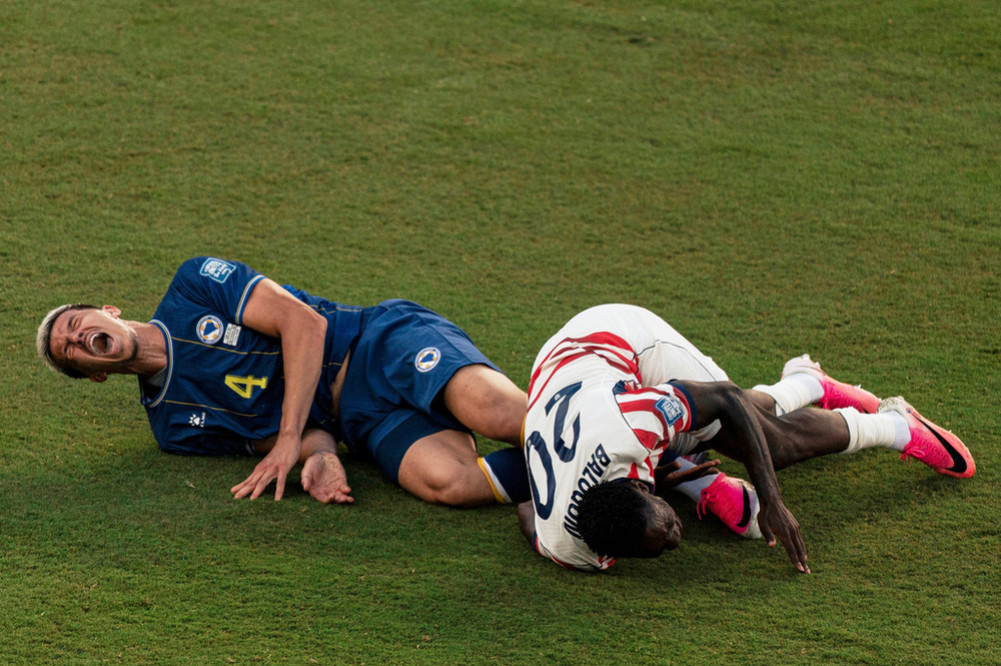
At the center of the controversy was the US president's call last week to FIFA chief Gianni Infantino and asking him to lift the ban on his player Florin Bolognese.
We use Google Cloud Translation Services. Google requires we provide the following disclaimer relating to use of this service:
This service may contain translations powered by Google. Google disclaims all warranties related to the translations, expressed or implied, including any warranties of accuracy, reliability, and any implied warranties of merchantability, fitness for a particular purpose, and noninfringement.
Football leaders expressed their disappointment on Tuesday, saying the reputation of the World Cup was in question. Reactions have come forward that there has never been such a bad day in the modern history of world football.
The center of the controversy was the US president's call last week to FIFA chief Gianni Infantino and ask him to lift the ban on his player Florin Bolognese. Bolognese was banned from the match against Belgium for receiving a red card in the previous match.
FIFA also lifted his ban on him. In the meantime, he took the field in the match against Belgium. This did not help the US much and they were eliminated from the tournament after a humiliating 4-1 defeat at the hands of Belgium. Since 1962, a red card in the World Cup has meant a ban for the next match. Since then, Bolognese was the first player to escape such action. This has shown Infantino's sole control over FIFA and his close relationship with President Trump.
UEFA has strongly criticised FIFA's decision, calling it "unbelievable, unjustified and unfair". Infantino has said he had no role in FIFA's decision. Trump has said he called Infantino to take credit for the whole process, but he has not said he should have changed his mind. The Belgian Football Association has also condemned the whole process.
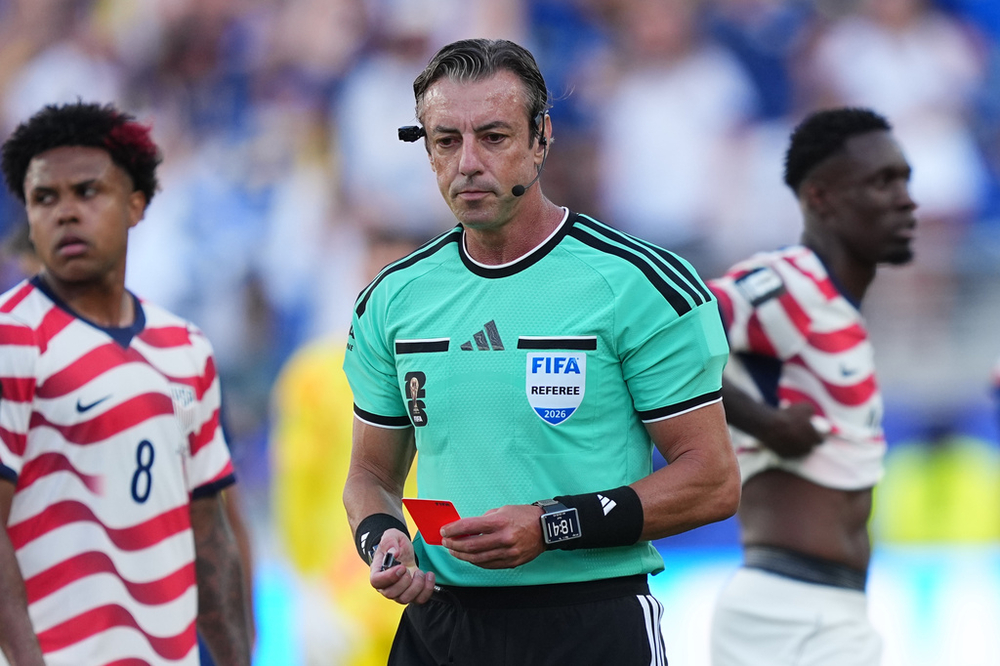
But FIFA's appeals committee has rejected Belgium's argument. It said there was no reason for Belgium to challenge FIFA's decision. It is not yet clear whether Belgium will take further action to the Court of Arbitration in Switzerland. The decision to show Boghosneg was made by Brazilian referee Rafael Klaas. He was shown a red card in the United States' last-16 defeat of Bosnia and Herzegovina, which would have meant he would have been automatically banned for one match.
Referee Klaus did not initially show a red card, but later made a decision with the help of 'weight'. FIFA's disciplinary committee imposed a fine of 40,000 dollars while lifting the ban on Bologna. This amount was asked to be paid by the US Soccer Federation. Recently, there has been a sharp disagreement between FIFA and UEFA. UEFA has said, 'Whenever a parent organization like FIFA does not protect a specific rule, it damages the reputation of the game. It also damages the reputation of the competition.'
Infantino has been listening to UEFA's opposition since he took over FIFA. His predecessor, FIFA President Sepp Blatter, has opposed the entire incident. He said, 'A red card cannot be changed by a political phone call. If such a decision is changed, it will be made in accordance with the rules, and by an independent body.' The Swiss Football Association has also expressed surprise at FIFA's decision. Norwegian coach Stal Solbækken said, "What will be the decision on the next red card? Will there be a committee that can revoke a red card? Now there is a decision that can only be considered bad, it has hurt the game of football itself."
England coach Thomas Tuchel has questioned whether the yellow cards shown to England's Declan Rice and France's Michael Olis will be revoked.
FIFA's disciplinary committee has been trying to defend its decision. It said, "The process of reviewing red cards is nothing new. This decision has been made many times in the European leagues, but no one has questioned it."
Trump claimed that the referee's decision was very bad and that he himself was in doubt about the decision. Trump said, "It was not a foul. I think it was just two players bumping into each other."
Infantino, on the other hand, has claimed that all bodies under FIFA are independent. Questions have been raised about the relationship between Trump and Infantino many times before. At the FIFA Congress in Paraguay last year, European representatives boycotted the meeting, protesting that it started three hours late. At that time, Infantino was in the middle of the meeting with Trump and arrived late at the event. He was the one who presented FIFA's first peace prize to Trump.
The Norwegian Football Association also submitted a letter of protest to FIFA. The Belgian Football Association said that the full story was not complete even after the US defeat. The association said, 'Regardless of the result of the game, what happened before the game is unacceptable.' In the match against Bosnia, Bologna hit the opponent's defender Tarik Muharreković in the ankle with his foot while fouling him.
Such a foul is shown a straight red card and, according to FIFA's rules, a ban of at least two matches. In this World Cup, Argentina's Lionel Messi and Morocco's Achraf Hakimi have also been spared two such fouls. Bologn himself said, "Maybe a yellow card would have been enough."
Infantino has made some similar liberal decisions since he took over at FIFA. Cristiano Ronaldo was exempted from playing in this World Cup. In a World Cup qualifier against Ireland, he kicked his opponent with a shovel, which is considered a serious foul.