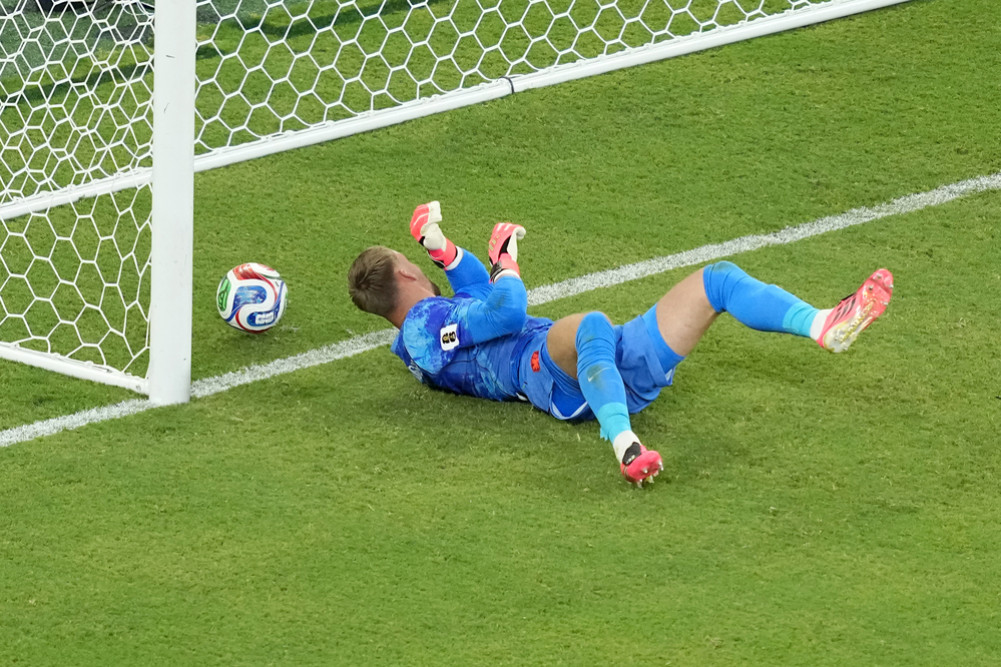
The situation has now reached the 'lose or go home' stage in the 2026 World Cup. This has created immense pressure on every team.
We use Google Cloud Translation Services. Google requires we provide the following disclaimer relating to use of this service:
This service may contain translations powered by Google. Google disclaims all warranties related to the translations, expressed or implied, including any warranties of accuracy, reliability, and any implied warranties of merchantability, fitness for a particular purpose, and noninfringement.
The situation has now reached the ‘lose or go home’ stage in the 2026 World Cup. This has created immense pressure on each team. Of all these types of pressure, the most intense is the tiebreaker. Again, this is necessary when the players are tired and exhausted. On one side is the striker, on the other the goalkeeper. It is a ‘one to one’ situation.
The last 32 of the competition is currently underway. Two games have gone to tiebreakers. In one of them, Morocco defeated the Netherlands and in the other, Paraguay defeated Germany. A miss in a tiebreaker means humiliation for the player. And a single save by the goalkeeper is so important that it brings joy to thousands and millions of fans.
The pressure to endure in such a penalty shootout is especially inhuman. According to Professor Ger Jordet of the Norwegian School of Sports Science, everyone’s attention is focused on the penalty taker in the tiebreaker. He has also written a book focusing on tiebreakers. He says, “Our research shows that the pressure players face in penalty shootouts ultimately turns into anxiety.”
And the more penalties are taken, the more pressure they face. The more pressure they take, the more anxiety they experience. Five games in the 2022 World Cup were decided on a penalty shootout. The biggest of these was the final, in which Argentina beat France. “At the top level, the pressure in a tiebreaker is really unbearable,” says England winger Noni Maduke.
The distance between the striker and the goalkeeper is about 12 yards. The penalty shootout has only been in place since 1970, and since then, major matches in world football have been decided by it. The first World Cup final to be decided on a penalty shootout was in 1994. Brazil beat Italy to win the World Cup.
A player missed a penalty in that one, and that was one of the reasons he became famous. That player was Roberto Baggio. His final and decisive shot hit the post. The funny thing is that there are different ways to take a penalty kick. Some shoot immediately, some pause and shoot. Some take a long breath before shooting the ball.
They even take a long run and shoot powerfully. Perhaps the most popular is to predict where the opposing goalkeeper will ‘dive’ and shoot in the opposite direction. In a penalty kick situation, the player in front of him is often under more pressure than the goalkeeper. This is why it is more likely that the shooter will score a goal than the goalkeeper.
Research has shown that those who wait a few seconds after the referee blows the whistle are more likely to score a goal than those who shoot immediately. “A player who shoots quickly is not particularly able to handle a lot of pressure, so he doesn’t think much and shoots straight away,” says Jordet.
In theory, the player who makes the right decision in a short time is the one who succeeds in a tiebreaker. The dilemma is never good. On the other hand, what is the goalkeeper's mindset? He has the opportunity to dive right or left or stand in the middle and do nothing. Against the Netherlands, Morocco's goalkeeper Yacine Bonou did something a little different, on the final shot. He stood but leaned slightly to the right. In the process, he saved a shot by Krisenko Sommervalley.