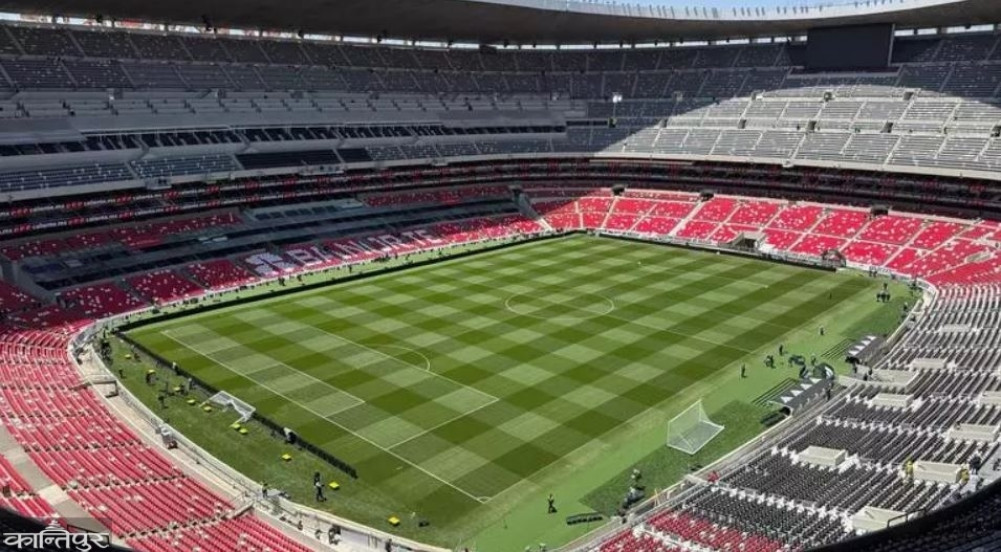
The World Cup in Mexico comes at a time when President Claudio Senbaum is in a political crisis. Relations with the United States have been at a critical juncture recently.
We use Google Cloud Translation Services. Google requires we provide the following disclaimer relating to use of this service:
This service may contain translations powered by Google. Google disclaims all warranties related to the translations, expressed or implied, including any warranties of accuracy, reliability, and any implied warranties of merchantability, fitness for a particular purpose, and noninfringement.
Social unrest has erupted as Mexico prepares to host the 2026 World Cup. Mexico, which is co-hosting the tournament with the United States and Canada, will host South Africa in the opening match on Thursday. A star-studded program will precede the event. It is believed that this will boost the competition.
The World Cup has come to Mexico at a time when President Claudio Senbaum is in a political crisis. Relations with the United States have been strained in recent times. He himself is going through various political scandals. Not only that, Mexico City itself was plunged into violent violence in February. Tensions are also rising as the city hosts more visitors.
The biggest accusation made by local people is that the government is focused on organizing the tournament, but the same government is failing to meet the basic needs of the common people. “Mexico is trying to project an image to the rest of the world that doesn’t really exist,” says Carlos Perev, a political analyst at the Mexican Center for Research and Economic Education. “This World Cup will put the president under even more pressure. The Mexican government is really under a lot of pressure right now.” Mexico City, Guadalajara, and Monterrey will host the World Cup. The streets of all three cities are now decorated with FIFA logos, orange Godavari flowers, and giant balls. Football fans are already experiencing the World Cup. Supporters are walking around the city wearing their country’s jerseys and taking pictures. The Mexican Football Federation estimates that the World Cup will bring in $3 billion in revenue from hotels, restaurants, and stadiums. Not only the match between Mexico and South Africa, but the main attraction of the opening ceremony will be Colombian superstar Shakira. She will perform on the occasion.
‘If everything goes as expected, it will be like gold in a bottle,’ believes Perez Ricart. According to him, this World Cup is also an opportunity for the rest of the World Cup to show what modern Mexico is like. But recently, ordinary people have been taking to the streets to demonstrate, and it has also become violent. In particular, there were loud demonstrations in Guadalajara in February.
To quell such demonstrations, 100,000 soldiers and security personnel will take to the streets. Their job in all three cities will be to maintain peace and security. The main accusation made by critics is that the government has spent too much money and time on the World Cup. In the past few weeks, teachers’ unions have been taking to the streets to demonstrate and demand improvements in their working conditions.
The families of 130,000 disappeared people in Mexico have been saying that the human rights situation in their country is extremely poor. One such protester, Luis Antonia, says, “We are certainly not against football and the World Cup. But our demand is that the government is not investing as much as it should in education. But the entire focus is on shaking up the city.”